
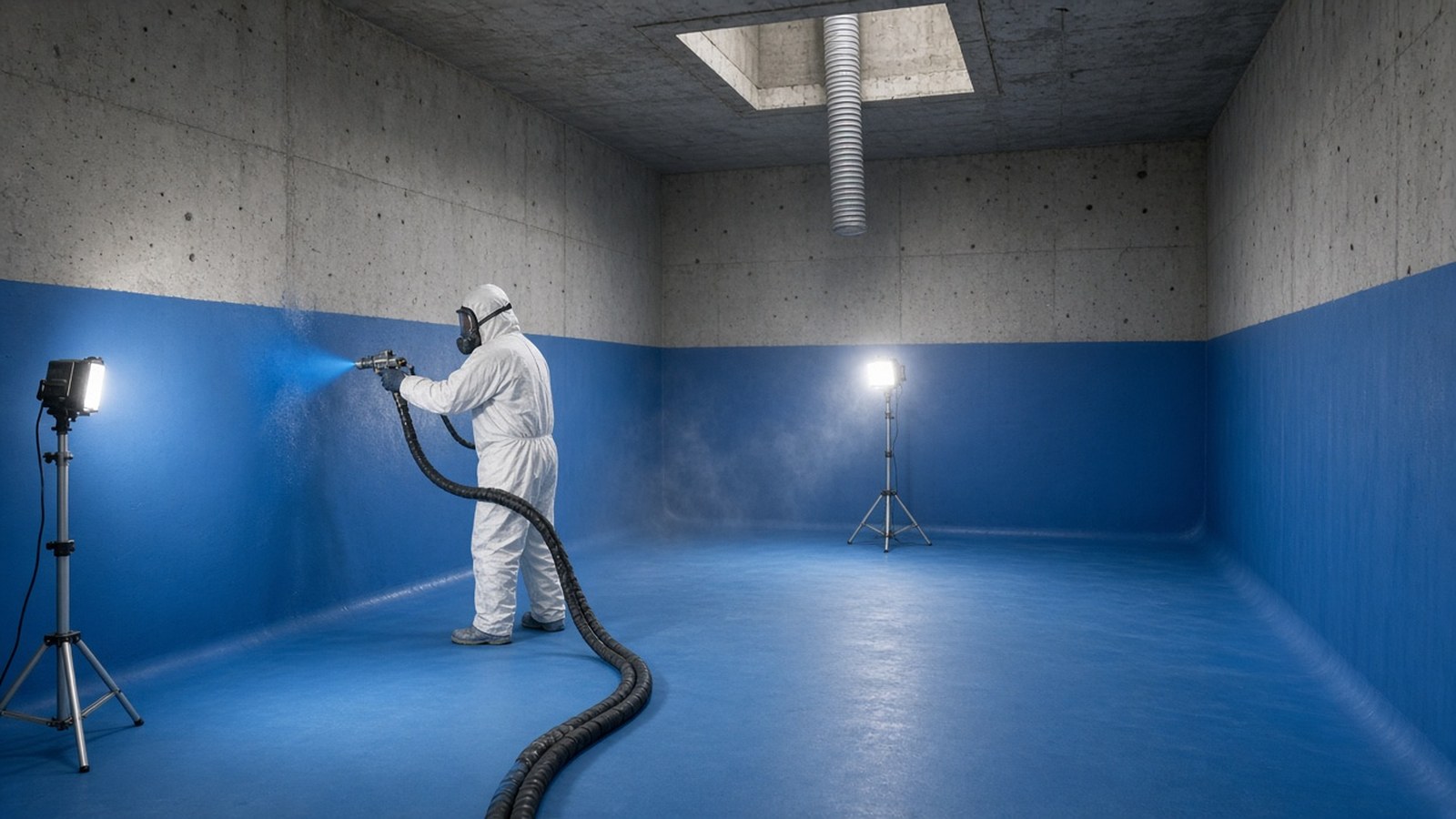
Polyurea tank lining means spraying a hot, two-component pure polyurea membrane onto the inside of a concrete tank. The result is a lining that bonds to the walls and the floor. This guide covers the hot-spray route step by step: preparation, primer, spraying, checks and what the approvals really cover. For cold-applied and cementitious options, see our general guide to water tank waterproofing.
Contents
- What polyurea tank lining offers
- The Krypton build-up for concrete tanks
- Step-by-step polyurea tank lining
- Drinking-water tanks: what WRAS and Applus really cover
- Common mistakes in polyurea tank lining
- Polyurea tank lining projects by Target in Egypt
- Frequently asked questions
- Request a tank survey in Cairo
What polyurea tank lining offers
A tank lining works under constant water pressure. In fact, it must also follow small movements in the concrete. The datasheet of Polyurea Rayston, a pure polyurea from Krypton Chemical, reports these values:
- Watertight at 5 bar, equal to a 50 m water column (EN 12390-8).
- Maximum elongation of 324%.
- Crack bridging Class A5 at −10 °C (static) and Class B4.2 (dynamic), per EN 1062-7.
- Adhesion of 4.0 MPa to concrete with an epoxy primer.
- Best rating (5 of 5) after 15 days’ immersion in water at 80 °C.
However, these figures belong to one specific product. Another “polyurea” can behave very differently. So always ask for the product name and its datasheet.
The Krypton build-up for concrete tanks
Krypton’s drinking-water reservoirs system uses a short build-up: concrete tank wall, then Rayston Epoxy 100, then Polyurea Rayston. In addition, Krypton’s guide to lining drinking-water tanks with polyurea states that enclosed tanks need no internal aliphatic topcoat.
| Layer | Product | Key data from the datasheets |
|---|---|---|
| Substrate | Concrete tank wall and floor | Pull-off at least 1.4 N/mm²; moisture below 4% |
| Primer | Rayston Epoxy 100 (two-component epoxy) | For completely dry surfaces; CE marking to EN 13813 |
| Membrane | Polyurea Rayston (hot spray) | 1.5–2.0 kg/m² for 1.5–2 mm |
| Topcoat | None inside enclosed tanks | Per Krypton’s tank guide |
Where the concrete is slightly damp, Krypton also offers Humidity Primer, a water-based epoxy. Its datasheet lists “waterproofing treatment of tanks and other water management facilities” among its uses.
Step-by-step polyurea tank lining
1. Survey the tank and map the details
First, note how the tank will be used, its size and its condition. Then map every wall–floor junction, joint, pipe penetration, manway and overflow. Krypton’s reservoir page lists these same points. A lining is only as good as its weakest detail.
2. Prepare the concrete
Next, the crew prepares the concrete mechanically, with high-pressure sand or abrasion, to open the pores. According to the Polyurea Rayston datasheet, the surface must be:
- flat, compact and even;
- free from cracks, which need repair first;
- clean and dry, with no dust, oil or laitance;
- strong enough to give a pull-off result of at least 1.4 N/mm².
In addition, the concrete should be between 10 °C and 40 °C, with moisture below 4%. Also, relative air humidity should stay below 85%. This matters because higher humidity can cause condensation, which makes adhesion harder. Closed tanks also need good air flow. The datasheet calls for protective clothing and a breathing mask.
3. Apply the primer
After preparation, Rayston Epoxy 100 seals the concrete before the membrane. If underlying moisture is suspected, the membrane datasheet recommends two coats of epoxy primer, with quartz sand spread over the second coat. Importantly, spraying should start only after the primer has fully cured.
4. Treat joints and penetrations
Joints, pipe sleeves and wall–floor corners need extra care before the main spray. For example, Krypton’s Rayston Flex Joint GEO band is listed for “expansion joint waterproofing in… water tanks”. Our article on expansion joints in polyurea systems will cover this in detail.
5. Hot-spray the membrane
The datasheet recommends 65 °C for component A, 75 °C for component B and 65 °C for the hose. Also, pressure should be at least 140 bar. The target is 1.5–2.0 kg/m², which gives a 1.5–2 mm membrane. Finally, Krypton recommends reaching the right thickness in a single application.
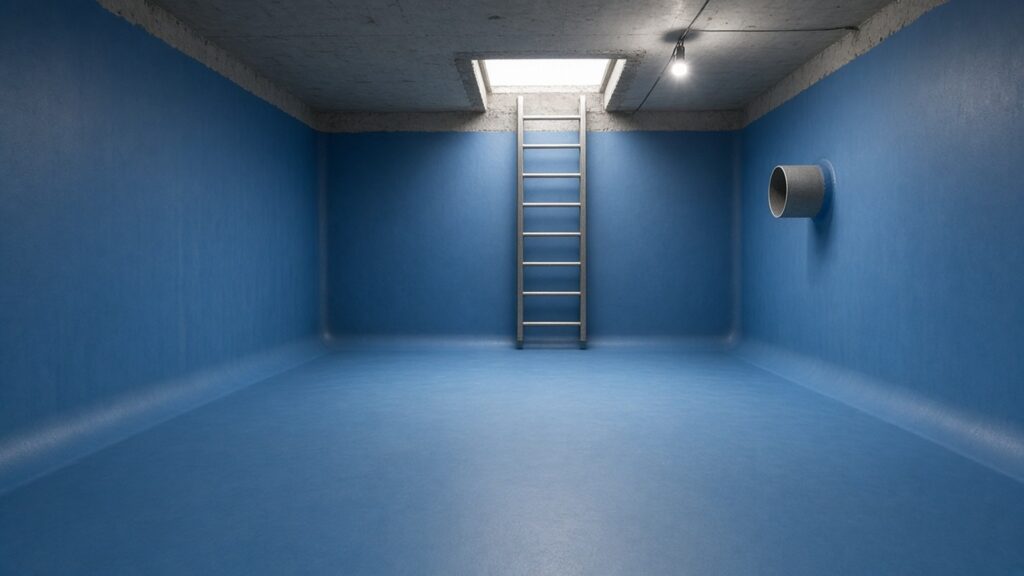
6. Check, then let it cure
While spraying, the crew checks thickness to make sure the cure is right. After that, hardness builds over time. The datasheet shows Shore A 28 after 5 minutes, 80 after 24 hours and 88 after 4 days (1 mm sample at 25 °C). However, the datasheet gives no filling time for tanks. So follow the project spec and Krypton’s advice before you fill the tank.
Drinking-water tanks: what WRAS and Applus really cover
Many owners ask if a polyurea tank lining is safe for drinking water. The answer depends on the exact product and its approvals. For Polyurea Rayston, the datasheet lists two pieces of evidence:
- WRAS material approval 2208579 (UK, contact with water for human consumption).
- Applus migration test 928/09/8505, an independent drinking-water test.
The WRAS approvals directory sets clear limits on approval 2208579:
- It covers the blue version, made from components A, B and C (pigment paste).
- The material must be mixed and applied as in the datasheet dated 13/09/22.
- It is for water up to 60 °C.
- It expires on 31/08/2027.
- It is valid only when the material is applied by crews that Krypton Chemical has authorised or certified.
Note that these approvals cover the cured lining only. They do not cover the primer, the tank itself or any other product. Krypton’s WRAS note for drinking-water reservoirs also warns against moving the WRAS approval onto other Krypton products. So, for a potable tank, ask your contractor for the colour, the datasheet and the applicator authorisation in writing.
Common mistakes in polyurea tank lining
Krypton’s reservoir page lists three typical errors:
- Choosing a lining from a generic “waterproofing” label without checking its drinking-water documents.
- Lining the open floor and walls but skipping joints, penetrations, manways and overflows.
- Closing the job before checking moisture, adhesion, thickness, pinholes and cure.
In addition, never skip the primer on porous concrete. The datasheet links bubbles and open holes in the membrane to a missing primer.
Polyurea tank lining projects by Target in Egypt
Target Engineering has carried out internal waterproofing of concrete tanks with pure polyurea on several Egyptian projects:
- Iconic Tower, New Administrative Capital (contractor CSCEC, consultant Dar El-Handasa).
- Capital Business District (CBD), towers D01–D03 and D04–D05.
- El-Mostakbal Tanks (contractor SIAC, consultant Space).
- Obour Dye.
Each tank, however, had its own joints, penetrations and access limits. That is why every polyurea tank lining we price starts with a site survey.
Frequently asked questions
Is polyurea tank lining safe for drinking water?
It depends on the product. Polyurea Rayston has WRAS approval 2208579 and an Applus migration test, within the limits above. Other polyurea products need their own evidence.
Does the inside of a tank need a topcoat?
Krypton’s tank guide states that enclosed tanks need no internal aliphatic topcoat. In other words, the lining itself is the wet surface.
Can polyurea line steel tanks?
Yes, the datasheet lists “protective coating for metallic structures”. Metal must be clean and free of rust, then primed with Primer PU.
How thick should the lining be?
The Polyurea Rayston datasheet gives 1.5–2 mm at 1.5–2.0 kg/m². Your specification may set a value within or above this range.
Polyurea or cold-applied polyurethane for my tank?
Both can work, but they suit different jobs. Krypton’s tank guide names Impermax Aqua 2K as the cold-applied alternative where reactor access is impractical. Our water tank waterproofing guide explains that route, and our hot and cold applied polyurea article compares the methods.
Request a tank survey in Cairo
Send us the tank size, drawings or photos. We will visit the site and propose a polyurea tank lining build-up with its datasheets.
- Office: 48 El-Horreya St, Heliopolis, Cairo
- Phone: +20 120 226 9326
- Email: admin@targetsw-eg.com
- Online: contact Target Engineering
For more background, read our polyurea waterproofing guide. Target also works from offices in Abu Dhabi and Kenitra for regional projects.


No comment