
Table of Contents
- Why water tank waterproofing differs from roof waterproofing
- Available water tank waterproofing solutions
- Technical properties
- Chemical resistance of Impermax Aqua 2K
- Preparing the tank for water tank waterproofing
- Application steps with Impermax Aqua 2K
- Application conditions
- Where are these water tank waterproofing solutions used?
- Common water tank waterproofing mistakes
- Target Engineering: tank lining to drinking-water standards
- Water tank waterproofing FAQ
A concrete water tank, whether on the roof or below the building, is under constant water pressure and permanent moisture. A leak does not only waste water; it can corrode the reinforcement and let dust and bacteria contaminate the supply. That is why water tank waterproofing needs materials designed for permanent immersion and approved for drinking-water contact, installed with no room for error. This article presents three solutions from their datasheets: Impermax Aqua 2K (solvent-free polyurethane), Sika Top® Seal-107 Elastic (flexible cementitious) and Rayston Spray D50 (polyurea for chemical tanks).
Key points
- Tank linings must withstand permanent immersion and be approved for drinking-water contact.
- Impermax Aqua 2K is solvent-free and certified under European regulation 98/83/EC.
- Substrate moisture below 4%, new concrete at least 21 days old, and no water pressure from behind.
- Wash the tank thoroughly before filling it with drinking water.
Why water tank waterproofing differs from roof waterproofing
A roof membrane sees rain and sun intermittently; a tank lining stays submerged for its whole life and touches water that people drink. It must therefore meet three conditions: full stability under permanent immersion, a recognised certificate for drinking-water contact, and strong adhesion that stops water creeping behind the layer. Ignoring any of them means failure or contamination.
Available water tank waterproofing solutions
Impermax Aqua 2K: polyurethane membrane for drinking water
A two-component, solvent-free polyurethane certified under European regulation 98/83/EC for drinking-water contact (Applus laboratory No. 928/08/6545), CE-marked to EN 1504-2 (0370-CPR-2247). The membrane is stable even in permanent immersion, and being solvent-free it suits enclosed, poorly ventilated spaces such as tanks. The datasheet lists water tanks, canals and aquaculture installations, on concrete, mortar, ceramics and glass-fibre reinforced polyester.
Sika Top Seal-107 Elastic: flexible cementitious
Holds a certificate from the Egyptian National Organization for Water and Sewage for drinking water, water permeability and crack bridging, and complies with EN 1504-2. Its datasheet lists water tanks, swimming pools and structures under hydraulic pressure among its main uses.
Rayston Spray D50: polyurea for chemical tanks
A hot-sprayed polyurea system intended, per its datasheet, for water tanks containing aggressive chemicals, with very good chemical resistance.
Technical properties
| Property | Impermax Aqua 2K | Sika Top Seal-107 Elastic | Rayston Spray D50 |
|---|---|---|---|
| Type | 2K solvent-free polyurethane | 2K flexible cementitious | Hot-spray polyurea |
| Elongation | >130% | 120–140% (ASTM D412) | 270% |
| Tensile strength | 4 MPa | — | 17.2 MPa |
| Hardness | 66–69 Shore A | — | 50 Shore D / 96 Shore A |
| Adhesion to concrete | 1.5 N/mm² (EN 13892-8); 2.5 MPa with Epoxy 100 primer | >0.5 N/mm² (EN 14891) | 2.5 MPa |
| Tear strength | — | — | 100 N/mm |
| Service temperature | −15 to 80 °C | — | — |
| Consumption | up to 1.5 kg/m² ≈ 1 mm | 1–1.5 then 0.8–1 kg/m² | 1–2 kg/m² |
| Approval | 98/83/EC, CE EN 1504-2 | Egyptian water authority certificate | — |
Chemical resistance of Impermax Aqua 2K
The datasheet rates permanent-contact resistance from 0 (worst) to 5 (best): water 5, chlorinated water at 20 ppm 5, sodium hydroxide 4% 5, hydrochloric acid 2% 4, ammonia 3% 4, and bleach 3. This matters because mains water in Egypt and the Gulf is chlorinated, so the membrane is suitable for everyday domestic service.
Preparing the tank for water tank waterproofing
- Empty and clean the tank fully, removing algae, sediment and weak old coatings.
- Mechanically prepare by sanding or sandblasting.
- Repair concrete: treat honeycombing, cracks and corroded steel first.
- Dryness: for Impermax Aqua 2K moisture must be below 4%, new concrete must wait 21 days, and there must be no water pressure from behind.
- Strength: substrate compressive strength at least 25 MPa and cohesive strength at least 1.5 MPa.
- Primer: apply a suitable primer and let it dry.
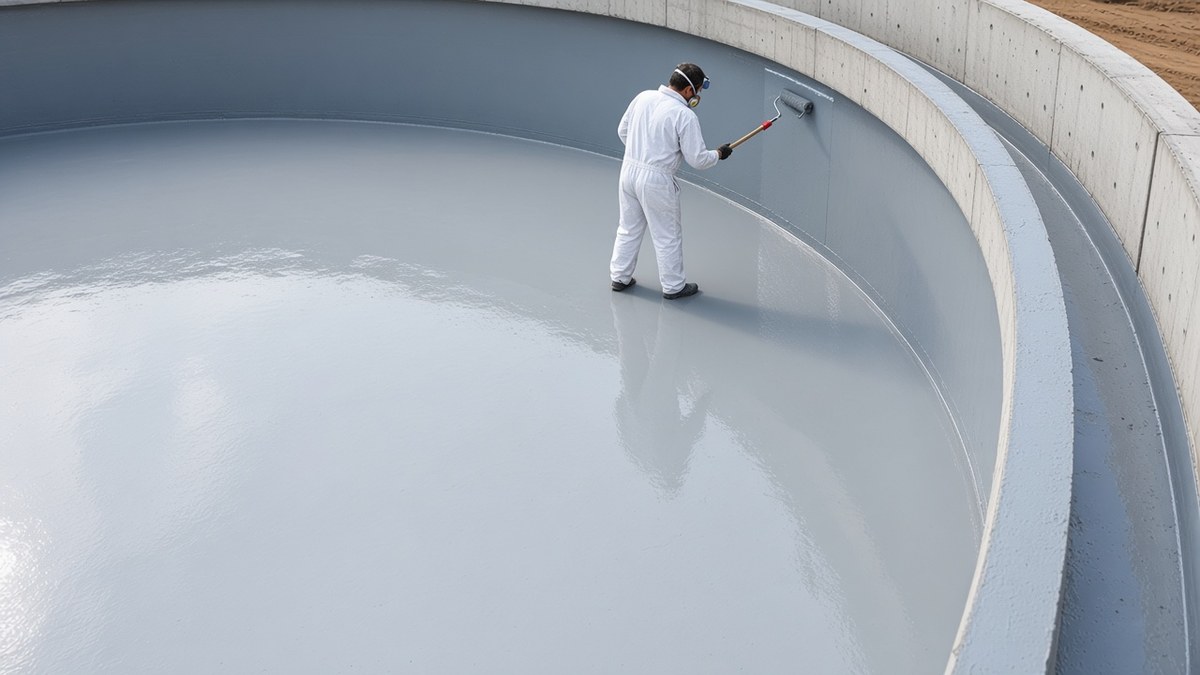
Application steps with Impermax Aqua 2K
- Mixing: stir component A for 2 minutes, add component B and stir 2 more minutes, then transfer to a larger container to make sure no unmixed material remains. Mix ratio A=100, B=38 by weight.
- Spreading: pour and spread quickly with a squeegee or notched trowel, wearing spiked shoes.
- De-aerating: spike-roll in a crossing pattern within 10 minutes of spreading.
- Walls: add Thickening Additive to prevent sagging on vertical surfaces; Geomax reinforcement allows thicker layers.
- Next coat: after 24 hours.
- Before service: wash the tank thoroughly before filling with drinking water.
Application conditions
Air temperature +10 to 30 °C, relative humidity below 60%, substrate temperature 10–25 °C; the datasheet warns against warm or humid conditions. Pot life is 45–50 minutes at 18 °C and 40% RH, so enough crew must be assigned to mix and spread quickly and evenly.
Where are these water tank waterproofing solutions used?
- Rooftop and underground drinking-water tanks in apartment blocks, villas and facilities.
- Canals and aquaculture installations (Impermax Aqua 2K).
- Swimming pools and structures under water pressure (Sika Top Seal-107 Elastic).
- Water tanks containing aggressive chemicals (Rayston Spray D50).
Common water tank waterproofing mistakes
- Using materials not approved for drinking water: such as some bituminous or solvent-borne coatings.
- Coating damp or young concrete: causes blisters and delamination.
- Incomplete mixing: leaves soft, sticky spots under a hard skin.
- Neglecting corners and pipe inlets/outlets: the most common leak points.
- Filling without washing: the tank must be washed thoroughly before drinking-water contact.
- Worrying about colour change: Impermax Aqua 2K changes colour in sunlight without loss of mechanical properties.
Target Engineering: tank lining to drinking-water standards
Target Engineering carries out water tank waterproofing for rooftop and underground tanks with drinking-water approved materials, including surface preparation, moisture testing, detailing of corners and pipes, and a fill test before handover. See our tank insulation and thermal insulation works, polyurea and polyurethanes and cementitious waterproofing pages, or contact us to inspect your tank.
References: the European Commission’s drinking water page on EU rules for materials in contact with drinking water, and the WHO Guidelines for drinking-water quality.
Water tank waterproofing FAQ
Is the lining safe for drinking water?
Impermax Aqua 2K is certified to 98/83/EC and Sika Top Seal-107 Elastic holds the Egyptian water authority certificate, provided application rules and pre-service washing are followed.
How long does tank waterproofing take?
It depends on tank size and condition, allowing 24 hours between Impermax Aqua 2K coats plus curing and washing before filling.
Can underground tanks be lined from inside?
Yes, but Impermax Aqua 2K requires no water pressure from behind, so groundwater must be dealt with first or a suitable system chosen.
Polyurethane or cementitious?
Flexible cementitious is economical and tolerates a slightly damp substrate, while polyurethane offers higher elongation and a smooth continuous membrane. The choice depends on tank condition and budget.
Need a site inspection or a quotation? The Target Engineering team is ready to help.

[…] to curing and fill testing. See our cementitious waterproofing service page, read our guides to water tank waterproofing and crystalline waterproofing, or browse our waterproofing […]
[…] cementitious and polyurea systems, detailing lights and joints and running fill tests. Read our water tank waterproofing guide, and see our cementitious waterproofing service and other waterproofing […]
[…] quickly and at an even thickness. See our polyurea and polyurethanes page, and read our guides to water tank waterproofing and liquid roof waterproofing. If you also need thermal insulation, see spray foam roof […]
[…] Polyurea tank lining means spraying a hot, two-component pure polyurea membrane onto the inside of a concrete tank. The result is a lining that bonds to the walls and the floor. This guide covers the hot-spray route step by step: preparation, primer, spraying, checks and what the approvals really cover. For cold-applied and cementitious options, see our general guide to water tank waterproofing. […]
[…] lining material, within the limits above. Therefore, the primer and the tank are outside it. Our water tank waterproofing guide covers other tank […]