
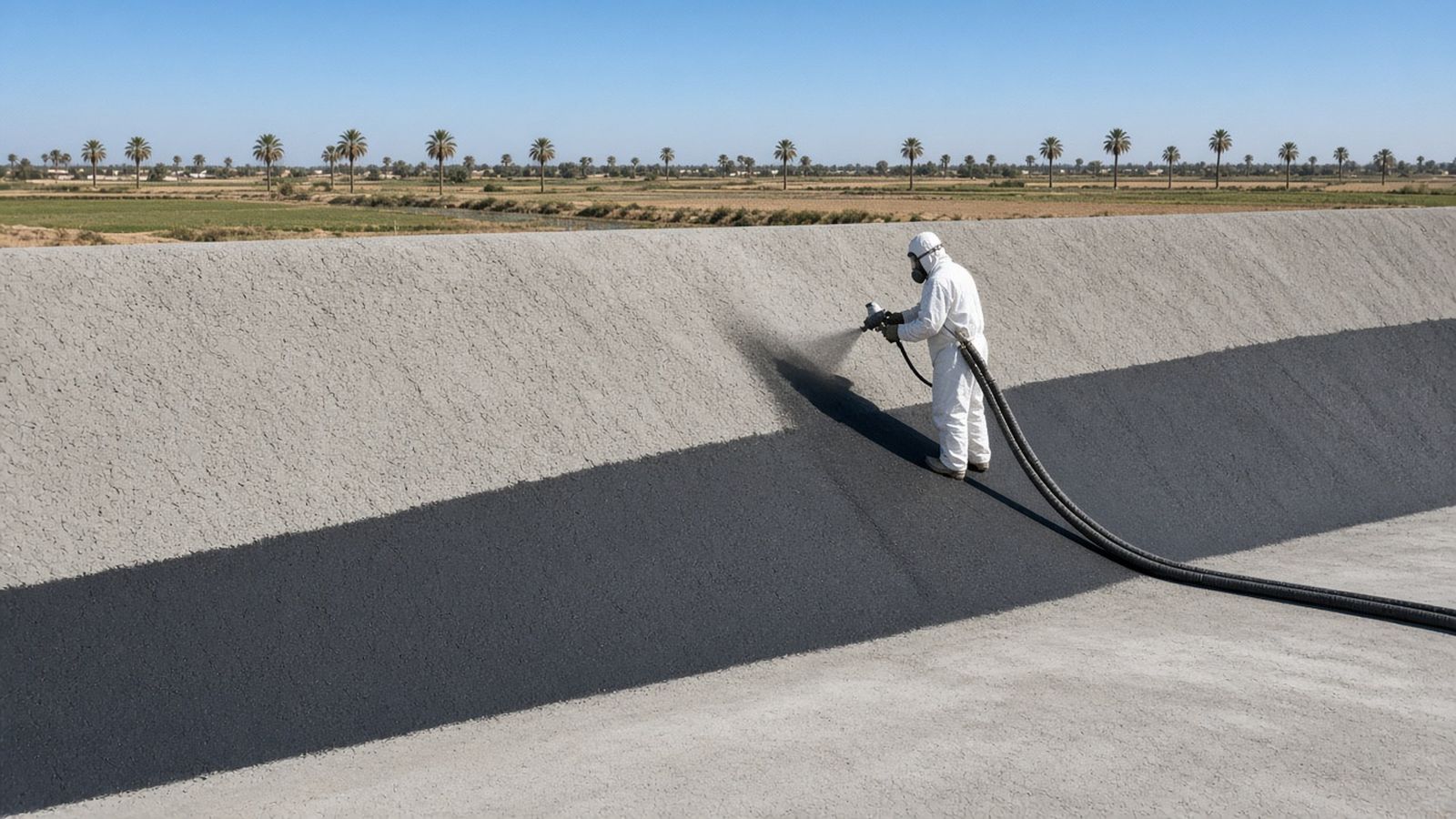
Polyurea pond lining means spraying a hot, two-component membrane onto the bed and banks of a pond, lake or basin. In Egypt, many compounds use artificial lakes as their main landscape feature. At the same time, farms store water in concrete or earth basins. Both lose water, and money, through leaks. This guide explains where polyurea fits, how concrete and earth basins differ, and what the Krypton datasheets say.
Contents
- Where polyurea pond lining is used
- What the datasheet says about water
- Concrete or earth: two kinds of polyurea pond lining
- Polyurea pond lining step by step
- Polyurea pond lining mistakes at banks and edges
- Maintenance and repair
- Water features by Target in Egypt
- Frequently asked questions
- Request a pond or basin survey in Cairo
Where polyurea pond lining is used
Krypton’s datasheet for Polyurea Rayston, a hot-spray pure polyurea, lists on-site liners among its uses. These include secondary containment, ponds, landfills, tunnels, canals and dam repair. Its product card also lists “Ponds and artificial lakes” and “Channels and irrigation ditches” among its applications.
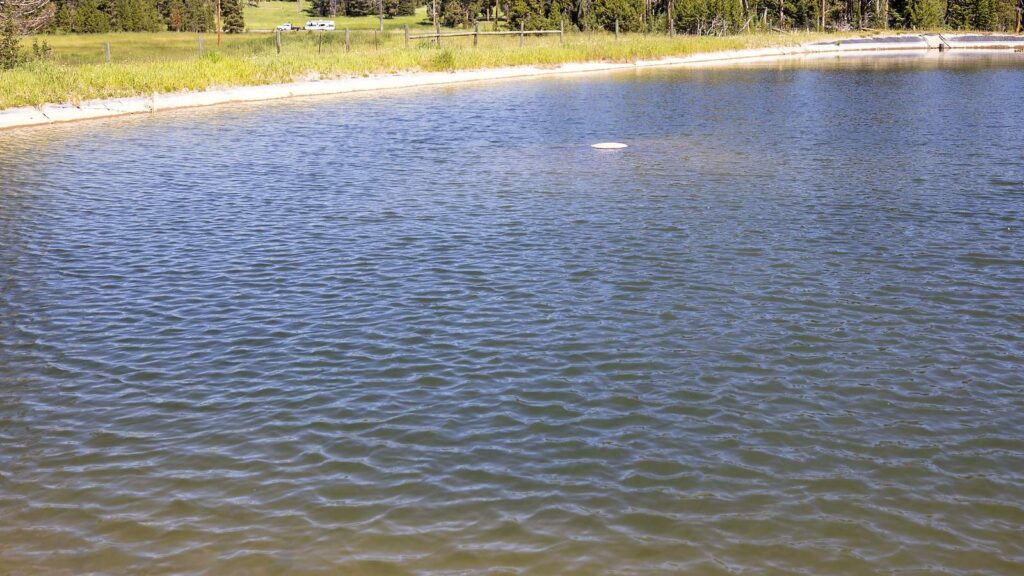
However, a lake is not a fountain, and a farm basin is not a tank. Each one has its own water, edges and access, because each serves a different use. So the first step is always a survey, not a product choice.
What the datasheet says about water
The Polyurea Rayston datasheet (PDF) reports these values that matter for water bodies:
| Property | Value as printed | Test |
|---|---|---|
| Watertightness | Watertight at 5 bar (50 m water column) | EN 12390-8 |
| Liquid water permeability | 0.002 kg/m²·h^0.5 | EN 1062-3:2008 |
| Maximum elongation | 324% | UNE EN ISO 527-1/3 |
| Immersion in water | 5 of 5 after 15 days at 80 °C | Krypton immersion test |
| Immersion in saturated salt water | 5 of 5 after 15 days at 80 °C | Krypton immersion test |
| Root resistance | Tested | CEN/TS 14416:2014 |
Also note one limit. Polyurea Rayston is an aromatic product, so its datasheet says “a colour change is to be expected under sunlight”. This change does not affect its mechanical properties. Krypton offers Impertrans or Colodur topcoats where looks matter.
Concrete or earth: two kinds of polyurea pond lining
The substrate changes the whole build-up. So decide this first.
Concrete basins and irrigation cisterns
Krypton’s irrigation cisterns page shows a short route: concrete tank wall, then Rayston Epoxy Plus, then Polyurea Rayston. Rayston Epoxy Plus is a filled epoxy primer for slightly porous concrete. For decorative lakes, Krypton’s English ponds page uses another route. It lists Rayston Epoxy 100, then Polyurea Rayston A (an aliphatic grade), then Impertrans.
In both cases, however, the concrete must meet the membrane datasheet. That means a pull-off result of at least 1.4 N/mm², moisture below 4% and a clean, sound surface.
Earth basins with a geotextile
Krypton’s ponds page names “prepared earth” as a possible substrate. In this case, the datasheet says Polyurea Rayston “can be combined with different geotextiles” to build liners on site. Krypton’s product list includes Geomax Spray NMDC, described as a “geotextile for reinforcement of Polyurea Rayston” applications.
In addition, the datasheet gives a figure for this combined liner. It states that Polyurea Rayston plus selected geotextiles “give a static indentation resistance higher than 4000 kN (UNE-EN ISO 12236:2007)”. We quote this as printed. Ask Krypton which geotextile the test used before you write it into a spec.
Polyurea pond lining step by step
1. Survey the water body
First, record the water source, the fill and draw-down pattern and the basin size. Then map the banks, inlets, outlets, overflows and pipes. Krypton’s pages list the same points.
2. Prepare the base
Next, prepare concrete by machine, with high-pressure sand or abrasion. For earth basins, shape and firm the ground as the project spec requires. Then lay the chosen geotextile.
3. Prime the concrete
After that, prime the concrete. If hidden moisture is likely, the datasheet suggests two coats of epoxy primer, with quartz sand on the second. Spray only after the primer has fully cured.
4. Hot-spray the membrane
The datasheet calls for 65 °C on component A, 75 °C on component B and 65 °C on the hose. Pressure should be at least 140 bar. Apply 1.5–2.0 kg/m² for a 1.5–2 mm membrane. Krypton advises reaching full thickness in one pass where possible.
5. Check and fill
Finally, check thickness, pinholes and cure. The datasheet gives no filling time for ponds. So follow the project spec and Krypton’s advice before you let water in.
Polyurea pond lining mistakes at banks and edges
Krypton’s Arabic ponds page makes a sharp point: most leaks happen at the edge. Its pages also list typical errors:
- treating the open bed as the whole job and skipping banks, overflows, inlets and outlets;
- copying an open irrigation-channel spec onto a deep artificial lake;
- treating a small fountain and a large lake as the same job;
- closing the work before checks of adhesion, thickness, pinholes and cure.
Maintenance and repair
Even so, a lined pond still needs care. The datasheet asks for regular cleaning of drains and outlets. It also warns that strong acids are not suitable for cleaning, and some solvents may damage the membrane. If damage happens, the affected area must be cut out and repaired with a new Polyurea Rayston application.
Water features by Target in Egypt
This section lists Target project scope only. It is separate from the product data above, and our records do not name the products used.
- District 5, New Cairo: “Water features and fountains and landscape polyurea”.
- Ministries District, New Administrative Capital: “Water Features using hot applied Polyurea”.
Frequently asked questions
Can polyurea line an earth pond?
Yes, as a liner built with a geotextile, according to the datasheet. Ask Krypton to confirm the geotextile and the build-up for your site.
Is irrigation water treated like drinking water?
No, and no claim should cross over. WRAS approval 2208579 covers the blue Polyurea Rayston lining material only. It applies to water up to 60 °C, expires on 31/08/2027 and holds only when Krypton-authorised crews apply it. Therefore it says nothing about a whole pond system.
Will fish or plants be safe?
Krypton’s Arabic ponds page says that rules for contact with living organisms must come from the finish’s own document. So ask for that document for your exact build-up.
Does a lake need a topcoat?
It depends on looks and design. Krypton’s English ponds route ends with an Impertrans topcoat. For more, read our aliphatic topcoat guide.
How is a fountain different?
In short, a fountain has more nozzles, lights and pipes in a small space. Our guide to fountain waterproofing with polyurea covers those details. The Food and Agriculture Organization (FAO) also publishes general guidance on irrigation and farm water.
Request a pond or basin survey in Cairo
Send us the basin size, drawings or photos. We will visit the site and propose a polyurea pond lining build-up with its datasheets.
- Office: 48 El-Horreya St, Heliopolis, Cairo
- Phone: +20 120 226 9326
- Email: admin@targetsw-eg.com
- Online: contact Target Engineering
For more background, read our polyurea waterproofing guide and our comparison of hot and cold applied polyurea. Target also works from offices in Abu Dhabi and Kenitra for regional projects.


[…] Leachate and storage ponds use the same sheet types. For decorative or irrigation ponds, read our guide to pond and lake lining. […]