
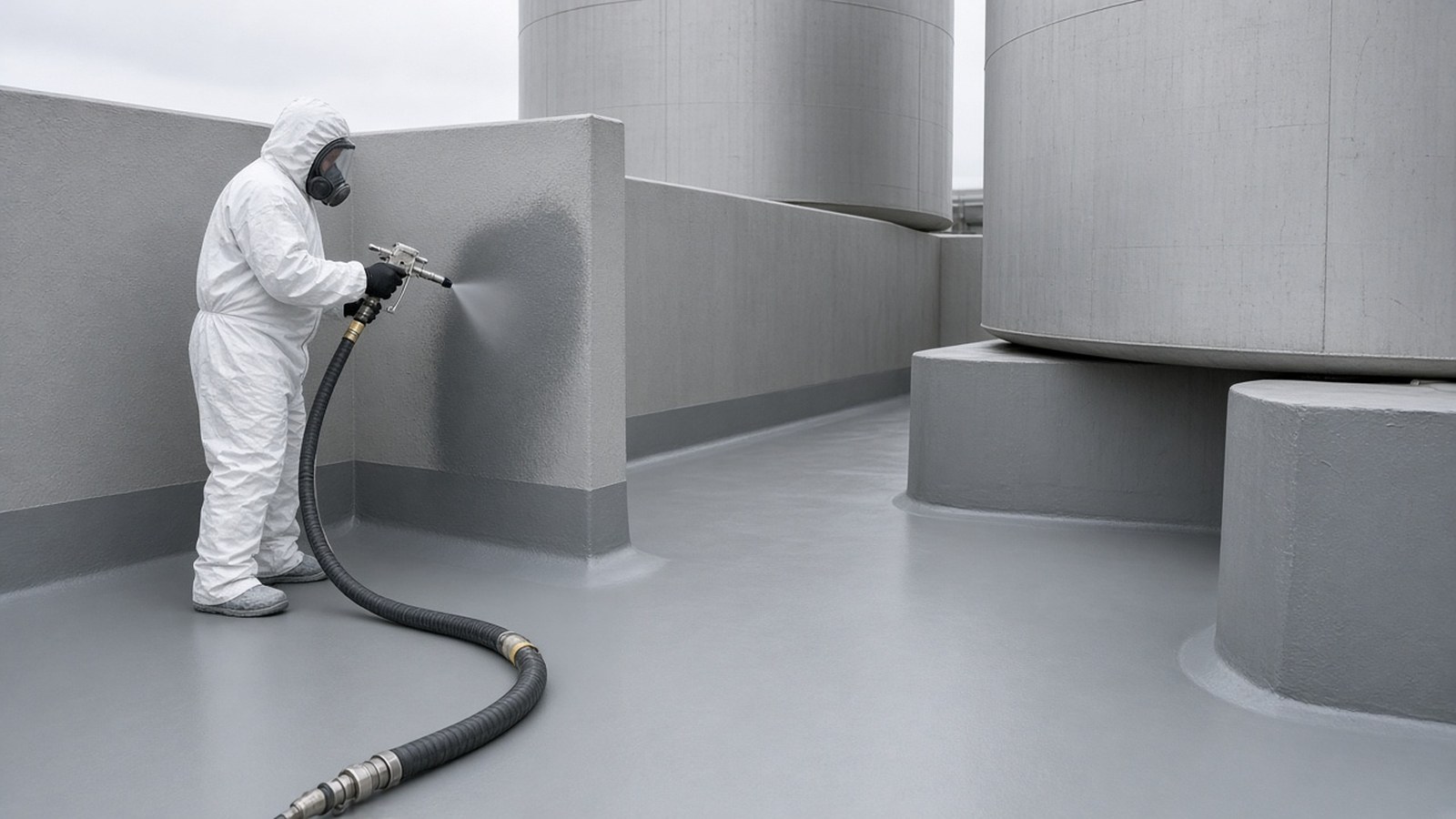
Polyurea wastewater lining is a hot-sprayed membrane that protects concrete in sewage and treatment structures. Egypt keeps building new treatment plants and lifting stations as its cities grow. In these structures, bare concrete faces water, salts, gases and acids every day. This guide explains what the Krypton datasheet reports, how to prepare damp concrete, and how to handle joints. It also notes where a more specialised lining may fit better.
Contents
- What wastewater does to concrete
- Where polyurea wastewater lining fits
- Chemical resistance from the datasheet
- Preparing damp concrete
- Polyurea wastewater lining step by step
- Joints and penetrations
- Industrial linings for harsher chemistry
- Wastewater work by Target in Egypt
- Frequently asked questions
- Request a wastewater survey in Cairo
What wastewater does to concrete
Sewage is harder on concrete than clean water, because it carries salts, and the air above it can hold hydrogen sulphide (H2S) gas. Over time, these attack the cement paste, open the surface and expose the steel. In addition, many chambers stay wet, so repairs must work on damp concrete.
So a lining for this job needs two things. First, it must resist the chemicals in the water. Second, it must bond well to concrete that is rarely dry.
Where polyurea wastewater lining fits
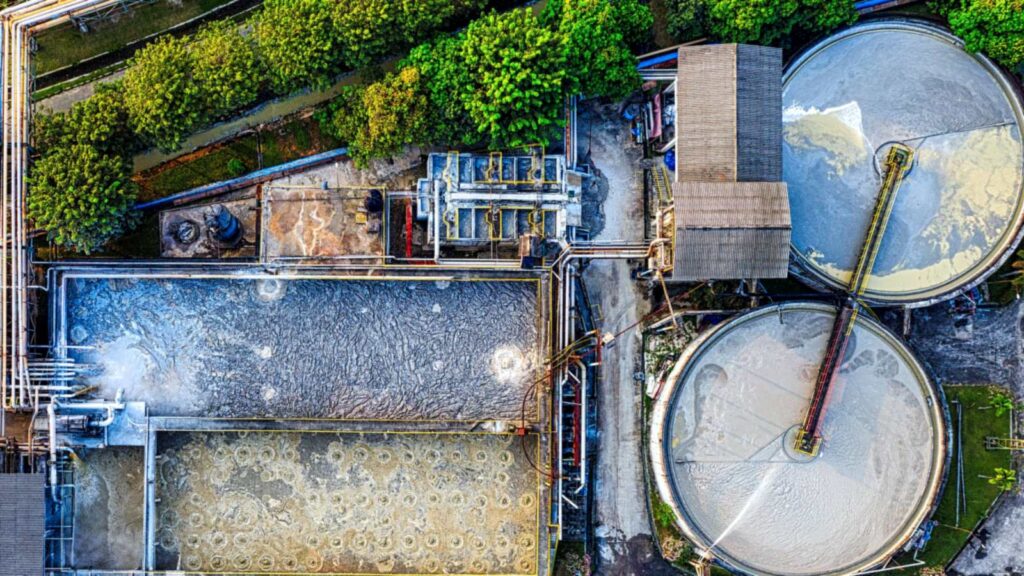
The Polyurea Rayston datasheet (PDF) lists “sewage and wastewater treatment structures” among its uses. It also lists on-site liners for secondary containment. Krypton’s Polyurea Rayston guide names wastewater treatment plants, tunnels and channels as well.
In fact, Polyurea Rayston is a two-component pure polyurea. It sprays hot and sets in seconds. Its datasheet reports watertightness at 5 bar (EN 12390-8) and a maximum elongation of 324%.
Chemical resistance from the datasheet
The datasheet gives two kinds of chemical data. First, it uses EN 13529, with classes under EN 1504-2. Second, it reports Krypton’s own immersion test, scored from 0 (not recommended) to 5 (best). We copy the values below exactly as printed.
| Chemical | Test conditions | Result as printed |
|---|---|---|
| 25% NaCl (sodium chloride) | EN 13529 | Class II |
| 3,000 ppm H2S (hydrogen sulphide) | EN 13529 | Class III |
| 10% H2SO4 (sulphuric acid) | EN 13529 | Class III |
| Water | Immersion, 15 days, 80 °C | 5 |
| Salt water (saturation) | Immersion, 15 days, 80 °C | 5 |
| Sulphuric acid 10% | Immersion, 7 days, 80 °C | 5 |
| Sulphuric acid 30% | Immersion, 30 days, 80 °C | 4 |
| Sodium hydroxide 50% | Immersion, 7 days, 80 °C | 5 |
| Ammonia 3% | Immersion, 7 days, 80 °C | 5 |
| Bleach | Immersion, 7 days, 80 °C | 4 |
| Sodium hypochlorite 1% | Immersion, 7 days, 80 °C | 3 |
| Diesel | Immersion, 16 days, 80 °C | 5 |
| Hydrochloric acid 37% | Immersion, 7 days, 80 °C | 0 |
| Isopropyl alcohol | Immersion, 7 days, 80 °C | 0 |
Note the low scores too. For example, strong hydrochloric acid and isopropyl alcohol score 0. So check the real chemistry of each plant before you choose a lining. A sample of the effluent is a good place to start.
Preparing damp concrete
Wastewater chambers are rarely dry. The membrane datasheet asks for moisture below 4%, a pull-off result of at least 1.4 N/mm² and a clean, sound surface. However, it also gives a route for hidden moisture. Apply two coats of epoxy primer, and spread quartz sand over the second.
For concrete with 4–8% moisture, Krypton offers Humidity Primer, a water-based epoxy. Its product card lists purification plants among its uses. But it does not help where groundwater pushes through at pressures above 1.5 N/mm². In that case, the leak must be stopped first.
Meanwhile, work inside closed chambers also needs care. The datasheet asks for good ventilation, protective clothing and a breathing mask with combined organic vapour and particle filters (A2P). Keep the relative air humidity below 85% to limit condensation.
Polyurea wastewater lining step by step
In practice, the work follows a clear order:
- First, isolate, empty and clean the chamber, then set up ventilation.
- Next, test the concrete for strength and moisture.
- Then repair weak concrete and prepare the surface by blasting or abrasion.
- After that, prime, and detail joints and pipes.
- Finally, hot-spray the membrane and check thickness, pinholes and cure.
In short, a polyurea wastewater lining is only as good as the concrete under it.
Joints and penetrations
Joints often leak before the lining does. Krypton offers two joint products for these structures:
- Rayston Flex 70, a polyurea mastic for expansion and working joints. Its datasheet names “water treatment structures” among its outdoor uses.
- Rayston Flex Joint GEO, an elastic band with geotextile edges. Its datasheet lists “water treatment plants” and says it suits permanent immersion. It also reports good chemical resistance to diluted acids, bases and salts.
Similarly, pipe sleeves and wall–floor corners need the same care. Prime and detail them before the main spray. Our guide to expansion joint waterproofing with polyurea will cover the methods in depth.
Industrial linings for harsher chemistry
Some plants hold stronger chemicals than normal sewage. For these, Krypton has a separate industrial range. For instance, its product list describes Krypton ProLine CH55 as a pure polyurea for chemical and moisture resistance, for tank linings, bunds and buried pipe. We name it only as an option to discuss with Krypton; we make no claim about its performance here.
Wastewater work by Target in Egypt
This section lists Target project scope only. It is separate from the product data above.
At Wadi El-Natroon lifting station (7, 8), Target carried out “Expansion Joints treatment by using Polyurea” (contractor SIAC, consultant Hydro). Our records do not name the product used. Also, the scope covered joints only, not a full structure lining.
Frequently asked questions
Does polyurea resist hydrogen sulphide?
The Polyurea Rayston datasheet reports Class III for 3,000 ppm H2S under EN 13529. That figure applies to that product only.
Can polyurea handle strong acids?
It depends on the acid. For example, the datasheet scores 10% sulphuric acid at 5, but 37% hydrochloric acid at 0. So match the lining to the real chemistry.
What is secondary containment?
It is a second barrier, such as a lined bund, that holds a spill if a tank leaks. The datasheet lists secondary containment among its liner uses.
Can the lining go on while the plant runs?
The concrete must meet the moisture, strength and weather limits first. In practice, the chamber is usually isolated, cleaned and ventilated before work. Your project plan sets the shutdown.
Are there non-polyurea options?
Yes. For example, crystalline systems treat the concrete itself. Read our guide to crystalline waterproofing to compare.
Request a wastewater survey in Cairo
Send us drawings, photos or an effluent analysis. We will visit the site and propose a polyurea wastewater lining build-up with its datasheets.
- Office: 48 El-Horreya St, Heliopolis, Cairo
- Phone: +20 120 226 9326
- Email: admin@targetsw-eg.com
- Online: contact Target Engineering
For more background, read our polyurea waterproofing guide and our comparison of hot and cold applied polyurea. The test standards named here, EN 13529 and EN 1504-2, are European standards; see CEN-CENELEC for background. Target also works from offices in Abu Dhabi and Kenitra for regional projects.


[…] sulfide attack. In those cases, a heavier lining is often the better choice. Our article on wastewater lining systems covers that […]