
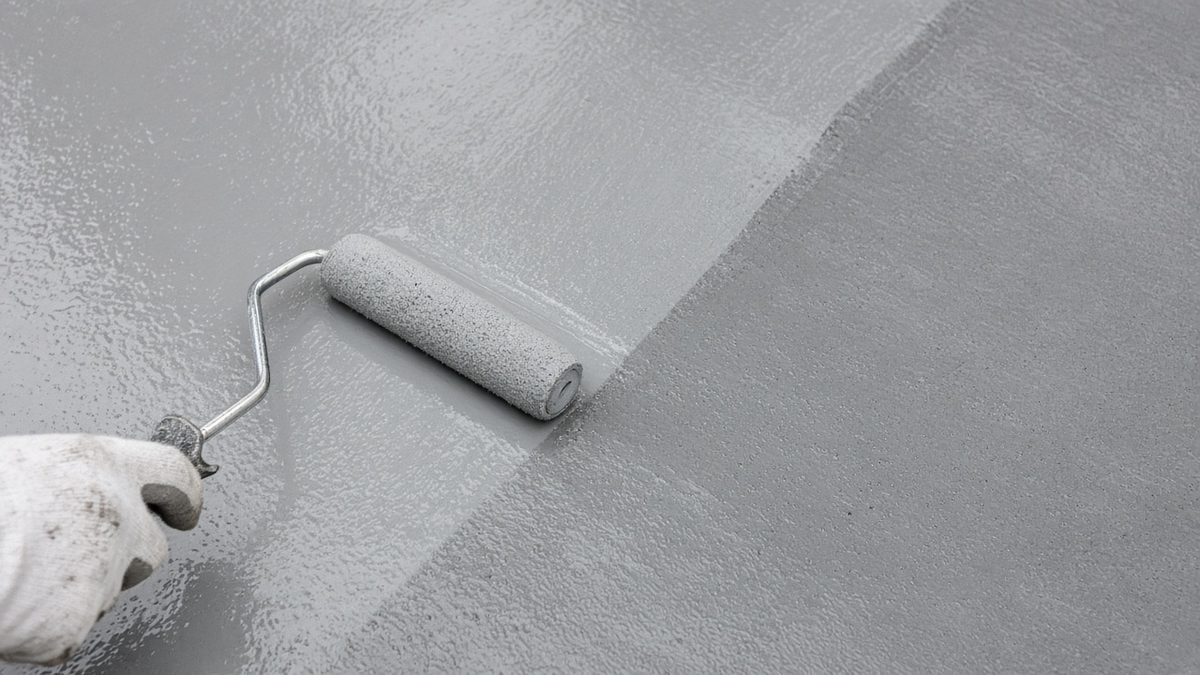
Most spray-applied polyurethane and polyurea roof membranes are aromatic: strong and elastic, but not built for long UV exposure. In the sun they discolour and the surface degrades. The answer is a thin final layer, an aliphatic topcoat, that shields the membrane, gives a stable colour and adds abrasion resistance. This guide sets out the values in KRYPTON’s datasheets for Colodur, Colodur 40, Impertop Fast 2K and Impertop Fast 2K SF.
Key points
- Aromatic membranes discolour and degrade at the surface in sunlight; an aliphatic topcoat does not yellow.
- Colodur is a one-component moisture-curing PU; Impertop Fast 2K is a two-component polyaspartic with a 30-minute pot life.
- Typical application rate is 200–500 g/m², depending on product and use.
- Quartz sand can be broadcast between coats for slip resistance.
What is an aliphatic topcoat?
“Aliphatic” describes the type of isocyanate in the resin. Aliphatic materials are colour-stable and do not yellow in sunlight, unlike aromatic ones. They are therefore used as a protective layer over aromatic membranes rather than as a replacement. Our article on aromatic and aliphatic polyurethanes explains the difference in detail.
Two types of aliphatic topcoat
- One-component, moisture-curing: such as Colodur, opened, stirred and applied directly, curing with moisture in the air.
- Two-component polyaspartic: such as Impertop Fast 2K, mixed at a set ratio and fast-curing, so the surface returns to service sooner.
Where it is used
- UV protection for cold- or hot-applied polyurethane and polyurea membranes.
- Car parks and industrial floors, as listed in the Colodur 40 sheet.
- Protective topcoat for metal anticorrosion systems and outdoor timber.
- Reflective roofs: white Colodur has an SRI of 104.5–105.4.
- Slip-resistant surfaces when quartz sand is broadcast.
Aliphatic topcoat comparison
| Property | Colodur | Impertop Fast 2K | Impertop Fast 2K SF |
|---|---|---|---|
| Type | 1K aliphatic PU | 2K polyaspartic | 2K polyaspartic, 100% solids |
| Hardness (Shore D) | 53D clear / 60D pigmented | 55D | 65D |
| Maximum elongation | 173% clear / 70% pigmented | 150% | 123% |
| Tensile strength | 27.4 / 15 MPa | 22 MPa | 29.3 MPa |
| Abrasion (Taber) | 11 mg | 15 mg | — |
| Pot life | 6 h (clear) | 30 min at 22°C | 25 min |
| Application rate | 200–500 g/m² | 200–600 g/m² wet | 200–500 g/m² |
| Method | Roller, brush or airless | Roller only | — |
Values are from the product datasheets; a dash (—) means not stated. Colodur is stable up to 80°C and holds European Technical Assessment ETE 16/0148 as a protective topcoat for waterproofing membranes.
Chemical resistance and choosing the right product
The Colodur sheet rates permanent contact at 80°C from 0 (worst) to 5 (best). It scores 5 with water, salt water, ammonia and engine oil, but 0 with concentrated hydrochloric acid (200 g/l) and xylene, so it is not for areas exposed to strong acids. Impertop Fast 2K SF is solvent-free and needs a substrate with at least 1.5 MPa cohesion and 25 MPa compressive strength. Colodur 40, by contrast, has a high solvent content (VOC 560 g/L), and its sheet states that it does not comply with EU limits, which matters on projects with green-building requirements.
How to apply an aliphatic topcoat
- Timing: on a freshly sprayed membrane, apply Impertop Fast 2K within about 30 minutes for best adhesion.
- Older membranes: sand gently, clean with Rayston solvent and apply a PU primer first.
- Conditions: for Colodur, substrate 10–30°C, substrate moisture below 4% and relative humidity below 85%.
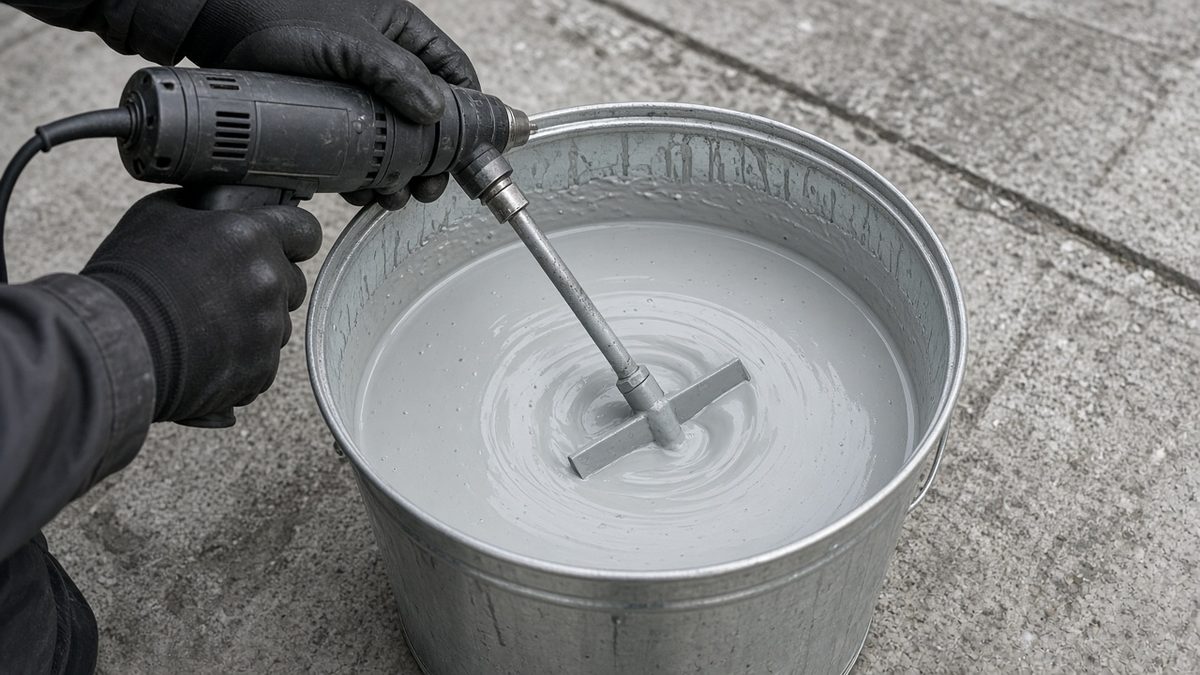
- Mixing: stir Colodur with a low-speed mixer and thin by up to 10% with Rayston Solvent if needed. For Impertop Fast 2K, stir component A, add B at 100:36 by weight (clear) and mix gently for two minutes.
- Batch size: mix no more Impertop than you can apply in 15 minutes, as larger batches react faster.
- Application: roll in an even layer. The Impertop sheet advises against airless equipment for safety reasons.
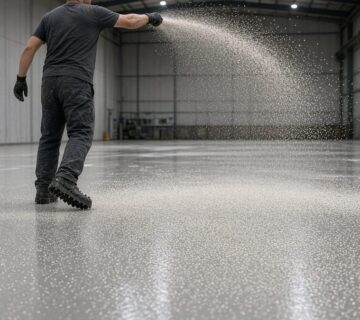
- Anti-slip: if required, broadcast 0.4–0.9 mm quartz into the first coat while wet and seal with a second coat.
Coverage and return to service
At 200–500 g/m², a 100 m² roof needs roughly 20–50 kg of Colodur, i.e. one to three 20 kg clear tins before waste. This is an approximate figure. Impertop Fast 2K is applied at 200–500 microns dry in a single coat.
- Colodur: light foot traffic after 24–48 hours, normal traffic after 7–10 days, full hardness in up to 15 days.
- Impertop Fast 2K: touch-dry in 1.5 hours and fully dry in 3 hours at 22°C; light traffic 2 hours after touch-dry; normal use the next day.
Common mistakes with an aliphatic topcoat
- Leaving an aromatic membrane exposed: it will discolour and degrade at the surface.
- Coating an old membrane without sanding and primer: poor adhesion and peeling follow.
- Wrong thinner: the Colodur sheet warns that some solvents stop curing; use Rayston Solvent only.
- High-pressure spraying in hot, humid weather: causes micro-bubbles and a hazy finish.
- Mixing large two-component batches: they cure in the bucket.
- Opening to traffic too early: heavy use needs the full waiting period.
Topcoats with Target Engineering
Target Engineering installs polyurethane and polyurea systems finished with the right aliphatic topcoat for each use, from homes to car parks. See our polyurea and polyurethanes and polyurea waterproofing works pages, or read our guide to liquid roof waterproofing.
Useful references: the European Organisation for Technical Assessment (EOTA) issues European Technical Assessments for liquid-applied systems, and ASTM D4060 covers the Taber abraser test used to rate coating durability.
FAQ about the aliphatic topcoat
Is a topcoat necessary over polyurea?
If the membrane is aromatic and exposed to sun, yes: the aliphatic topcoat is what protects it from UV and keeps its colour.
Colodur or Impertop Fast 2K?
Colodur is one-component with a long pot life and is stable to 80°C. Impertop Fast 2K is two-component, cures faster and takes light traffic within hours.
How often should it be renewed?
The Colodur sheet notes that layers may need reapplying when worn by traffic or weather, so inspect the surface periodically.
Is it suitable for car parks?
Yes. The Colodur 40 sheet lists parking and industrial floors among its uses.
Need a site inspection or a quotation? The Target Engineering team is ready to help.

[…] So a roof with a topcoat costs more than one without, but it keeps its colour. Our article on the aliphatic topcoat explains the […]
[…] datasheet expects a colour change in sunlight and lists Impertrans or Colodur. Our guide to the aliphatic topcoat explains the […]
[…] A wet deck can be slippery. That is why the topcoat matters. The Colodur datasheet lists slip resistance with quartz sand of 0.4–0.9 mm spread at 1 kg/m². It also lists an antiskid test by the Giordano laboratory (DIN 51130). As a rule, Colodur goes on at 200–500 g/m². For more on finishes, see our guides to anti-slip flooring and the aliphatic topcoat. […]
[…] and design. Krypton’s English ponds route ends with an Impertrans topcoat. For more, read our aliphatic topcoat […]