
Table of Contents
- How does crystalline waterproofing work?
- Advantages of crystalline waterproofing
- Technical properties
- Surface preparation for crystalline waterproofing
- Application steps
- Crystalline waterproofing or surface membranes?
- Where is crystalline waterproofing used?
- Common mistakes
- Target Engineering: crystalline waterproofing solutions
- Crystalline waterproofing FAQ
In basements, lift pits and underground tanks, damp and leaks often appear from the inside after the foundations are backfilled, when the outer face can no longer be reached to repair the membrane. Crystalline waterproofing offers a completely different approach from conventional membranes: rather than only forming a layer on the concrete, it penetrates into it and blocks the pores with crystals, and it can be applied on the water-pressure side or the opposite side. This article explains how it works and reviews three products from their datasheets: MasterSeal® 501/502 by Master Builders Solutions, Sika MonoTop®-160 Migrating and Fosroc Brushbond TGP.
Key points
- Crystals grow inside the concrete pores, blocking water while letting vapour pass.
- Works against positive and negative water pressure, from inside or outside.
- Saturate the surface with water first; moisture is essential for crystal growth.
- Moist-cure for 5–7 days (MasterSeal), 5 days (MonoTop-160) or at least 48 hours (Brushbond TGP).
How does crystalline waterproofing work?
The product is a powder of cement, silica aggregate and active chemicals, mixed with water and applied as a thin slurry on concrete. In the presence of moisture, the active chemicals react with free lime in the concrete to form insoluble crystals that grow inside capillaries and pores, blocking water while still letting air and water vapour pass, so the concrete “breathes”. The MasterSeal 501 datasheet states that crystals penetrate to the depth where water is present and that the active chemicals then remain dormant in the concrete, reactivating the sealing process on any later contact with water. The crystals also fill hairline shrinkage cracks.
Advantages of crystalline waterproofing
- Integral to the concrete: will not peel, delaminate or wear away like surface membranes.
- Works both ways: against positive and negative water pressure, applied inside or outside.
- Self-reactivating: sealing action renews on fresh contact with water.
- Suitable for drinking water: the MasterSeal 501 datasheet describes it as non-toxic and non-tainting, suitable for potable water systems.
- Unaffected by surface damage: according to the Brushbond TGP datasheet.
Technical properties
| Property | MasterSeal 501 | Sika MonoTop-160 Migrating | Brushbond TGP |
|---|---|---|---|
| Water pressure resistance | up to 5 bar | ~3 times less penetration than reference under 5 bar (EN 12390-8) | low pressure, below 1 bar |
| Bond to concrete | >1.0 N/mm² at 28 days (EN 1542) | ~2.0 N/mm² (EN 1542) | — |
| Compressive strength | >20 N/mm² at 28 days | — | — |
| Chloride content | ≤0.03% | — | contains no chlorides |
| Fire classification | Class 1 (BS 476-7) | A1 (EN 13501-1) | — |
| Mixing | — | ~9.2 L water per 25 kg | 6.6 L water per 20 kg (slurry) |
| Slurry consumption | 0.8–1 kg/m²/coat × 2 | ~1.2 kg/m² per layer | 1–1.5 kg/m² by brush |
| Dry shake | 1–2 kg/m² (501/502 datasheet) | — | 1.2–1.3 kg/m² on fresh concrete |
| Standard | BS 1881 Part 124 | CE, EN 1504-2 | — |
| Pack | 25 kg | 25 kg | 20 kg |
MasterSeal 502 is a crystalline re-profiling render for patch repairs and renewing old concrete, at 10 kg/m² for 4–5 mm, used together with MasterSeal 501.
Surface preparation for crystalline waterproofing
- Remove dust, oil, grease, paint residue, curing compounds, mould oil and any previous treatment that impairs penetration, such as polymer-modified renders or silicone/silane-treated surfaces.
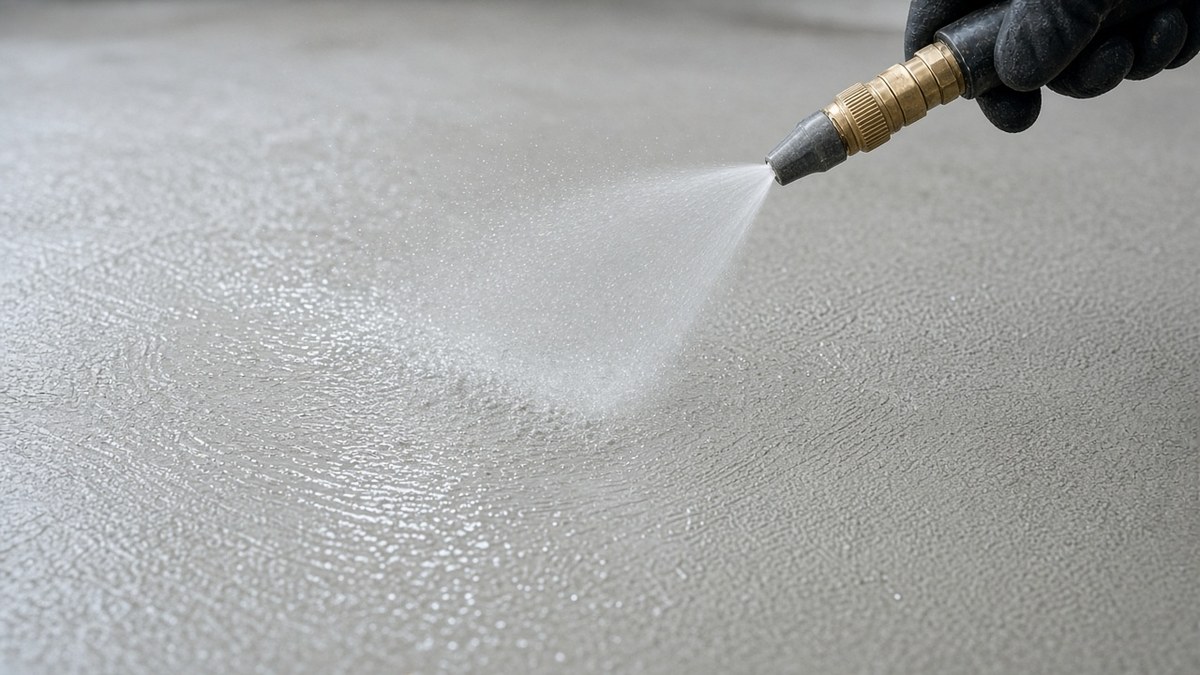
- Remove laitance to give an open-pored, slightly rough surface; high-pressure water jetting is preferred.
- Repair weak and honeycombed concrete and remove hollow, debonded renders.
- Saturate the surface with clean water before application; moisture is essential for crystal growth.
Application steps
- Mixing: always add powder to water, not the reverse, and mix with a slow drill (300–500 rpm for Brushbond TGP) to a creamy consistency. Do not mix more than can be used in 20 minutes; if it stiffens, re-stir rather than adding water.
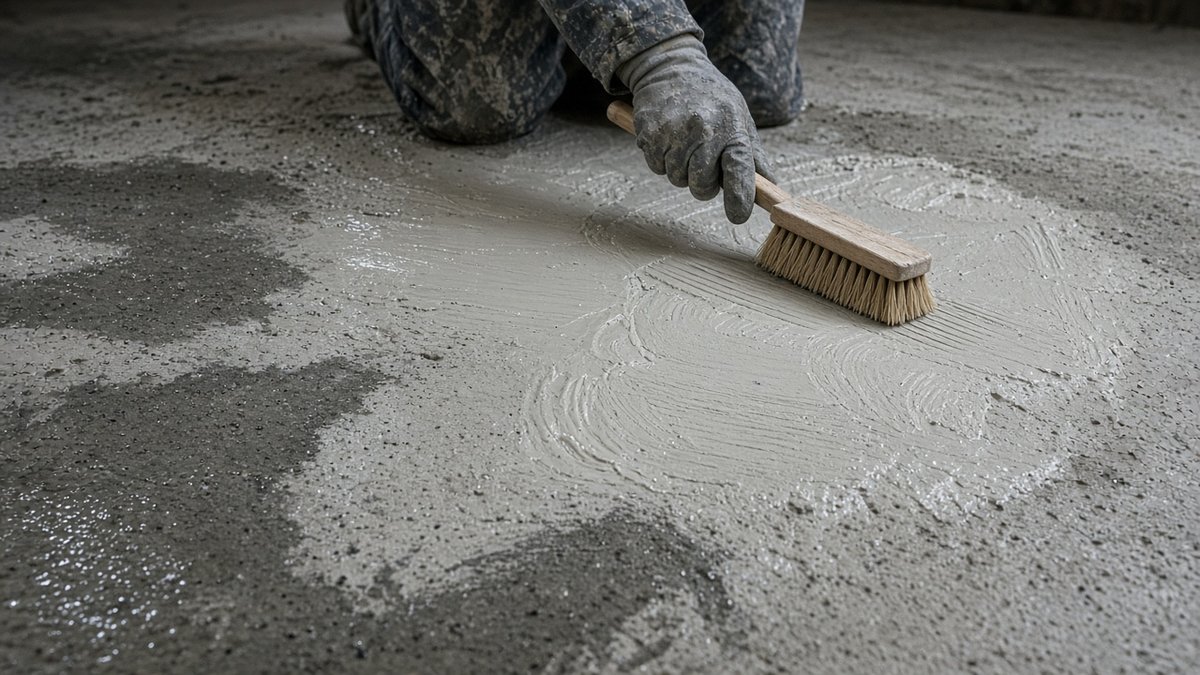
- First coat: apply with a stiff brush or low-pressure spray to the damp surface.
- Second coat: after 2–4 hours per the 501/502 datasheet, at right angles to the first.
- Moist curing: keep damp for 5–7 days for MasterSeal, 5 days for MonoTop-160 and at least 48 hours for Brushbond TGP, protected from sun and wind.
- Tanks: the 501/502 datasheet allows filling 24 hours after the last coat.
Dry shake on fresh concrete
On new slabs, Brushbond TGP powder can be broadcast by hand at 1.2–1.3 kg/m² before final trowelling, spreading 50% in one direction and 50% at right angles, then trowelling. The MasterSeal 501 datasheet also cites dry-shake use on horizontal construction joints.
Crystalline waterproofing or surface membranes?
Bituminous and liquid membranes act as a barrier on the surface, usually need to be on the water-facing side, and any hole or damage lets water through. Crystalline systems work inside the concrete, making them the logical choice when the outer face is inaccessible after backfilling, or when a solution unaffected by scratches and abrasion is needed, such as basement floors and lift pits. On the other hand, they do not accommodate large structural crack movement or expansion joints, which need flexible materials. Many projects therefore combine both: crystalline for the concrete, flexible materials for joints and movement.
Where is crystalline waterproofing used?
- Water-retaining structures: tanks and towers, reservoirs, swimming pools, water and sewage treatment plants, canals, concrete pipes and manholes.
- Water-excluding structures: basements, tunnels, foundations, retaining walls, lift shafts and construction joints.
Common mistakes
- Applying on a dry surface: crystals need moisture; pre-saturate first.
- Skipping moist curing: causes cracking and reduces penetration.
- Applying over paints or polymer-modified renders: they block the active chemicals.
- Relying on it for moving joints: the MasterSeal 501 datasheet requires these to be formed into watertight elastomeric movement joints.
- Using a low-pressure product under high pressure: Brushbond TGP is designed for below 1 bar.
Target Engineering: crystalline waterproofing solutions
Target Engineering applies crystalline waterproofing in basements, tanks and lift pits, with high-pressure water cleaning, treatment of joints and leak points, and moist curing as specified. See our cementitious waterproofing, repair and rehabilitation and tank insulation pages, or contact us for a site inspection.
References: the EU Construction Products Regulation (CPR) governing CE marking to EN 1504-2, and the WHO Guidelines for drinking-water quality for water structures.
Crystalline waterproofing FAQ
Can a basement be treated from inside?
Yes. All three products work against positive and negative pressure, although the MasterSeal 501 datasheet prefers the water-facing side where possible for faster penetration.
When does it take effect?
The MasterSeal 501 datasheet cites sufficient penetration after 5–7 days, and Brushbond TGP full effect within 2–3 weeks.
Is it suitable for drinking-water tanks?
Yes. MasterSeal 501/502 is non-toxic and suitable for potable water systems; wash the tank before service.
Does it replace external foundation waterproofing?
It can be the main or complementary system depending on water pressure and design; the engineer decides after inspection.
How much is needed per square metre?
For two coats, MasterSeal 501 needs 0.8–1 kg/m² per coat and Sika MonoTop-160 Migrating about 1.2 kg/m² per layer, more on rough or very porous surfaces.
Need a site inspection or a quotation? The Target Engineering team is ready to help.

[…] For example, crystalline systems treat the concrete itself. Read our guide to crystalline waterproofing to […]
[…] they work within the concrete, not just on it. In addition, they let the wall breathe. Our page on crystalline waterproofing explains the chemistry in more […]