
Table of Contents
- What is a liquid polyurethane membrane?
- Why choose liquid roof waterproofing?
- Technical properties
- Surface preparation for liquid roof waterproofing
- Liquid roof waterproofing application steps
- Application conditions and curing
- Where is it used?
- Choosing a liquid roof waterproofing product
- Routine maintenance
- Common liquid roof waterproofing mistakes
- Target Engineering and liquid membranes
- Liquid roof waterproofing FAQ
When owners look for liquid roof waterproofing that will stay leak-free for years, they face many options, but liquid polyurethane membranes have become one of the most popular in Egypt and the Gulf for a clear reason: they form a continuous rubbery layer with no joints, wrapping pipes, equipment bases and parapets in a way rolls cannot. This article explains how the system works, presents the technical values in the datasheets of Impermax LY and Impermax QC by KRYPTON and Kemroof PU by Prokem, then sets out the correct application steps and mistakes to avoid.
Key points
- A seamless elastomeric membrane with elongation above 600% (Impermax LY) and 617% (Impermax QC).
- A clean, dry substrate with a pull-off of at least 1.4 N/mm² for Impermax LY.
- Two coats in different colours, with reinforcement mesh at critical points.
- Avoid midday heat; early-morning work is preferable in summer.
What is a liquid polyurethane membrane?
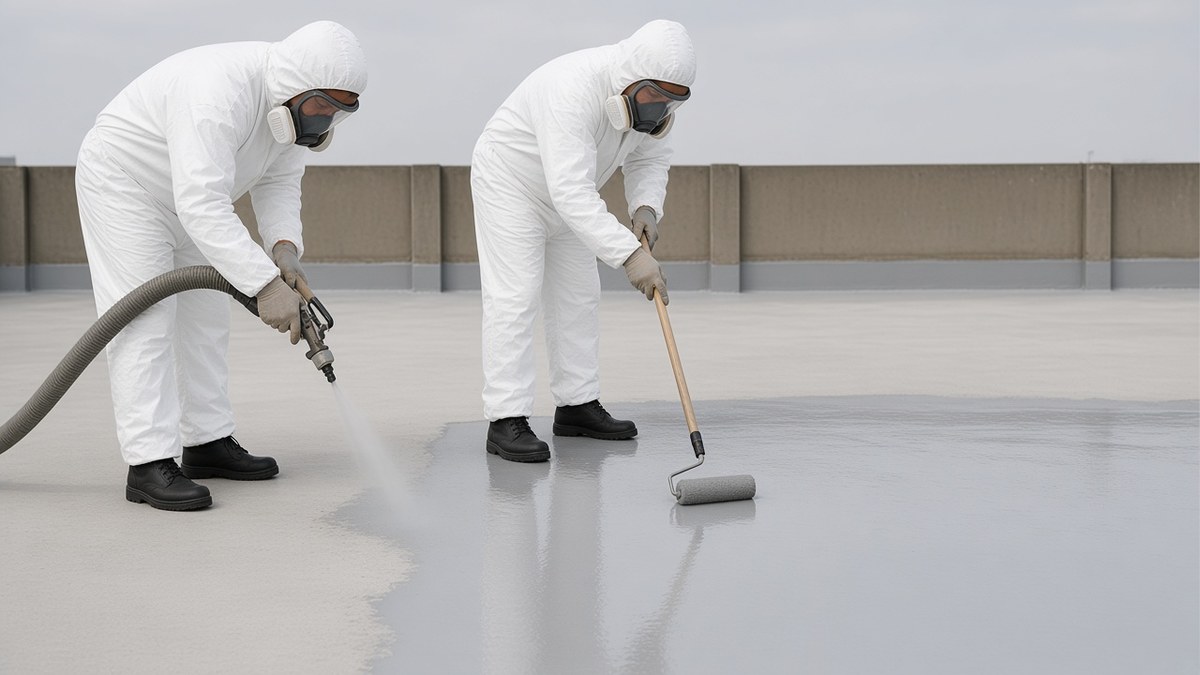
It is a liquid applied by roller, brush, trowel or spray that reacts with air humidity to become a flexible elastomeric membrane fully bonded to the surface. Impermax LY is a one-component, low-yellowing, cold-applied product; Impermax QC is a one-component, semi-thixotropic, fast-curing, solvent-borne aromatic polyurethane. Either way, the result is a flexible layer that accommodates building movement and thermal expansion without cracking.
Why choose liquid roof waterproofing?
Very high elasticity
Impermax LY elongation exceeds 600%, and Impermax QC reaches 617%, so the membrane stretches several times its length before breaking, absorbing cracks and joint movement.
Seamless
The layer is fully continuous with no laps or welds to act as weak points, a decisive advantage on roofs crowded with pipes and AC bases.
Bonds to many substrates
The Impermax LY datasheet lists concrete, brick, fibre cement, ceramic tiles, bituminous surfaces, steel, zinc and aluminium, each with the appropriate primer.
European approvals
Impermax QC holds European Technical Assessment ETA 06/0263 (10- and 25-year working-life categories), BBA Agreement 11/4836 for roofs and a B roof t1 classification.
Technical properties
| Property | Impermax LY | Impermax QC | Kemroof PU |
|---|---|---|---|
| Elongation | >600% | 617% | 367% |
| Tensile strength | >2.5 MPa (EN-ISO 527-3) | 4.1 MPa | 6–7 N/mm² |
| Hardness | 60–65 Shore A (ISO 868) | — | 80 Shore A |
| Adhesion | 1 MPa concrete with epoxy primer; 1.2 PU foam; 1.7 steel with Primer PU | 2.0 MPa on concrete | 1.2 N/mm² |
| Temperature flexibility | — | — | −40 to +90 °C |
| Consumption | 2 coats × 1 kg/m² | 2 coats × 1.5–2 kg/m² | 0.3 kg/m² per 250 µm; 1.5 kg/m² over 3 reinforced layers |
| Reference | — | ETA 06/0263, BBA 11/4836 | ASTM C836 |
| Pack | 25 kg | 5 / 10 / 25 kg | — |
Surface preparation for liquid roof waterproofing
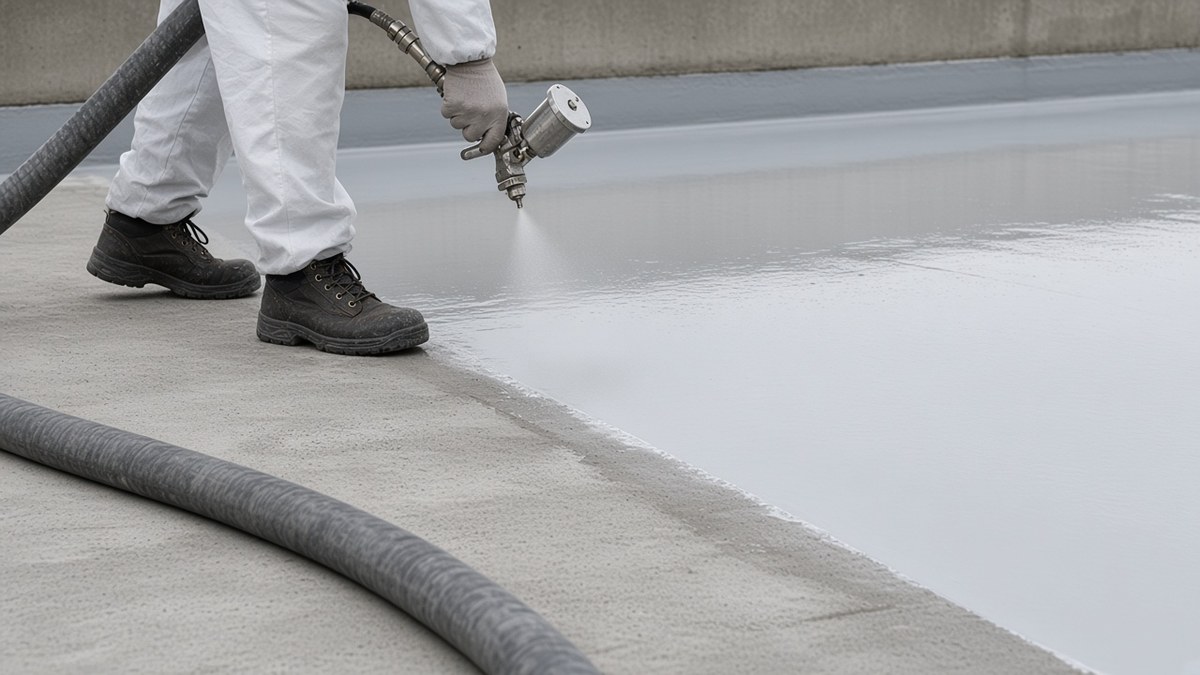
Preparation is half the success of any liquid system, because the membrane is fully bonded and any weakness in the substrate transfers directly to the waterproofing.
- Flat, cohesive substrate: the Impermax LY datasheet requires a minimum pull-off of 1.4 N/mm².
- Crack repair: all cracks and fissures repaired beforehand.
- Clean and dry: free of dust, oil, organic residue and laitance; substrate moisture no more than 5% for Kemroof PU.
- Critical points: pre-treat drains, corners, upstands and pipes with reinforcement.
- Primer: epoxy primer on concrete, Primer PU on steel, Humidity Primer where needed.
Liquid roof waterproofing application steps
- Stir: homogenise before use, as some content settles during storage.
- First coat: apply by roller, brush, trowel or airless spray at 1 kg/m² for LY, or 1.5–2 kg/m² for QC.
- De-aerate: pass a spiked roller immediately after spreading.
- Reinforce: a reinforcement mesh between Impermax LY coats is recommended and essential at critical points.
- Second coat: in a different colour to ensure full coverage; for QC, apply as soon as the first coat can be walked on and before 48 hours.
- Final protection: Impermax QC is aromatic and changes colour under UV, so an aliphatic topcoat is advisable where colour stability matters.
Application conditions and curing
For Impermax LY, substrate temperature must be 0–40 °C and air temperature 0–30 °C; high moisture can cause bubbles under the membrane. In the Egyptian summer, early-morning work is therefore preferable. Walking is usually possible after 1–2 days, and the membrane reaches 90% of its properties within 3 days.
Where is it used?
- Roofs, terraces and balconies.
- Showers, kitchens and hard-to-reach spots.
- Floors with light foot traffic, stairs, stadiums and stands.
- Over polyurethane foam as the waterproofing layer (1.2 MPa adhesion with Impermax LY).
Choosing a liquid roof waterproofing product
Impermax LY is a balanced choice for residential roofs, terraces and wet areas, with elongation above 600%, low yellowing and a total of about 2 kg/m². Impermax QC suits projects that need documented European approvals (ETA and BBA) and greater thickness, applied at 1.5–2 kg/m² per coat with fast curing. Kemroof PU has the highest tensile strength of the three (6–7 N/mm²), Shore A 80 and a wide service range of −40 to +90 °C, in a three-layer reinforced system. The engineer selects according to substrate, use and budget.
Routine maintenance
The Impermax LY datasheet recommends a simple maintenance routine: remove leaves and debris, keep drains and rainwater pipes working, check flashings, seams and upstands, and look for damage from improper use such as installing equipment or drilling without detailing. Catching defects early means a small local repair instead of re-roofing.
Common liquid roof waterproofing mistakes
- Applying in midday heat: exceeds permitted air temperature and causes bubbles.
- Thinning with unknown solvents: datasheets forbid universal solvents such as white spirit; only Rayston Solvent is allowed.
- One thick coat: instead of two coats in different colours.
- Neglecting critical points: drains and upstands cause most leaks.
- Leaving aromatic material exposed: where colour and appearance matter.
Target Engineering and liquid membranes
Target Engineering carries out liquid roof waterproofing from substrate cohesion and moisture testing, through critical-point detailing and reinforcement, to the final protective layer and flood test. See our liquid applied membranes, hot and cold applied liquid polyurethanes and waterproofing and roofing pages, or contact us for a roof inspection.
References: ASTM C836 for cold liquid-applied elastomeric membranes, and the European Organisation for Technical Assessment (EOTA), which issues ETA documents.
Liquid roof waterproofing FAQ
Can I walk on the roof after waterproofing?
Yes. Impermax LY suits floors with light foot traffic and is usually walkable after 1–2 days.
Can it go over old bitumen rolls?
The datasheet lists bituminous surfaces among suitable substrates, provided they are bonded and sound and the right primer is used.
How many kilos per square metre?
About 2 kg/m² for Impermax LY (2 × 1 kg), 3–4 kg/m² for QC, and 1.5 kg/m² for the reinforced Kemroof PU system.
Is it affected by sunlight?
Impermax QC contains anti-UV additives, but a colour change is expected because it is aromatic; an aliphatic topcoat is recommended.
Need a site inspection or a quotation? The Target Engineering team is ready to help.

[…] Target Engineering installs polyurethane and polyurea systems finished with the right aliphatic topcoat for each use, from homes to car parks. See our polyurea and polyurethanes and polyurea waterproofing works pages, or read our guide to liquid roof waterproofing. […]
[…] See our polyurea and polyurethanes page, and read our guides to water tank waterproofing and liquid roof waterproofing. If you also need thermal insulation, see spray foam roof […]