

A polyurea car park deck coating has to keep water out and carry cars at the same time. That is a harder job than a normal roof. In fact, wheels turn, brake and climb ramps, while rain and sun work on the deck from above. This guide explains the two routes Krypton Chemical documents for car parks. It also covers the layers in each route and when epoxy may suit you better.
Contents
- Exposed car park roofs vs indoor parking floors
- Two Krypton routes for a polyurea car park deck coating
- What “hybrid” means: Impermax Polyurea H Flex
- Anti-slip finish on the deck
- Polyurea car park deck coating: sequence and return to traffic
- Epoxy or polyurea for your car park?
- Common mistakes with a polyurea car park deck coating
- Frequently asked questions
- Request a car park survey in Cairo
Exposed car park roofs vs indoor parking floors
First, decide which kind of deck you have. The two cases look alike, but they face different loads. So the polyurea car park deck coating route changes with the deck.
- Exposed car park roof. The deck is the roof of the building below. So it must stop water, take heat and movement, and drain well.
- Indoor or covered parking floor. The slab sits inside the building. Here wear, slip, cleaning and fire rules matter more than rain.
In addition, Krypton gives each case its own application page. For that reason, it is worth reading both before you write a specification.
Two Krypton routes for a polyurea car park deck coating
| Area | Krypton reference products, in order | Source |
|---|---|---|
| Exposed car park roof | Rayston Epoxy Plus → Impermax Polyurea H Flex → Colodur | Krypton car park roofs page |
| Indoor and outdoor parking floor | Humidity Primer → Rayston Floor D50 FR → Kryptanate 100 | Krypton indoor and outdoor parking page |
Krypton lists these as typical reference products for each case. On the roof route, Rayston Epoxy Plus is a filled epoxy primer. Next, Impermax Polyurea H Flex is the membrane, and Colodur is the aliphatic polyurethane topcoat. Krypton’s product card lists Colodur for “heavy pedestrian traffic and light vehicular decks”.
On the floor route, Krypton describes Rayston Floor D50 FR as a “hot-spray polyurea pavement membrane with fire resistance”. Then Kryptanate 100, a polyaspartic topcoat, protects the floor from wear. We have not reviewed the datasheets of these two products, so this guide quotes no figures for them.
What “hybrid” means: Impermax Polyurea H Flex
Krypton’s card calls Impermax Polyurea H Flex a “hot-spray hybrid polyurea”. Krypton’s note on pure vs hybrid asks writers to keep these names apart. So H Flex is not the same product as Polyurea Rayston, and its marks differ too.
However, its datasheet is in Spanish (Impermax Polyurea H Flex TDS, Spanish PDF). It reports:
- ETA 21/0740 (EAD 030675-00-0107) for bridge-deck waterproofing, with CE marking.
- Elongation of 400% and tensile strength of 15 MPa.
- Crack bridging Class A5 at 23 °C and −10 °C, and Class B4.2 at −20 °C (EN 1062-7).
- Impact strength of 24.5 N·m, Class III (EN ISO 6272-1).
- Taber abrasion of 22 mg (CS17, 1,000 cycles, 1 kg).
Krypton’s guide to Impermax Polyurea H Flex sums up these values in English. Also, its note on crack bridging stated in the cold explains a key point. You should read the class at the coldest deck temperature.
Anti-slip finish on the deck
A wet deck can be slippery. That is why the topcoat matters. The Colodur datasheet lists slip resistance with quartz sand of 0.4–0.9 mm spread at 1 kg/m². It also lists an antiskid test by the Giordano laboratory (DIN 51130). As a rule, Colodur goes on at 200–500 g/m². For more on finishes, see our guides to anti-slip flooring and the aliphatic topcoat.
Polyurea car park deck coating: sequence and return to traffic
The H Flex datasheet sets these conditions:
- Substrate. Pull-off of at least 1.5 N/mm², moisture below 4% and air humidity below 85%. The deck should be between 10 °C and 40 °C.
- Preparation. Blast or scarify the concrete to open the pores. If you suspect moisture, apply two coats of epoxy primer, the second with a sand broadcast.
- Primer cure. Spray H Flex only on dry primer, after about 8 hours.
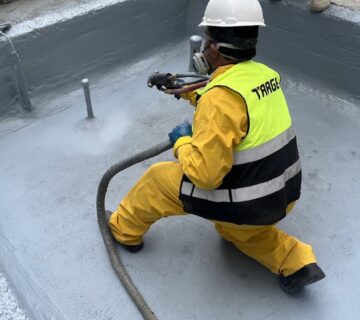
- Spraying. Use 70 °C for both components and 65 °C for the hose, at 135–170 bar. The usual rate is 2.0 kg/m². However, wind above 25 km/h can cause problems.
- Topcoat. Then apply Colodur as specified.
After spraying, H Flex resists rain drops in 15 minutes and light foot traffic in 1 hour. It reaches 90% of its final properties after 2 days. Colodur takes light traffic in 24–48 hours, while Krypton suggests 7–10 days before usual traffic. Neither datasheet gives a separate time for car traffic. Therefore, the project specification sets the opening date.
Epoxy or polyurea for your car park?
In short, it depends on the deck. Exposed roofs over occupied space need a waterproofing membrane, which is where the H Flex route fits. Indoor floors, by contrast, often need wear and slip more than waterproofing.
To be clear, Target’s own parking work so far has been epoxy, not polyurea. For example, our records list “epoxy flooring for parking” at Aeon Towers Mall of Arabia. Similarly, they list “Parking and garages epoxy flooring” at District 5. We have no polyurea car park project to show yet. Our epoxy flooring guide explains that option.
Common mistakes with a polyurea car park deck coating
Krypton’s car park roofs page lists three typical errors:
- Looking only at the membrane and ignoring falls, outlets and ponding.
- Crossing movement joints or penetrations without a designed detail.
- Closing the job before checking moisture, adhesion, thickness, cure and weather limits.
Frequently asked questions
Is H Flex the same as pure polyurea?
No. Krypton calls it a hybrid, and it carries its own ETA. Pure polyurea, such as Polyurea Rayston, is a separate product.
Can the deck stay without a topcoat?
On the roof route, Krypton lists Colodur as the top layer. So follow the full build-up.
How long before cars can park?
The datasheets give foot-traffic times, not car times. So the project specification decides.
Hot or cold application?
H Flex is hot-spray only. Our article on hot and cold applied polyurea compares the methods.
Request a car park survey in Cairo
Send us the deck drawings, photos and use. We will visit, test the concrete and propose a polyurea car park deck coating or an epoxy floor, with datasheets.
- Office: 48 El-Horreya St, Heliopolis, Cairo
- Phone: +20 120 226 9326
- Email: admin@targetsw-eg.com
- Online: contact Target Engineering
For more background, read our polyurea waterproofing guide. To learn how European assessments such as ETA 21/0740 work, visit EOTA. Target also works from offices in Abu Dhabi and Kenitra.

No comment