
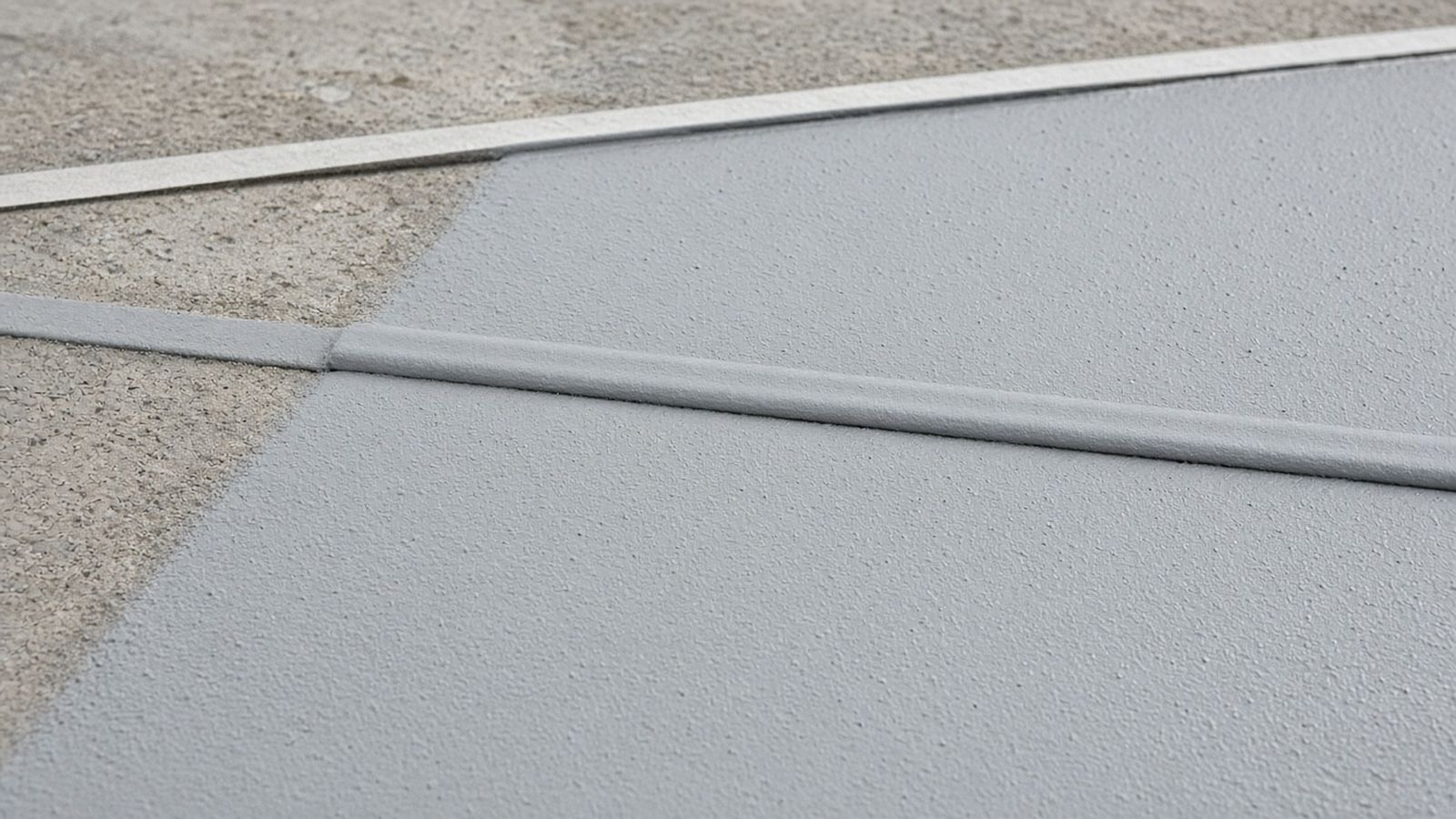
Expansion joint waterproofing polyurea work deals with the one place where a concrete structure is meant to move. A spray membrane bonds well to flat concrete. However, a joint opens and closes with heat, load and settlement. So it needs its own product and its own detail. This guide explains the options Krypton Chemical documents and the steps on site. It also shows how joints differ in tanks, roofs and floors.
Contents
- Why joints are the weak point of liquid membranes
- Expansion joint waterproofing polyurea options from Krypton
- Step-by-step expansion joint waterproofing polyurea
- Expansion joint waterproofing polyurea in tanks, roofs and floors
- Expansion joint work by Target in Egypt
- Frequently asked questions
- Request a joint survey in Cairo
Why joints are the weak point of liquid membranes
A liquid membrane bonds fully to the concrete below it. In fact, that is its strength on a flat slab. At a joint, though, the two sides move apart and back again. As a result, a thin film over that gap carries all the movement in a very small strip.
For this reason, Krypton’s car park roofs page names a common mistake. It is “bridging movement joints or penetrations without a designed detail and compatible reinforcement.” In other words, the membrane alone is not the joint solution. The joint needs a filler or a band, and the membrane must then tie into it.
Expansion joint waterproofing polyurea options from Krypton
Krypton documents several joint products. Each one, however, has a different job, so it helps to read them side by side.
| Product | Type (per TDS) | Intended use (per TDS) |
|---|---|---|
| Rayston Flex 70 | Two-component modified-polyurea mastic, from cartridges with a pump | Expansion and working joints outdoors: roofing, water treatment structures, bridge decks, foundations |
| Rayston Flex Joint GEO | TPE band with geotextile strips on both sides | Expansion joints in walls, roofs, terraces, water tanks, water treatment plants, pools, basements |
| Geomax | Polyester/polyamide geotextile | Reinforcement; also “an inner stopper when filling expansion joint spaces” |
| Rayston Flex 90 | Modified-polyurea mastic | Joints and cracks in concrete floors |
Rayston Flex 70: polyurea mastic
The Rayston Flex 70 datasheet describes a “polyurea mastic, mechanically applied”. It comes in prefilled cartridges. Also, it needs a dedicated pump from Krypton. Key values from the Rayston Flex 70 datasheet (PDF):
- Elongation at break of 690% and tensile strength of 20 MPa.
- Watertight to EN 1928 (60 kPa, a 6 m water column).
- No cracking when folded at −45 °C.
- Gel time of about 12 seconds at 25 °C.
Rayston Flex Joint GEO: elastic band
Meanwhile, this band suits wide joints and joints with large movement. Its datasheet lists a 170 mm width and a thickness of about 1.5 mm. It also reports water pressure resistance above 3 bar (DIN EN 1828). On dry concrete you bond it with epoxy glue. On damp concrete, however, the datasheet uses a flexible waterproof mortar instead.
How much mastic do you need?
The Flex 70 datasheet gives a theoretical yield table. For example, one 1.7 kg cartridge fills about 11.8 m of a joint 12 mm wide and 10 mm deep. However, this figure does not include losses. So Krypton advises a site test first.
Geomax and Rayston Flex 90
Geomax can act as a stopper inside a joint, so the liquid does not run away. Note, though, that its datasheet is written around Impermax membranes, which are polyurethane. So confirm its use in a polyurea system with Krypton. Rayston Flex 90, finally, is for floor joints only.
Step-by-step expansion joint waterproofing polyurea
1. Open and clean the joint
First, open the joint to its design width. Then remove dust, oil, old sealant and water. The Flex 70 datasheet says the joint must be clean and free of water, and it needs no special primer.
2. Check the weather
Next, check the air. For Flex 70, air should be between 10 °C and 40 °C, with humidity below 70%. For the GEO band, apply between +5 °C and +30 °C, and not when rain is expected within 24 hours.
3. Place a stopper or backing
Then set the depth of the filler. Geomax is one documented stopper. Otherwise, follow the backing that the project drawing shows.
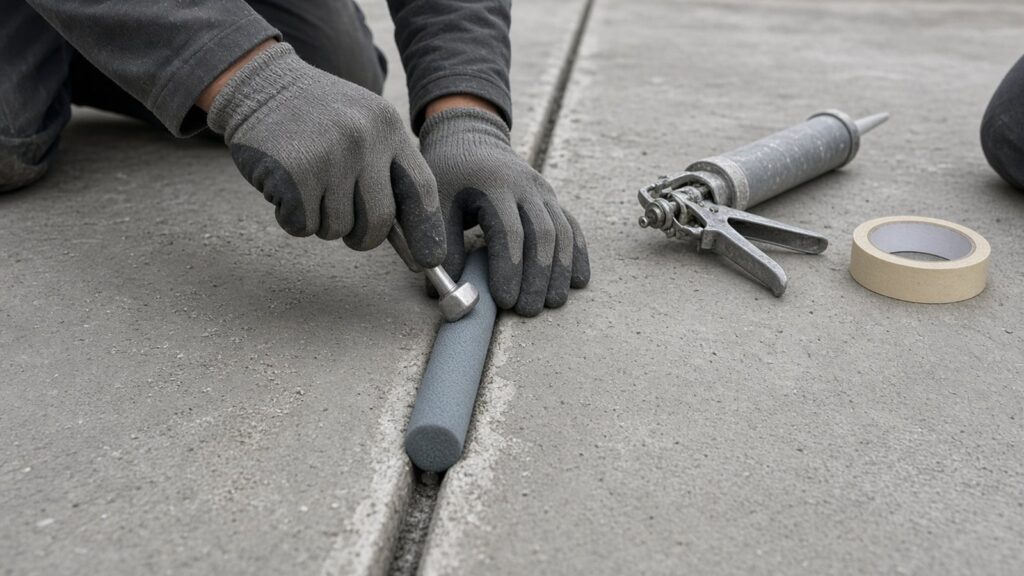
4. Fill or band the joint
After that, fill the joint fully with Flex 70 and cut off the excess. The datasheet says you can cut it with a steel blade after 60 seconds. Or, for a band, press GEO into fresh glue or mortar. Then add a second layer on top. Join two pieces with a patch or a hot-air welded overlap of at least 40–50 mm.
5. Tie in the main membrane
Next, bring the main membrane up to the joint detail as drawn. In short, the detail decides where the membrane stops, laps or passes over.
6. Cure and protect
Flex 70 resists rain drops after 5 minutes and light foot traffic after 1 hour. The GEO band takes about 3–4 days to cure at 20 °C. Also, its datasheet asks you to protect the band from mechanical damage.
Expansion joint waterproofing polyurea in tanks, roofs and floors
Each place puts a different load on an expansion joint waterproofing polyurea detail:
- Tanks. The GEO band lists water tanks and permanent immersion. For negative water pressure, its datasheet calls for a metal plate on one side.
- Roofs and podiums. Flex 70 lists roofing. Both products accept outdoor use.
- Floors. Wheels cross the joint all day, which is why Krypton has Rayston Flex 90 for concrete floors.
For more on this, see our pages on repairing expansion joints and filling joints.
Expansion joint work by Target in Egypt
This section lists project records only. It is separate from the product guide above. Target Engineering’s presentation lists “Expansion Joints treatment by using Polyurea” on these projects:
- Wadi El-Natroon lifting station (7, 8), contractor SIAC, consultant Hydro.
- El-Mostakbal Tanks, contractor SIAC, consultant Space.
- Ministry AFF, New Capital, contractor SIAC, consultant ECG.
- Mansoura 1, contractor TIBA, consultant Five Plus.
The records name no product for these joint works.
Frequently asked questions
Is polyurea a joint sealant?
Some polyurea products are. Rayston Flex 70 and Flex 90 are polyurea mastics made to fill joints. A spray membrane, by contrast, is a surface layer. It bridges fine cracks but does not replace a joint detail.
How much movement can a joint take?
The datasheets give material values, such as 690% elongation for Flex 70. They do not give a joint movement rating. So the joint size comes from the structural engineer.
Can old mastic joints be repaired?
Yes. The GEO band datasheet lists the “repair of expansion joints made with mastics or water-stop-like joints”.
What about joints in tanks?
Treat them first, then apply the main lining. Our hot and cold applied polyurea article explains the lining methods.
Request a joint survey in Cairo
Send us photos, joint widths and drawings. We will inspect the joints and propose an expansion joint waterproofing polyurea detail with its datasheets. You can also read the Rayston Flex Joint GEO datasheet (PDF).
- Office: 48 El-Horreya St, Heliopolis, Cairo
- Phone: +20 120 226 9326
- Email: admin@targetsw-eg.com
- Online: contact Target Engineering
For more background, read our polyurea waterproofing guide. For concrete repair practice in general, the International Concrete Repair Institute is a useful source. Target also works from offices in Abu Dhabi and Kenitra.

[…] Every sealant has limits. The Sikaflex-1A PLUS sheet rules out bituminous substrates, natural rubber and EPDM. It also excludes joints under water pressure, permanent immersion and joints in or around swimming pools. For wet or trafficked joints, see our guide to expansion joint waterproofing. […]