
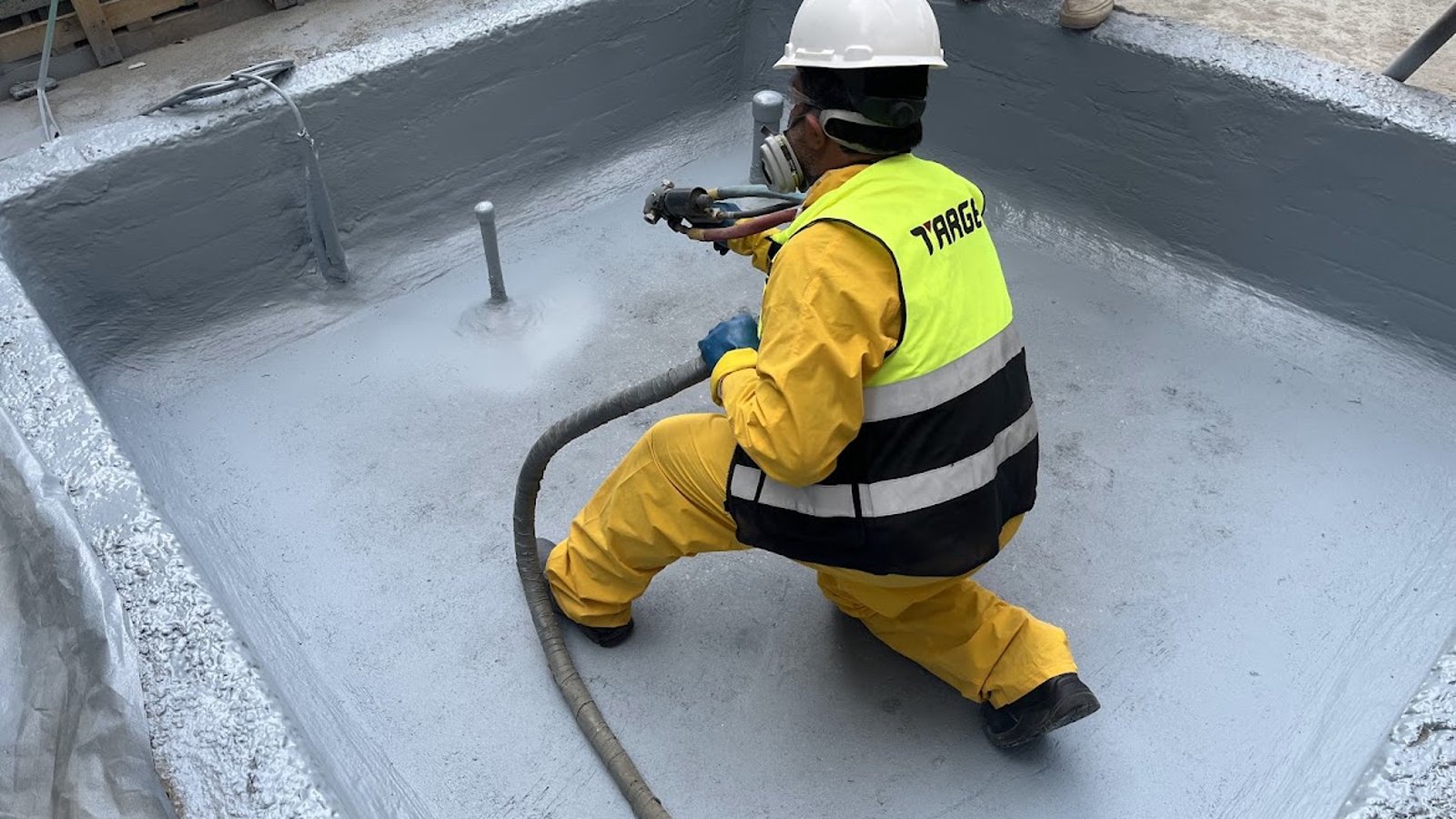
Fountain waterproofing polyurea is a hot-sprayed membrane that lines a concrete basin. A topcoat then covers the parts you can see. A fountain is a hard place for any lining. In fact, it sits under water most of the day. Its edges get wet and dry, and its floor is full of nozzles, lights and pipes. This guide explains the build-up, the steps on site and the details that decide whether a fountain stays watertight.
Contents
- What fountain waterproofing polyurea has to handle
- A documented build-up: Polyurea Rayston with a Colodur topcoat
- Check the water treatment first
- Step-by-step fountain waterproofing polyurea
- Common mistakes in fountain waterproofing polyurea
- Water features by Target in Egypt
- Frequently asked questions
- Request a fountain survey in Cairo
What fountain waterproofing polyurea has to handle
Krypton’s page on decorative fountains lists the loads a fountain lining faces:
- Constant immersion in recirculating water.
- Splash zones and wet–dry cycles at edges and overflows.
- Chlorine or other water treatment chemicals.
- Porous or cracked concrete and render.
- Nozzles, pipe penetrations, overflows, weirs, lighting sleeves and upstands.
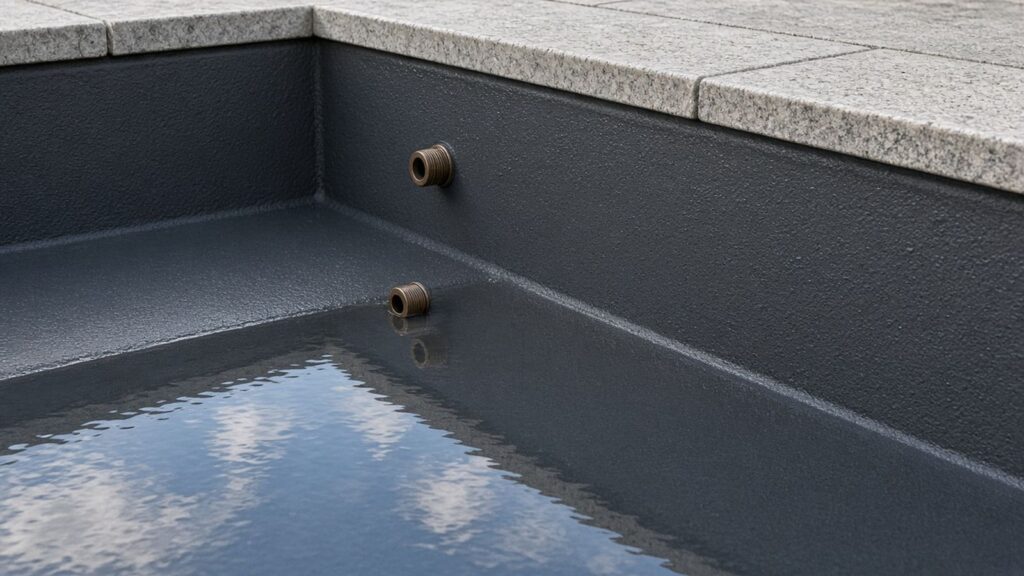
So the basin floor is only part of the job. In addition, every opening needs its own drawn detail before work starts. Krypton also warns that tiles and other finishes must not cut through or damage the membrane.
A documented build-up: Polyurea Rayston with a Colodur topcoat
One build-up that Krypton documents well is Polyurea Rayston with a Colodur topcoat. Polyurea Rayston is a two-component pure polyurea. According to its datasheet, it can only be applied with hot spray equipment. The same datasheet reports:
- Watertight at 5 bar, equal to a 50 m water column (EN 12390-8).
- Maximum elongation of 324%.
- Crack bridging Class A5 at −10 °C and Class B4.2 (EN 1062-7).
- The best rating (5 of 5) after 15 days in water at 80 °C.
However, Polyurea Rayston is aromatic. Its datasheet says the colour will change in sunlight, and that this does not affect its mechanical properties. For that reason, it lists an Impertrans or Colodur topcoat.
Colodur is a one-component aliphatic polyurethane, not a polyurea. Its datasheet states that it “does not yellow on exposure to sunlight”. It comes clear or pigmented, and it carries CE marking to EN 13813 (DoP 20-210). You can read the CE marking rules on the EU website.
| Layer | Product | Rate | Source |
|---|---|---|---|
| Primer (dry concrete) | Rayston Epoxy 100 | 0.3–0.8 kg/m² | ETA 16/0148 kit |
| Primer (damp concrete) | Humidity Primer | 0.3–0.5 kg/m² | ETA 16/0148 kit |
| Membrane | Polyurea Rayston, hot spray | 1.5–2.0 kg/m² for 1.5–2 mm | Polyurea Rayston TDS |
| Topcoat | Colodur, pigmented | 0.25–0.35 kg/m² | ETA 16/0148 kit |
Note that the ETA rates belong to a roof kit. For a fountain, the project specification sets the final rates.
Another Krypton route for fountains
Krypton’s fountain page lists a second route: Rayston Epoxy Plus, then Polyurea Rayston A, then Impertrans. Impertrans is also an aliphatic polyurethane. Its datasheet says it resists immersion and lists it for outdoor garden ponds with fish. So you have two documented options, and the choice depends on the project.
Check the water treatment first
Chlorine matters more than many owners expect. Krypton names “ignoring chlorination or treatment chemistry” as a common mistake. The datasheets also show why:
- Polyurea Rayston rates sodium hypochlorite 1% at 3 of 5 and bleach at 4 of 5 (7 days, 80 °C).
- Colodur rates bleach at 0 of 5 in its 7-day test at 80 °C.
These are hard lab tests, not normal fountain water. Still, they tell you to share the treatment plan with Krypton before you fix the topcoat.
Step-by-step fountain waterproofing polyurea
1. Drain, dry and survey
First, drain the basin and let it dry. Then record the water treatment, the size of the basin and the state of the concrete. After that, map every nozzle, light, pipe and overflow.
2. Repair the concrete
Next, repair cracks and weak areas. The datasheet asks for a flat, firm, clean and dry surface. It also needs a pull-off result of at least 1.4 N/mm².
3. Prepare the surface
The crew then prepares the concrete with high-pressure sand or abrasion to open the pores. Also, the concrete should be between 10 °C and 40 °C, with moisture below 4%. Air humidity should stay below 85%.
4. Prime
After that, apply the epoxy primer. If you suspect moisture under the surface, the datasheet advises two coats, with quartz sand on the second. Spray only after the primer has fully cured.
5. Hot-spray the membrane
The datasheet recommends 65 °C for component A, 75 °C for component B and 65 °C for the hose. Pressure should be at least 140 bar. Krypton also advises reaching the full thickness in one pass.
6. Detail nozzles, lights and overflows
Each opening needs its own detail, so treat them one by one. Our article on expansion joints in polyurea systems covers joints in more depth.
7. Apply the topcoat
Then apply Colodur. Its datasheet asks for a substrate between 10 °C and 30 °C. A second coat can go on once the first is no longer sticky, but within 24 hours.
8. Cure, test and release
Polyurea Rayston resists rain after 10 minutes. Colodur, however, may take up to 15 days to reach final hardness. Neither datasheet gives a refill time for fountains. Therefore, test a sample area, check the work, and refill only when the project spec and Krypton agree.
Common mistakes in fountain waterproofing polyurea
Krypton’s fountain page lists three typical errors:
- Choosing a lining and finish without checking the water chemistry.
- Lining the floor but leaving out walls, overflows, nozzles, light sleeves or edges.
- Closing the job before checking moisture, adhesion, thickness, pinholes and cure.
In addition, never skip the primer on porous concrete. The datasheet links bubbles and open holes to a missing primer.
Water features by Target in Egypt
This section lists project records only. It is separate from the product guide above. Target Engineering’s presentation lists these fountain and water feature jobs:
- El-Mostakbal Fountain: fountain waterproofing, with the products listed as “Polyurea Rayston, Colodur” (contractor DMC, consultant Space).
- Ministries District, New Administrative Capital: “Water Features using hot applied Polyurea”.
- District 5, New Cairo: “Water features and fountains and landscape polyurea”.
- Aeon Towers Mall of Arabia: water features “using cold polyurea”.
El-Mostakbal Fountain is the only one where the records name a product. For the other three, they name no product.
Frequently asked questions
Hot or cold polyurea for a fountain?
Both methods appear in our records of fountain waterproofing polyurea work. Polyurea Rayston itself is hot-spray only. Our article on hot and cold applied polyurea compares the two methods.
Does a fountain need a topcoat?
On visible areas, yes in most cases. The Polyurea Rayston datasheet expects a colour change in sunlight and lists Impertrans or Colodur. Our guide to the aliphatic topcoat explains the options.
Can I tile over polyurea?
The fountain datasheets do not cover tiling. So follow the project specification and ask Krypton first.
How soon can I refill the fountain?
The datasheets give no refill time. Wait until the topcoat has cured and the project spec allows it.
Is a fountain the same as a pond or a pool?
No. Krypton warns against using a small fountain route on a large lake. For pools, see our swimming pool waterproofing guide.
Request a fountain survey in Cairo
Send us photos or drawings of your fountain. We will visit, check the basin and propose a fountain waterproofing polyurea build-up with its datasheets.
- Office: 48 El-Horreya St, Heliopolis, Cairo
- Phone: +20 120 226 9326
- Email: admin@targetsw-eg.com
- Online: contact Target Engineering
For more background, read our polyurea waterproofing guide. Target also works from offices in Abu Dhabi and Kenitra.



No comment