
Table of Contents
- What is epoxy flooring?
- Where is epoxy flooring used?
- Advantages of epoxy flooring over tiles
- Technical properties
- Preparing concrete for epoxy flooring
- Application steps
- Total consumption
- Application conditions
- How to choose between the three systems
- Maintenance and cleaning
- Common epoxy flooring mistakes
- Target Engineering: professional epoxy flooring
- FAQ
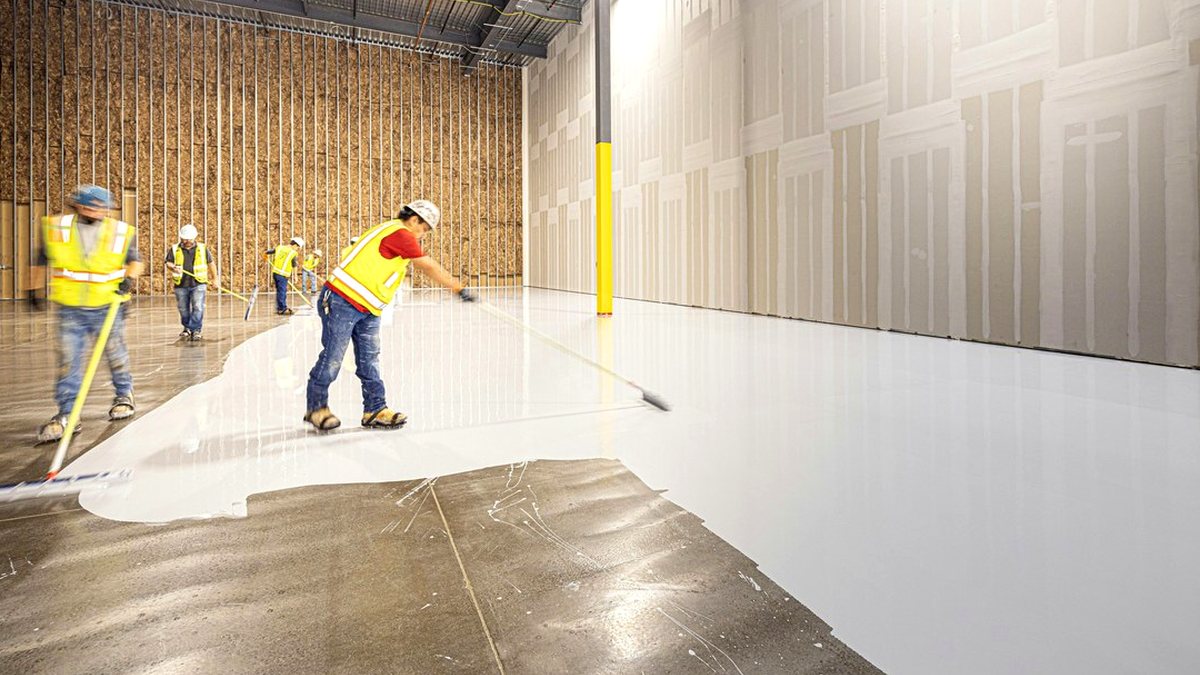
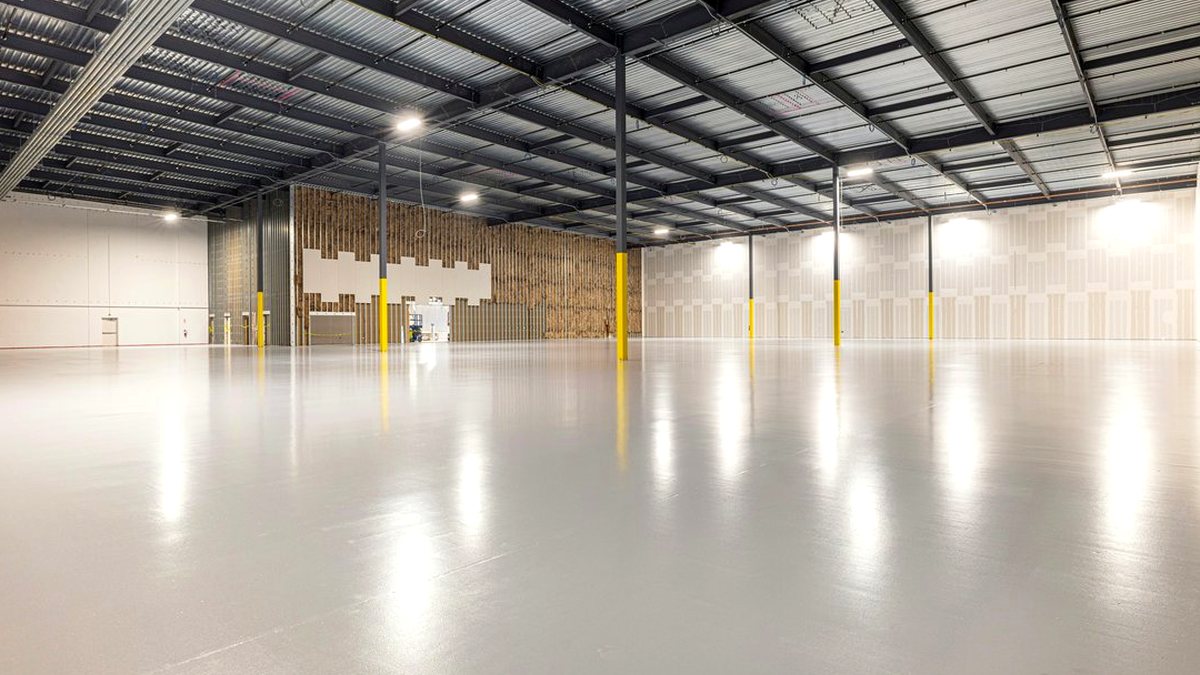
In recent years epoxy flooring has moved from a premium option to a basic standard in factories, warehouses, garages and hospitals across Egypt and the Gulf. It gives a seamless, easy-to-clean surface that resists wear and chemicals, hides concrete defects and stops dusting. But a floor’s success does not depend on the material alone: most cases of peeling and blistering come from poor preparation or excess moisture in the concrete. This guide reviews three roller-applied epoxy systems from their official datasheets, Sikafloor®-264, Rayston floor 1175 and Kemfloor E43, and explains the correct application steps.
Key points
- Concrete 28 days old, at least 25 N/mm² compressive strength and moisture below 4%.
- Grind or shot-blast to remove weak laitance before priming.
- Typical system: primer at 0.15–0.25 kg/m², then two coats of 0.2–0.3 kg/m² each.
- Never bridge expansion joints; fill them with a flexible sealant.
What is epoxy flooring?
Epoxy is a two-component resin: a resin (A) and a hardener (B). Mixed at the specified ratio they react chemically to form a hard, glossy layer strongly bonded to concrete. Systems vary by thickness: roller coats at low thickness, broadcast systems with sand for slip resistance, or self-levelling systems at higher thickness. The three products in this article are roller-coat systems that can be made slip-resistant by adding aggregate.
Where is epoxy flooring used?
- Storage and assembly halls, maintenance workshops, garages and loading ramps (Sikafloor-264 datasheet).
- Seal coat for broadcast systems in multi-storey car parks.
- Areas requiring hygienic properties, car production and maintenance areas, and medium-traffic warehouses (Rayston floor 1175 datasheet).
- Wet industrial floors needing an anti-slip finish.
Sikafloor-264 also holds an ISO 14644-1 Class 4 particle-emission certificate, making it suitable for cleanrooms, and complies with EN 13813 and EN 1504-2.
Advantages of epoxy flooring over tiles
- Seamless surface: no grout lines to trap dirt and bacteria, important in food and pharmaceutical plants.
- High wear and compressive resistance: the compressive values below (49 to 65 N/mm²) are well above the 25 N/mm² minimum required of the concrete base.
- Fast installation: floors can return to service within days compared with tiling.
- Colours and line marking: help organise traffic and improve light reflection.
Technical properties
| Property | Sikafloor-264 | Rayston floor 1175 | Kemfloor E43 |
|---|---|---|---|
| Compressive strength | ~53 N/mm² (EN 196-1); ~49 N/mm² (ASTM C579) | 65 N/mm² (ASTM C579) | 55–57 N/mm² |
| Tensile strength | 21 N/mm² | 15 N/mm² (ASTM C307) | — |
| Bond strength | >1.6 N/mm² | 2.5 N/mm² (concrete failure) | >2 N/mm² (concrete failure) |
| Shore D hardness | ~76 | 75 (ASTM D2240) | 80–82 |
| Mix ratio | — | A:B = 9:1 | Pre-weighed packs |
| Pot life | — | 30 min at 25 °C | — |
| Full cure | 7 days | 7 days | 7 days |
| Pack | 15 kg | 20 kg | 20 kg |
Preparing concrete for epoxy flooring
- Concrete age: the Kemfloor E43 datasheet requires 28 days after casting.
- Strength: concrete compressive strength of at least 25 N/mm², and pull-off of at least 1.5 N/mm² for Sikafloor-264.
- Moisture: substrate moisture below 4%; ambient RH no more than 80% for Sikafloor-264 and 75% for Rayston 1175.
- Mechanical preparation: remove weak laitance by grinding or shot blasting, then vacuum all dust.
- Repairs: fill holes and honeycombing with a suitable epoxy mortar before priming.
Application steps
- Primer: Sikafloor-161 at 200–250 g/m² with Sikafloor-264, or Sealer E43 at 0.15–0.2 kg/m² with Kemfloor E43.
- Mixing: stir component A, add all of B and mix with a low-speed mixer until homogeneous, respecting pot life.
- First coat: roll at 200–300 g/m² for Sikafloor-264, or 0.2–0.25 kg/m² for Kemfloor E43.
- Slip resistance (optional): broadcast Kemfloor Aggregate at 1–2 kg/m² where needed.
- Second coat: same rate once the first is dry.
- Protection: foot traffic after about 24 hours at 20 °C for Sikafloor-264, light loads after 3 days for Rayston 1175, full cure after 7 days.
Total consumption
A two-coat roller system typically needs: primer 0.15–0.25 kg/m², then two coats of 0.2–0.3 kg/m² each. Consumption rises with surface roughness and porosity, and with anti-slip aggregate.
Application conditions
The Sikafloor-264 datasheet specifies air and substrate temperatures of 10–30 °C, with the substrate at least 3 °C above dew point to avoid condensation, which causes blooming and a tacky surface.
How to choose between the three systems
For cleanrooms or pharmaceutical facilities that need documented emission certificates, Sikafloor-264 with ISO 14644-1 is the clearest choice. Where the priority is maximum compressive strength and bond in car workshops and warehouses, Rayston floor 1175 at 65 N/mm² and 2.5 N/mm² performs strongly. Kemfloor E43 stands out with Shore D 80–82, a dedicated primer (Sealer E43) and matching anti-slip aggregate. The final decision depends on loads, expected chemicals and budget.
Maintenance and cleaning
Clean epoxy floors with scrubber-dryers and neutral detergents, avoiding sharp tools and dragging steel equipment across the surface. Gloss can be renewed with a fresh topcoat after preparing the old surface, without removing the whole system if it is still sound and bonded.
Common epoxy flooring mistakes
- Coating fresh or damp concrete: leads to blisters and delamination.
- Skipping grinding: weak laitance detaches and takes the coating with it.
- Bridging expansion joints: the Kemfloor E43 datasheet stresses never bridging joints; respect them and fill with a flexible sealant.
- Mixing more than can be used within pot life: material sets in the bucket.
- Applying in high humidity or near dew point: gives a dull, tacky surface.
- Opening to traffic too early: leaves permanent marks and shortens life.
Target Engineering: professional epoxy flooring
Target Engineering installs epoxy flooring for factories, warehouses, garages and healthcare facilities, starting with concrete moisture measurement and pull-off testing, through grinding and priming, to the final finish in the required colours and slip-resistance level. See our epoxy flooring works, epoxy coating systems and flooring pages, or contact us for a technical and financial proposal.
References: ASTM C579 for compressive strength of resin materials, and ASTM D2240 for durometer hardness.
FAQ
How long does epoxy flooring last?
Service life depends on traffic, loads, preparation and maintenance; the datasheets give no fixed figure, but correct installation on sound concrete is the key factor.
Can epoxy be applied over ceramic tiles?
The systems here are designed for concrete and cementitious screeds; other substrates need a specific study and suitable primer.
When can the floor be used?
Foot traffic after about 24 hours, light loads after 3 days, full service after 7 days under standard conditions.
Is epoxy slip-resistant?
A smooth epoxy finish is glossy and can be slippery when wet, so aggregate at 1–2 kg/m² is added in wet areas.
Epoxy flooring or polyurethane flooring?
Epoxy is harder with higher compressive strength and is mostly used indoors, while polyurethane systems offer more flexibility and, in some types, better colour stability. The choice depends on use, sun exposure and thermal shock.
Need a site inspection or a quotation? The Target Engineering team is ready to help.


[…] the aggregate size for each space. See our flooring and epoxy coating systems pages, read our epoxy flooring guide, or visit self-levelling polyurea […]