
Table of Contents
- Why swimming pool waterproofing differs from roof waterproofing
- Pool waterproofing systems
- Technical data for pool waterproofing materials
- Cementitious swimming pool waterproofing step by step
- Applying Paintchlore in painted pools
- Common swimming pool waterproofing mistakes
- Swimming pool waterproofing with Target Engineering
- FAQ about swimming pool waterproofing
A leaking pool does more than stain a ceiling: it means constant loss of treated water, corroding reinforcement and possibly damp in adjoining rooms. Swimming pool waterproofing therefore has to be designed as a complete system from day one, not just a coat of paint. Based on the datasheets, this article covers two main options: flexible cementitious waterproofing under tiles (Rayston 170 Elastic and MasterSeal 541) and aliphatic Paintchlore for painted pools.
Key points
- A pool needs waterproofing that withstands constant water pressure, chlorine and thermal movement of the concrete.
- Under tiles, the usual solution is a flexible cementitious slurry such as Rayston 170 Elastic in at least two coats.
- For painted pools without tiles, chlorine-resistant aliphatic Paintchlore is used.
- Paintchlore does not work against negative water pressure; an epoxy primer is needed in that case.
Why swimming pool waterproofing differs from roof waterproofing
A roof sees rain occasionally; a pool is full all year. The water presses on the waterproofing constantly, carries chlorine and treatment chemicals, and changes temperature between day and night. The material therefore needs three properties: resistance to hydrostatic pressure, flexibility to follow the concrete, and stability in chlorinated water.
Positive versus negative pressure
Positive pressure is the pool water pushing on the waterproofing from the inside; negative pressure is groundwater or water trapped in the walls pushing from behind. MasterSeal 541, for example, states 1.5 bar positive and 0.5 bar negative pressure, while the Paintchlore sheet warns against use where negative pressure can develop.
Pool waterproofing systems
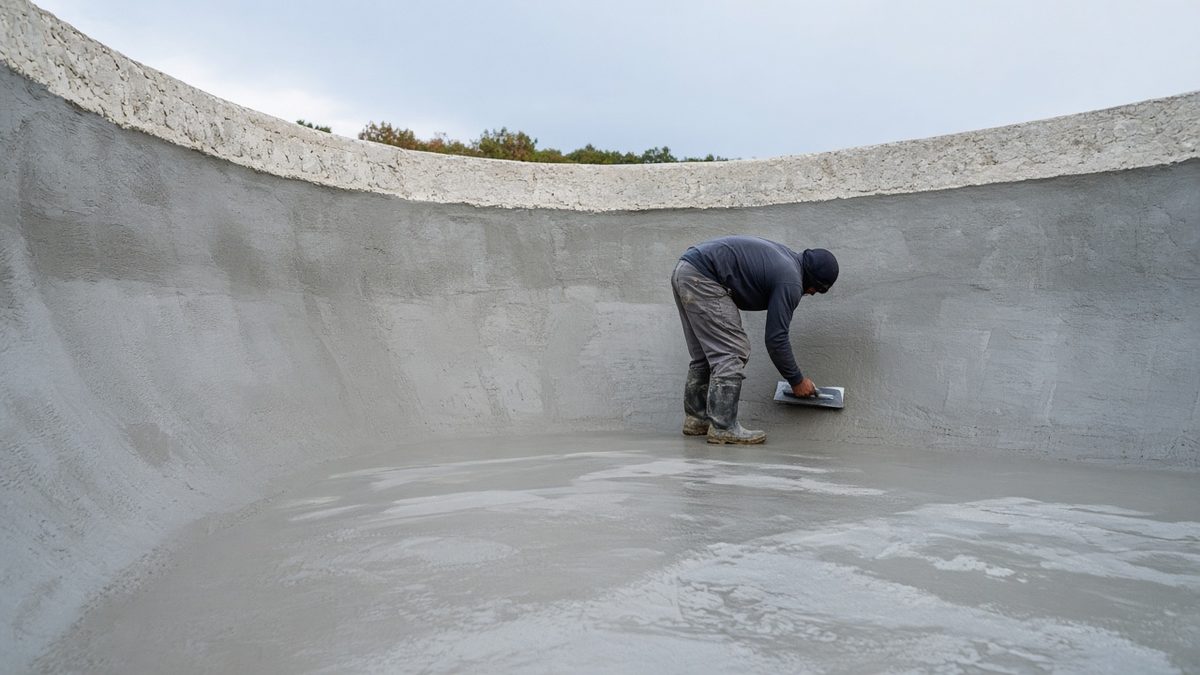
- Tiled or mosaic pool: flexible cementitious waterproofing on the concrete, then tiles bonded on top with a suitable adhesive.
- Painted pool without tiles: a Paintchlore finish on a prepared surface or over a polyurea membrane.
- Tanks, ponds and water-park structures: also listed among Paintchlore’s uses.
Where the pool sits above rooms or a car park, consider a more elastic system such as polyurea and polyurethanes.
Technical data for pool waterproofing materials
| Property | Rayston 170 Elastic | MasterSeal 541 | Paintchlore |
|---|---|---|---|
| Type | Flexible cementitious, 2-component | Cementitious, 2-component | 1K aliphatic polyurethane |
| Elongation | 65% | > 5% | 170% |
| Tensile / adhesion | Adhesion > 0.5 N/mm² after 28 days’ immersion | — | Tensile 27 MPa |
| Crack bridging | > 1.0 mm at 23°C | — | — |
| Water pressure | — | 1.5 bar positive / 0.5 bar negative | Not effective against negative pressure |
| Coverage | 1st coat 1–1.5 kg/m², 2nd 0.8–1 kg/m² | 0.8–1 kg/m² per coat, two coats | 300–500 g/m² per coat |
| Pack | 30 kg (7.5 liquid + 22.5 powder) | — | 4 / 20 kg |
A dash (—) means not stated in the datasheet. Paintchlore scores the top rating (5 of 5) after 5 days’ immersion in chlorinated water at 15 mg/l and 80°C; it has a hardness of 53D and does not yellow in sunlight.
Cementitious swimming pool waterproofing step by step
- Prepare the concrete: remove oil, dust, release agents and laitance, and repair honeycombing or spalled concrete with a repair mortar.
- Pre-wet: saturate the surface so it is damp with no standing water.
- Mix: pour the liquid into the bucket and add the powder gradually, mixing with a slow electric drill (below 500 rpm) for at least 3 minutes for Rayston 170 Elastic.
- First coat: by stiff plastic-bristle brush or spray, or a notched trowel for mortar consistency; let it harden for 2–6 hours.
- Second coat: at right angles to the first, never exceeding 4 kg/m² in one layer.
- Curing: protect from direct sun, wind and rain; curing is essential for every cement-based product.
- Fill test: fill the pool and monitor the water level before tiling.
- Tiling: bond the tiles with an adhesive compatible with the waterproofing, and seal joints around fittings carefully.
Applying Paintchlore in painted pools
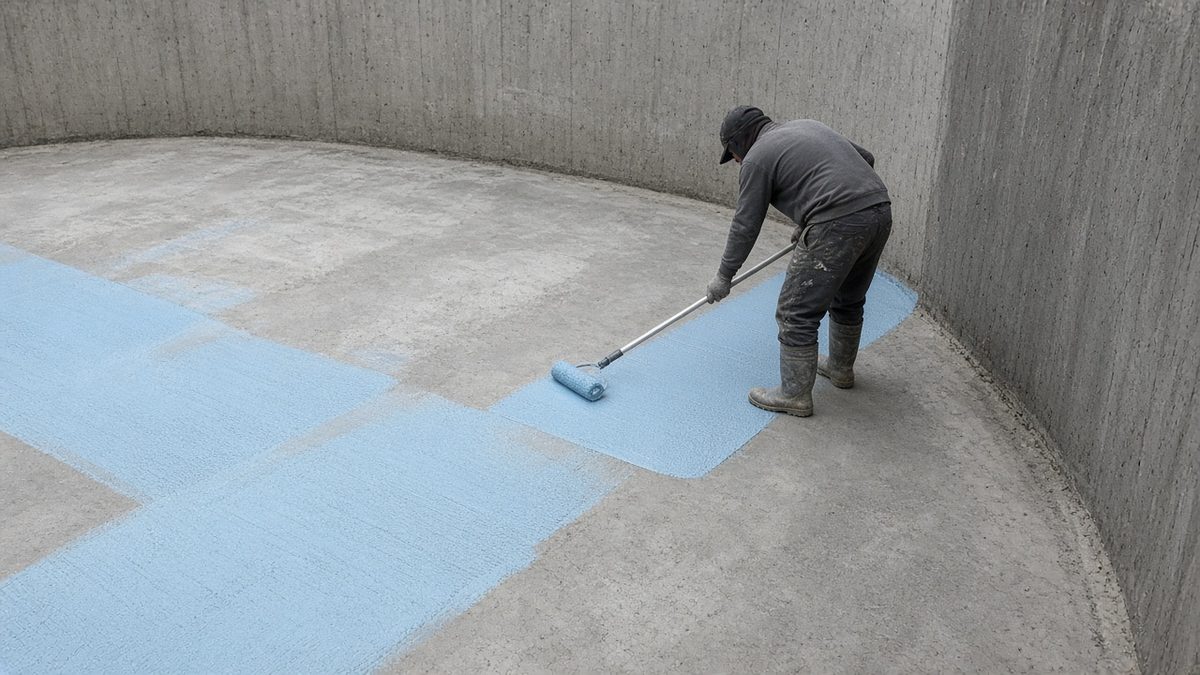
Stir Paintchlore with a low-speed mixer and thin by up to 10% with Rayston Solvent, but do not thin the first coat on non-porous surfaces. Apply by roller or brush; spraying the clear product is not recommended because of micro-bubbling.
- Floor: 2–3 coats for coverage.
- Walls: up to 7 thin coats to reach 1 mm, because the self-levelling product runs on vertical surfaces.
- Between coats: apply the next coat once the previous one is no longer sticky, within 24 hours at most.
- Conditions: substrate 10–30°C, air humidity below 80%, and no application in intense sunlight.
Approximate example: a pool with 100 m² of internal surface (floor and walls) needs about 30–50 kg per coat at 300–500 g/m². The total depends on the number of coats on walls and floor.
Common swimming pool waterproofing mistakes
- Painting Paintchlore on walls holding trapped water: negative pressure lifts the coating; seal with Primer H epoxy instead.
- Skipping curing: cementitious coats dry in summer sun before they set.
- Ignoring joints and penetrations: most pool leaks start at lights and outlets.
- Tiling before the fill test: makes finding and fixing leaks expensive.
- Over-thick cementitious layers: more than 4 kg/m² per layer for Rayston 170 Elastic.
Swimming pool waterproofing with Target Engineering
Target Engineering waterproofs pools and tanks with cementitious and polyurea systems, detailing lights and joints and running fill tests. Read our water tank waterproofing guide, and see our cementitious waterproofing service and other waterproofing works.
For reference, the WHO Guidelines for Safe Recreational Water Environments cover pool water quality and disinfection, and the Egyptian Organization for Standardization and Quality sets building-material standards in Egypt.
FAQ about swimming pool waterproofing
Aren’t tiles enough to stop leaks?
No. Tiles and grout are not a waterproof layer; water passes through to the concrete. The waterproofing must sit under the tiles.
Does chlorine damage waterproofing?
It depends on the material, so choose a product tested in chlorinated water, such as Paintchlore, or a cementitious layer protected by tiles.
When can the pool be filled after Paintchlore?
The datasheet gives 7–10 days for usual service and up to 15 days for final hardness.
Can an old pool be waterproofed without removing tiles?
It depends on the tiles and the leak. An aliphatic coating needs a sound, clean surface and does not cure water trapped behind tiles.
Need a site inspection or a quotation? The Target Engineering team is ready to help.

[…] Krypton warns against using a small fountain route on a large lake. For pools, see our swimming pool waterproofing […]