
Table of Contents
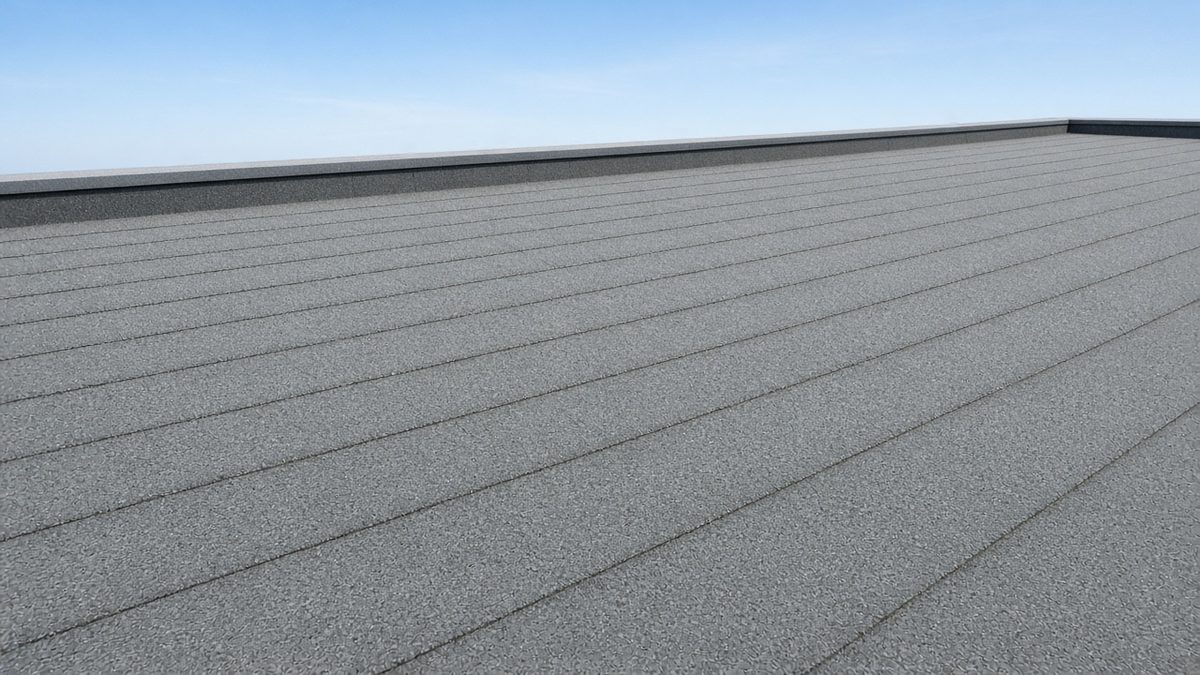
In a conventional sheet system the membrane is buried under sand, screed and tiles to protect it from the sun. On many roofs nobody walks on, such as warehouses, plant rooms and sloped roofs, those heavy layers can be skipped by using an exposed roof membrane with a mineral-slated top surface. This article reviews INSUTECH Mineral and INSUEXTRA P-E by INSUTECH and Hyperflex by Modern, with installation and maintenance tips.
Key points
- Mineral granules on the top face shield the bitumen from UV, so no screed or tiles are needed on top.
- INSUTECH Mineral passed a 2000-hour UV ageing test.
- Suited to non-accessible or low-traffic roofs, not a substitute for tiles on trafficked roofs.
- Side laps 8–10 cm and end laps 12–15 cm per the INSUTECH sheet.
What is an exposed roof membrane?
It is a polyester-reinforced modified bitumen sheet (APP or SBS) with a polyethylene burn-off film underneath and coloured mineral slates on top. The slates act as a shield against the UV radiation that cracks and ages bitumen. The INSUEXTRA P-E sheet states excellent UV resistance when the surface is finished with slates.
Exposed versus standard rolls
A roll with a PE-film or fine-sand top face is designed to be covered by a protection layer. A slated roll is the finished surface itself. That is why the Hyperflex sheet recommends a mineral-slated finish for exposed, non-accessible or low-traffic roofs. For sheet systems in general, see our bitumen membranes article.
Where an exposed roof membrane is used
- Non-accessible roofs, plant rooms and stair-core roofs.
- Sloped roofs and domes where tiling is impractical.
- Warehouses and industrial buildings that cannot take extra screed and tile loads.
- Re-roofing of existing roofs, as listed for INSUEXTRA P-E.
Exposed roof membrane technical data
| Property | INSUTECH Mineral N/4000 | INSUEXTRA P-E | Hyperflex P20 |
|---|---|---|---|
| Modifier | APP | APP | SBS |
| Thickness | 4 mm (±0.2) | 3 & 4 mm | 3 & 4 mm (PE finish) |
| Softening point | > 145°C | ≥ 150°C | — |
| Tensile L/T (N/5cm) | 700 / 550 | 1000 / 800 | 1000 / 750 |
| Elongation L/T | 46 / 46% | 45 / 50% | 50 / 55% |
| Low-temperature flexibility | +2°C | — | −20°C |
| High-temperature stability | ≥ 110°C | — | 100°C |
| Water absorption | 0.2% max | 0.1% | — |
| UV ageing | Passed 2000 h | Excellent when slated | Pass (EN 1296) |
| Granule loss | — | — | < 200 g/m² |
A dash (—) means not stated in the datasheet. Slated Hyperflex rolls come at 4, 4.5 and 5 kg/m² in grey, green, white and red.
How to install an exposed roof membrane
- Substrate: clean thoroughly, form proper falls to the drains and build cant strips at parapets.
- Primer: apply INSUPRIMER cold by brush, roller or spray at 0.2–0.3 l/m² depending on porosity, and let it dry.
- Layout: unroll each sheet in position to set its alignment before torching, starting at the lowest point of the roof.
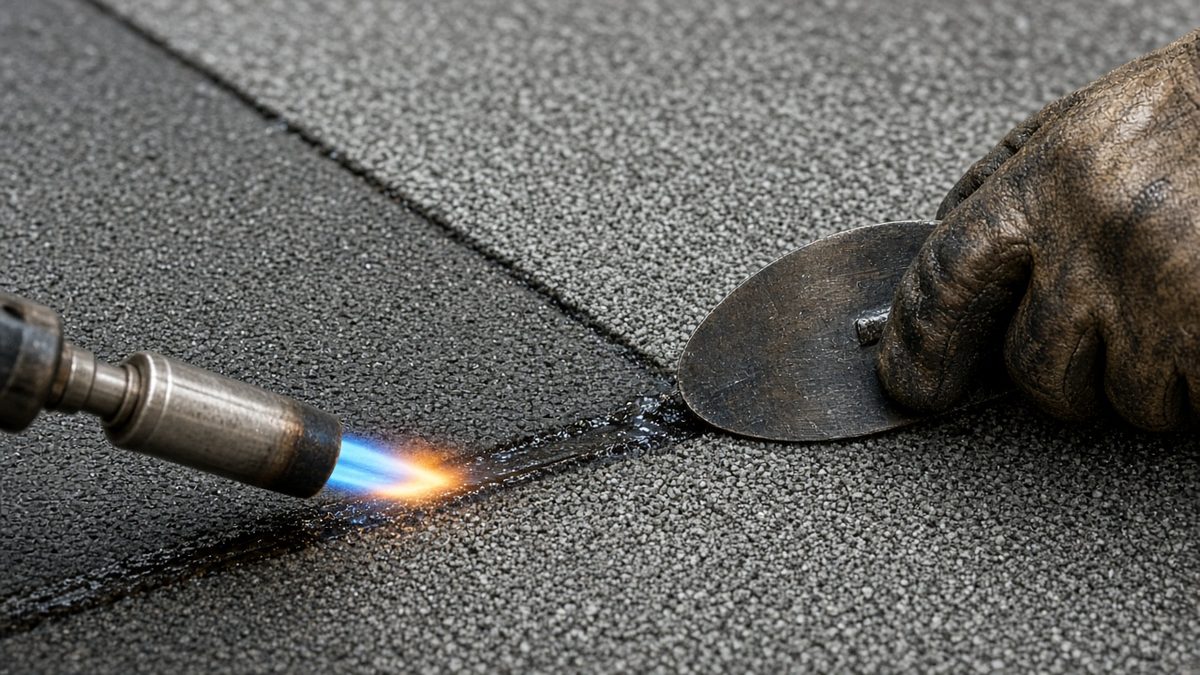
- Welding: torch the underside until the bitumen melts and bonds fully to the substrate.
- Side laps: 8–10 cm; the selvedge strip without slates allows direct bitumen-to-bitumen welding.
- End laps: 12–15 cm; heat the slates in the lap area and embed them into the bitumen with a trowel before welding the next roll on top.
- Finishing: sprinkle matching slates on any exposed bead of melted bitumen at the laps to protect it from sun.
Storage and sloped roofs
The INSUTECH sheet requires rolls to be stored upright in a dry place protected from sun and weather, on clean floors so the ends are not damaged. The Hyperflex sheet also warns against throwing rolls off the truck, as the impact can break the carrier or shed slates. On sloped roofs the flow test matters: INSUTECH Mineral shows less than 1 mm of slippage at a 90° slope and 90°C, meaning the bitumen does not readily run in summer heat. On steep slopes it is still wise to fix the top edge mechanically, which the sheet allows as an alternative installation method.
How many rolls are needed?
Each roll covers 10 m²; with 10 cm side laps and 15 cm end laps the effective coverage is about 8.9 m². A 100 m² roof therefore needs roughly 11–12 rolls, plus upstands and parapet cladding. Primer for the same area is about 20–30 litres at the INSUTECH rate. These are approximate figures confirmed after a site survey.
Common mistakes
- Using it on a regularly trafficked roof: foot traffic strips the slates and exposes the bitumen.
- Welding over slates at end laps: without embedding them, the bond is weak and the lap leaks.
- Ponding water: poor falls shorten the life of any system.
- Choosing a PE-faced roll for an exposed roof: it degrades quickly without protection.
- No inspections: check laps and penetrations after every summer.
Exposed roof membrane systems with Target Engineering
Target Engineering installs exposed mineral-slated systems on residential and industrial roofs, reviewing falls and details beforehand. See our bituminous sheets service and waterproofing and roofing page. If heat is the main concern, read about heat-insulating roof coating.
For reference: ASTM D6222 specifies polyester-reinforced APP-modified bituminous sheets, and the Egyptian Organization for Standardization and Quality grants the quality mark to compliant products.
FAQ about the exposed roof membrane
Can I walk on a slated roll?
For maintenance only. The datasheets recommend it for non-accessible or low-traffic roofs; walkways are a good idea.
Do light slates reduce roof heat?
Light colours absorb less heat than dark ones, but the sheets give no reflectance value. For a clear temperature drop, add a reflective coating or thermal insulation.
APP or SBS for an exposed roof?
APP rolls such as INSUTECH Mineral have a higher softening point; SBS rolls such as Hyperflex P20 stay flexible in cold and handle movement better.
Can it go over an old membrane?
Often yes, after inspecting the old layer and removing debonded areas. INSUEXTRA P-E lists re-roofing among its uses.
Need a site inspection or a quotation? The Target Engineering team is ready to help.

No comment