
Table of Contents
- What is rigid cementitious waterproofing?
- Where is rigid cementitious waterproofing used?
- Technical comparison
- Surface preparation
- How to apply rigid cementitious waterproofing
- Consumption
- Common mistakes with rigid cementitious waterproofing
- Target Engineering: supervised cementitious waterproofing
- FAQ about rigid cementitious waterproofing
Damp often starts where nobody looks: an underground tank wall, a balcony above a bedroom, or a basement wall against the soil. Here, rigid cementitious waterproofing bonded to the concrete remains one of the most practical solutions, because it tolerates damp substrates, withstands immersion and can be plastered or tiled over. This guide compares rigid and flexible systems, sets out the datasheet values of SikaTop® Seal-107, Rayston 170 and MasterSeal® 541, and covers application, consumption and common site mistakes.
Key points
- A two-component mortar (polymer liquid + cementitious powder), mixed with a slow drill and applied by stiff brush, trowel or spray.
- SikaTop Seal-107: 30–40 N/mm² compressive strength and about 2–3 N/mm² bond after 28 days.
- Rayston 170 resists water pressure up to 7 bar at 2 mm dry film (DIN 1048).
- At least two coats on a saturated surface with no standing water, followed by moist curing.
What is rigid cementitious waterproofing?
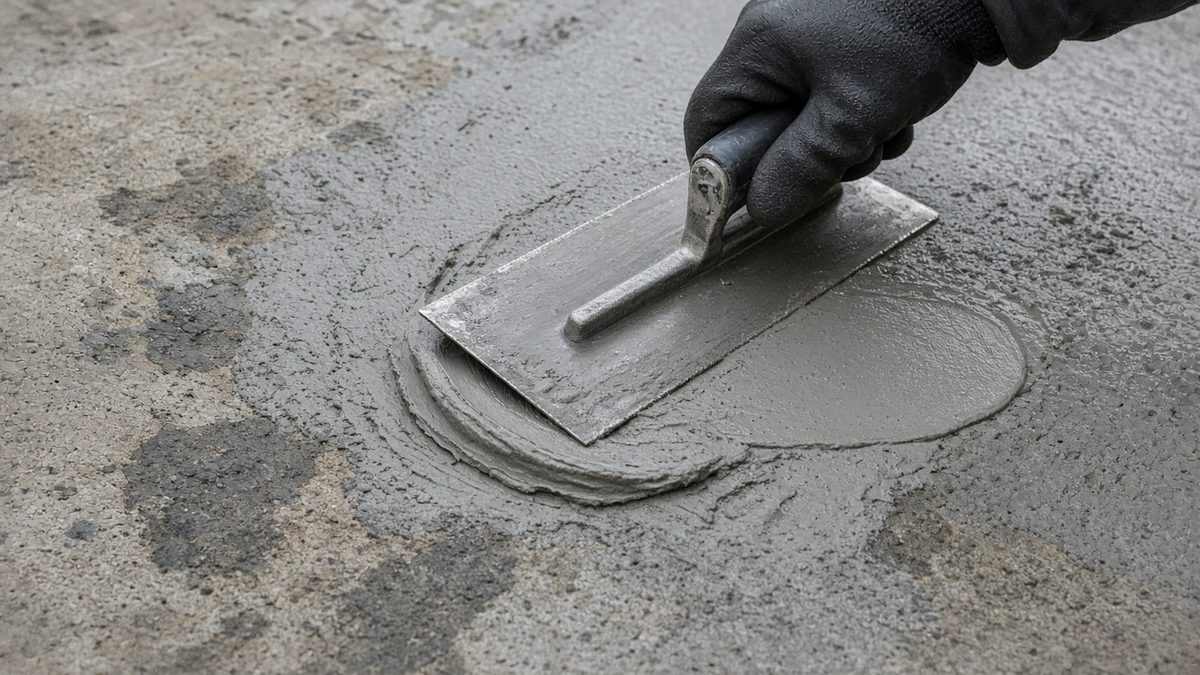
It is a two-component coating mixed on site: a polymer liquid (styrene acrylic or acrylic) and a powder of Portland cement, selected sand and admixtures. Once mixed, it forms a slurry or mortar that is spread over concrete, render or masonry, then hardens into a dense, low-permeability layer firmly bonded to the substrate.
SikaTop Seal-107 is described as “slightly flexible”, and Rayston 170 and MasterSeal 541 give an elongation just over 5%. They suit stable surfaces and static hairline cracks; areas that move need the flexible slurries covered in our article on bathroom waterproofing.
Where is rigid cementitious waterproofing used?
The three datasheets agree on these uses:
- Drinking-water tanks, ground and roof tanks, reservoirs and swimming pools.
- Water and sewage treatment plants, including tanks, digesters and clarifiers.
- Basements, retaining walls and foundations exposed to groundwater or brackish water.
- Terraces and balconies before finishes are laid.
Extra protection for the concrete
Besides keeping water out, rigid cementitious waterproofing protects concrete against carbonation and chlorides. Sika states that 80 microns of SikaTop Seal-107 is equivalent to 6 inches of concrete against carbonation, and Krypton states that 1 mm of Rayston 170 is equivalent to more than 80 cm of concrete. Rayston 170 and MasterSeal 541 can even go on 24-hour-old concrete.
Technical comparison
| Property | SikaTop Seal-107 | Rayston 170 | MasterSeal 541 |
|---|---|---|---|
| Composition | Styrene acrylic liquid + Portland cement and aggregate | Two-component acrylic-modified cement | Cement and silica sand + acrylic copolymer liquid |
| Density | 2.0 kg/l (mixed) | 1800 kg/m³ | 1800 kg/m³ |
| Water pressure | — | 7 bar, no leakage (2 mm, DIN 1048) | Positive 1.5 bar / negative 0.5 bar |
| Compressive strength | 30–40 N/mm² at 28 days (ASTM C579) | — | — |
| Flexural strength | 10–12 N/mm² (ASTM C580) | — | — |
| Bond strength | Approx. 2–3 N/mm² at 28 days | — | — |
| Elongation | “Slightly flexible” | > 5% (unbonded) | > 5% (ASTM C307) |
| Mixing ratio | 1:4 by weight (slurry), 1:4.5 (mortar) | Pre-measured (or 1 liquid : 3 powder by weight) | Pre-measured (or 1 liquid : 3 powder by weight) |
| Pack | 25 kg (A+B) | 25 kg (20 powder + 5 liquid) | 20 kg (15 powder + 5 liquid) |
| Potable water approval | Egyptian National Organization for Water and Sewage | National Organisation for Potable Water and Sanitary Drainage | National Organization for Potable Water and Sanitary Drainage |
A dash (—) means the value is not stated in that datasheet.
Surface preparation
- Remove oil, grease, dust, curing compounds and release agents; take off weak laitance by light sweep blasting or hydro-jetting.
- Cut back spalled concrete to a sound base and rebuild it with a suitable cementitious repair mortar.
- Saturate the substrate with clean water, then apply while it is still damp but free of standing water.
How to apply rigid cementitious waterproofing
- Mixing: add the powder slowly to the liquid and mix with a slow-speed drill and paddle until homogeneous. Never mix more than can be used within one hour; SikaTop Seal-107 has a pot life of about 35 minutes at 20°C.
- Consistency: for a trowel-grade mortar, use only 90% of the liquid in SikaTop Seal-107; for Rayston 170 and MasterSeal 541, reduce the gauging liquid to fill 6–10 mm honeycombs and depressions.
- First coat: apply with a stiff plastic-bristle brush, broom or roller, or with a notched trowel for mortar consistency. Spraying is recommended on large areas.
- Waiting time: about 12 hours at 10°C, 6 hours at 20°C and 3 hours at 30°C for SikaTop Seal-107; at least overnight for MasterSeal 541, dampening the first coat before the second.
- Second coat: apply at right angles to the first, then finish by rubbing down with a soft, dry sponge.
- Curing: protect from direct sun, wind and rain with polythene sheeting or similar. In tanks and pools, start curing immediately and continue for at least 3 to 5 days.
On balconies, Sika recommends embedding an alkali-resistant fibreglass mesh in the wet coat over static cracks and wall-to-slab junctions.
Consumption
- SikaTop Seal-107: first coat 1–1.5 kg/m² on a damp surface, second coat about 0.8–1 kg/m², for a total thickness of 1.0–1.5 mm. Never more than 4 kg/m² in one layer.
- Rayston 170: about 1.8 kg/m² per 1 mm. Under continuous water pressure the sheet gives 4 kg/m² for 3 bar and 6 kg/m² for 7 bar.
- MasterSeal 541: 0.8–1 kg/m² per coat, normally two coats.
Worked example (approximate): a 20 m² balcony in two coats of SikaTop Seal-107 needs about 1.8–2.5 kg/m², or roughly 36–50 kg, which is two 25 kg packs. Actual quantities are confirmed after a site inspection.
Common mistakes with rigid cementitious waterproofing
- Adding water: the SikaTop Seal-107 sheet forbids it, and the Rayston and MasterSeal sheets forbid re-tempering with water.
- Applying on dry concrete: a dry substrate draws water out of the mix, leaving a weak, cracked coat.
- One thick coat: instead of two crossed coats, often exceeding the maximum layer thickness.
- Skipping curing: summer sun and wind dry the coat before the cement hydrates.
- Filling tanks too early: Sika requires at least two days of air curing before immersion.
- Leaving it exposed to traffic: SikaTop Seal-107 is not a wearing surface and needs a protective screed.
Target Engineering: supervised cementitious waterproofing
Target Engineering carries out rigid cementitious waterproofing for ground and roof tanks, basements and balconies, from preparation and concrete repair to curing and fill testing. See our cementitious waterproofing service page, read our guides to water tank waterproofing and crystalline waterproofing, or browse our waterproofing works.
For reference: the Egyptian Organization for Standardization and Quality issues Egyptian standards for building materials, and ASTM C579 describes the compressive strength test quoted in the SikaTop Seal-107 datasheet.
FAQ about rigid cementitious waterproofing
What is the difference between rigid and flexible cementitious coatings?
Rigid cementitious waterproofing such as SikaTop Seal-107 or Rayston 170 has limited flexibility and suits stable surfaces and tanks. Flexible slurries such as SikaTop Seal-107 Elastic bridge moving cracks and are preferred in bathrooms.
Can it be used in drinking-water tanks?
Yes. According to their datasheets, all three products are approved by the Egyptian potable water authority for drinking-water contact.
Can I plaster or tile over it?
Yes. Sika recommends broadcasting rough sand onto the last coat when plaster will follow, and allowing 7 days before over-coating.
Does it resist water from the negative side?
MasterSeal 541 states 0.5 bar negative pressure. In basements with high groundwater the system is designed for the actual water level and may be combined with crystalline waterproofing.
Need a site inspection or a quotation? The Target Engineering team is ready to help.

[…] Downtown and the Iconic Tower in New Alamein. For tanks, balconies and other wet areas, see our rigid cementitious waterproofing service. Contact Target to review your coastal structure and its exposure […]
[…] carries out rigid cementitious waterproofing and related infrastructure work across Egypt. Browse our infrastructure waterproofing projects, or […]