
Table of Contents
- What is a hot-sprayed polyurethane membrane?
- Where a spray polyurethane membrane is used
- Spray polyurethane membrane technical data
- How to apply a spray polyurethane membrane
- Coverage and return to service
- Common spray polyurethane membrane mistakes
- Spray polyurethane with Target Engineering
- FAQ about the spray polyurethane membrane
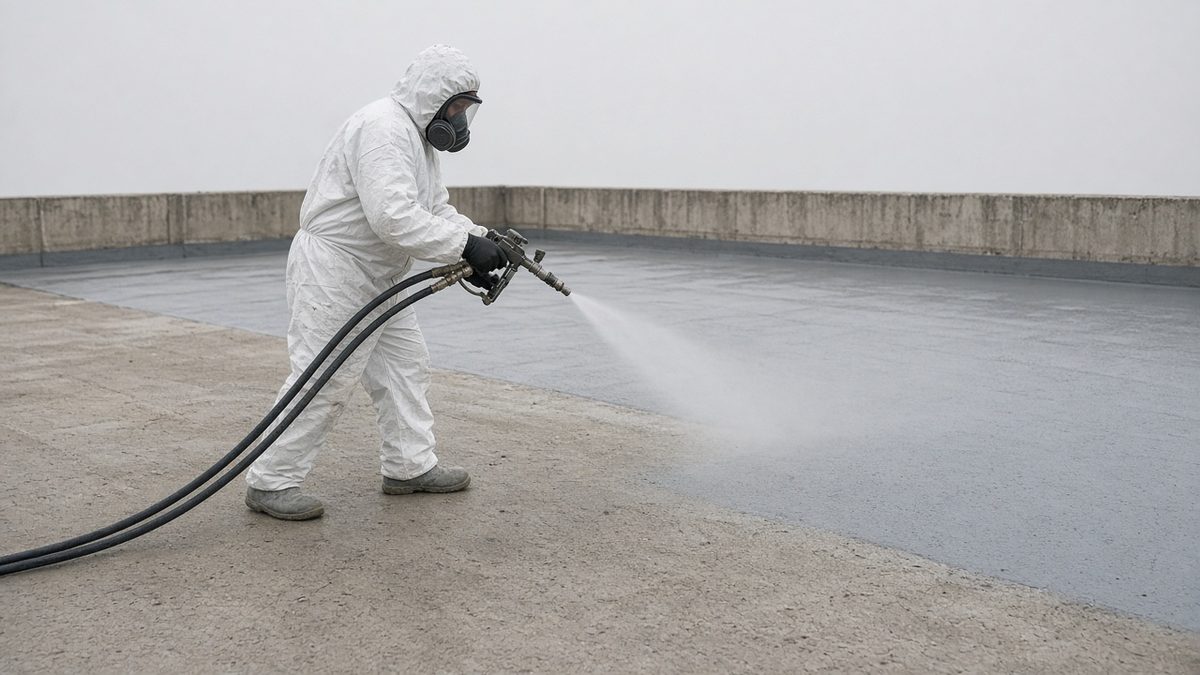
On large roofs, tanks and car-park decks, time is decisive; every day of downtime costs money. This is where a hot-applied spray polyurethane membrane stands out: two components leave the spray gun mixed and cure within seconds into a continuous, seamless rubbery layer that resists rain after a quarter of an hour. This article covers the datasheets of Impermax 2K and Impermax 2K Flex VR by KRYPTON and the correct application method.
Key points
- A two-component polyurethane sprayed hot with dedicated equipment that turns into a rubbery membrane within seconds.
- Impermax 2K: 88A hardness, 16-second gel time at 25°C, rain-resistant after 15 minutes, light traffic after 1 hour.
- Coverage is 1.8–2.0 kg/m² for a minimum thickness of 1.9 mm.
- The material is aromatic and changes colour in sun; an aliphatic topcoat adds UV protection.
What is a hot-sprayed polyurethane membrane?
It is a two-component polyurethane resin: component A (polyol/polyamide) and component B (an aromatic isocyanate prepolymer). Both are heated in plural-component spray equipment and pumped at high pressure to a gun that mixes them at the moment of spraying. Because the reaction is so fast, the material cannot be applied by roller or brush, only by machine.
How it differs from roller-applied polyurethane
One-component polyurethane is rolled on and needs hours between coats; a sprayed system usually reaches full thickness in a single pass and returns the roof to service quickly. Hot and cold systems are covered on our hot and cold applied liquid polyurethanes page.
Where a spray polyurethane membrane is used
- Concrete roofs and terraces.
- Water tanks; Impermax 2K passed a migration test for drinking-water contact.
- Car-park deck systems for light traffic (the Impermax Park system).
- Green roofs, with root penetration resistance certified to EN 13948.
- With Impermax 2K Flex VR: ponds, tunnels, canals, landfills and prepared metal roofs.
Spray polyurethane membrane technical data
| Property | Impermax 2K | Impermax 2K Flex VR |
|---|---|---|
| Hardness (Shore A) | 88A | 85A |
| Elongation / tensile | — | 500% / 14.5 MPa |
| Tear strength | 43 N/mm | 74 N/mm |
| Adhesion | Concrete 4.0 (epoxy primer), steel 4.7 (PU Primer), plywood 1.5 MPa | Metal 3.1 MPa |
| Mix ratio by weight | A=1 : B=1.12 | A=100 : B=75 |
| Component temperature | A 60°C / B 70°C | A 75°C / B 70°C |
| Spray pressure | 140 bar | — |
| Coverage | 1.8–2.0 kg/m² (≥ 1.9 mm) | — |
| Vapour permeability | µ = 2000 | — |
| Thermal resistance | Degradation begins at 180°C | — |
A dash (—) means not stated; the Impermax 2K sheet gives no elongation or tensile values. The product holds European Technical Assessment ETA 10/0296 and a BROOF t1 external fire rating.
How to apply a spray polyurethane membrane
- Mechanical preparation: abrade concrete by high-pressure sanding or grinding to open the pores, remove sharp irregularities with a disc grinder, then brush or vacuum.
- Check the substrate: cohesive (pull-off of at least 1.4 N/mm²), moisture below 4% and temperature between 10 and 40°C.
- Primer: epoxy primer on concrete, fully cured (about 8 hours) before spraying; on metal, thorough sanding plus PU Primer.
- Machine set-up: stir each component separately, add the pigment paste to component A, and recirculate both while heating to application temperature.
- Spraying: at 140 bar, constantly checking thickness and cure speed, in crossing passes for an even build.
- Second coat if needed: spray it immediately, and no later than 2 hours after the first.
- Protection: an aliphatic topcoat such as Colodur or Impertrans on exposed roofs and wherever colour stability matters.
The sheet warns against spraying in winds above 25 km/h, which strip reaction heat, disturb mixing at the gun and cause overspray.
Coverage and return to service
At 1.8–2.0 kg/m², a 500 m² roof needs 900–1,000 kg of material. One full kit (188 kg of A plus 208 kg of B, i.e. 396 kg) covers roughly 200–220 m². This is an approximate calculation before waste and details.
- Rain resistance: after 15 minutes at 25°C.
- Light foot traffic: after 1 hour.
- 90% of final properties: after 2 days; hardness reaches 87 Shore A after 7 days.
Routine maintenance
The Impermax 2K sheet sets out regular maintenance according to use: removing leaves, grass and dirt, keeping the drainage working with gratings in place, checking flashings, seams and upstands, and looking for damage from misuse. Worn topcoats should be reapplied. Stains can be treated with Rayston solvent or isopropyl alcohol, while strong acids must be avoided entirely.
Common spray polyurethane membrane mistakes
- Spraying a damp or porous surface without primer: causes bubbles and pinholes.
- Spraying over uncured epoxy primer: wait about 8 hours.
- Wrong ratio or temperature: the membrane will not cure properly.
- Delaying the second coat: more than 2 hours weakens intercoat adhesion.
- Spraying in wind: surface quality suffers and material drifts.
- Cleaning the machine with solvents: the sheet recommends a cleaning fluid such as Rayston Fluid.
Spray polyurethane with Target Engineering
Target Engineering has crews trained on hot plural-component spray rigs to waterproof roofs, tanks and decks quickly and at an even thickness. See our polyurea and polyurethanes page, and read our guides to water tank waterproofing and liquid roof waterproofing. If you also need thermal insulation, see spray foam roof insulation.
Useful references: the European Organisation for Technical Assessment (EOTA) issues assessments such as ETA 10/0296, and ASTM D4541 sets out pull-off adhesion testing for coatings.
FAQ about the spray polyurethane membrane
Sprayed polyurethane or polyurea?
Both are hot-sprayed with similar equipment, but the chemistry of component A differs. The choice depends on the elasticity, speed and use required.
Is it suitable for drinking-water tanks?
Impermax 2K passed a drinking-water contact migration test according to the Applus certificate listed in the datasheet.
Does it need a topcoat?
Per the sheet, colour change does not affect mechanical properties, but a topcoat adds UV protection and a stable appearance.
Can it be sprayed on metal?
Yes, after thorough sanding and PU Primer; Impermax 2K gives 4.7 MPa adhesion to steel.
Need a site inspection or a quotation? The Target Engineering team is ready to help.

No comment