
A smooth epoxy or polyurethane floor looks perfect on opening day, but it can turn dangerous as soon as water or oil lands on it. In factories, central kitchens, car parks and ramps, anti-slip flooring is a basic safety requirement, not an extra. This article explains how texture is built into resin floors by broadcasting aggregate, based on the datasheets of Sika Aggregate-501 and 506, Polyurea H SL, Colodur and Impertop Fast 2K.
Key points
- Slip resistance in resin floors comes from aggregate or quartz sand broadcast into the wet layer and locked in with a sealer.
- Bigger aggregate means coarser texture: Sika Aggregate-501 is graded 0.1–1.2 mm and Aggregate-506 up to 2.5 mm.
- With Polyurea H SL, sand must be broadcast within 4–10 minutes of spraying.
- Colodur with 0.4–0.9 mm quartz reaches slip class 3 to UNE EN 12633.
How anti-slip flooring works
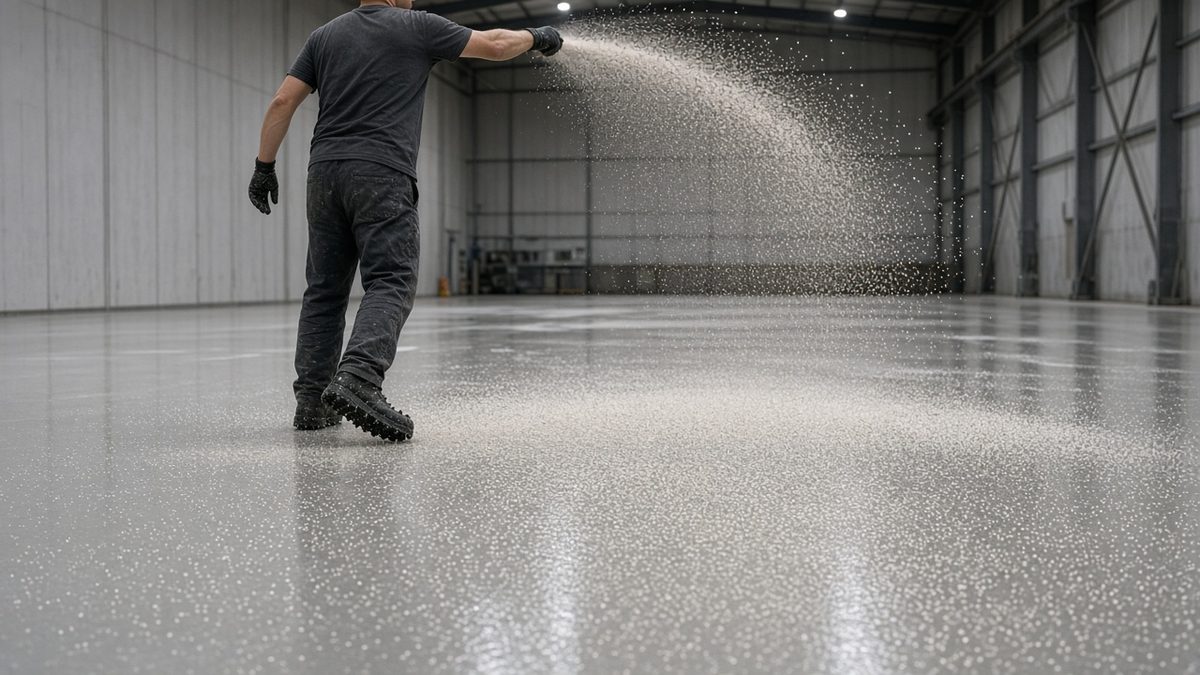
The principle is simple: dry, graded aggregate is broadcast onto the resin while it is still wet, so the grains sink in partly and lock in place. After curing, the loose excess is removed and a sealer coat encapsulates the grains while keeping their profile, which gives feet and tyres grip. The Sika Aggregate-501 sheet describes scattering the aggregate liberally at a uniform rate over the base coat to give a heavy-duty, non-skid surface once sealed.
Grain size sets the texture
Fine grains give an easy-to-clean surface suited to corridors and kitchens; coarse grains give more grip for ramps and oily areas. The trade-off is harder cleaning and higher sealer consumption.
Where anti-slip flooring is needed
- Food and beverage plants and central kitchens.
- Car parks, ramps and loading bays.
- Pedestrian routes in warehouses and wash-down areas.
- Pool surrounds and trafficked roofs waterproofed with polyurethane.
- Plant rooms and areas prone to oil spills.
Chemical resistance matters too
In factories a floor must not only be rough but also withstand whatever is spilled on it. The Polyurea H SL sheet rates 24-hour surface contact from 0 to 5: it scores 5 with water, sodium hydroxide up to 50% and 10% sulphuric acid, 3 with isopropyl alcohol and 0 with xylene. Check the chemical resistance table for the whole system, sealer included, before specifying it for an industrial floor.
Aggregates and broadcast systems compared
| Product / system | Grain size | Quantity or note | Source |
|---|---|---|---|
| Sika Aggregate-501 | 0.1–1.2 mm | Bulk density 1.5 kg/l, 20 kg bags, heavy-duty surface | Sika sheet |
| Sika Aggregate-506 | 0.1–2.5 mm | Bulk density 1.6 kg/l, 20 kg bags, coarse texture | Sika sheet |
| Polyurea H SL at 700 g/m² | 0.1–0.3 mm | 2 kg/m² to saturation | KRYPTON sheet |
| Polyurea H SL above 1 kg/m² | 0.4–0.9 mm | 3 kg/m² to saturation | KRYPTON sheet |
| Colodur topcoat | Quartz 0.4–0.9 mm | Slip class 3 (UNE EN 12633) | KRYPTON sheet |
| Impertop Fast 2K | Quartz sand or bauxite | Broadcast between two coats within pot life | KRYPTON sheet |
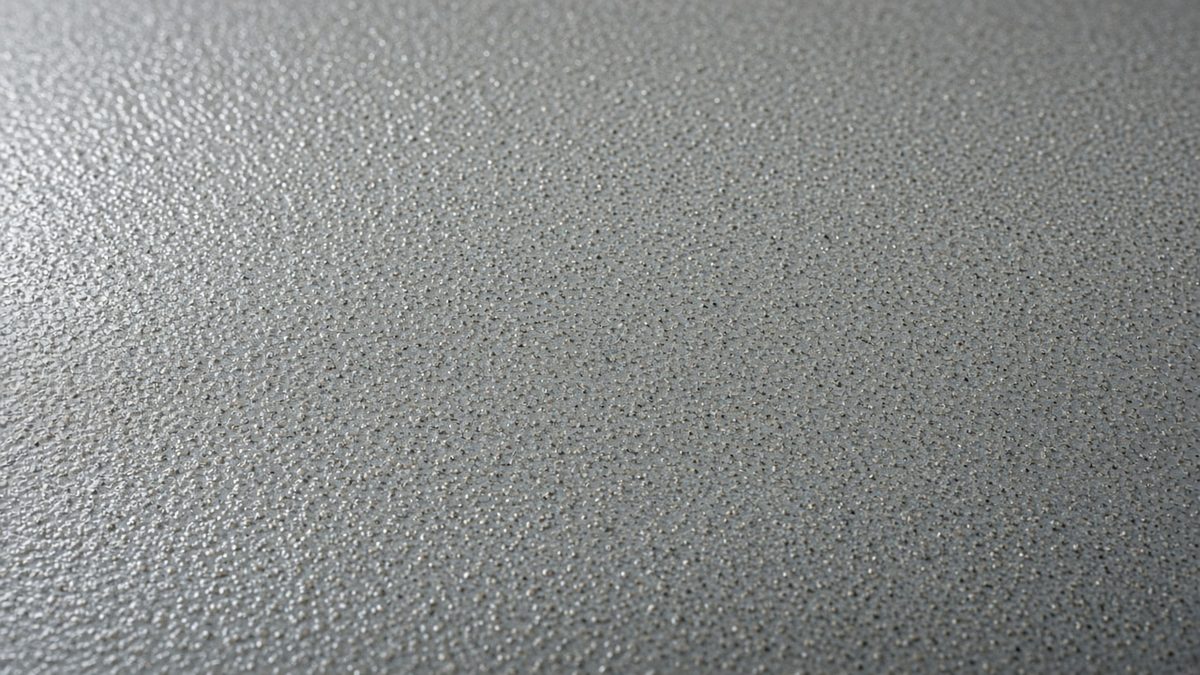
Polyurea H SL has a hardness of 95A/55D, Taber abrasion of 40 mg and adhesion of 5.6 MPa to concrete with EP 100 primer. Sika specifies its aggregates over a Sikafloor-264 base coat followed by a sealer.
How to install anti-slip flooring
- Mechanical preparation: shot-blast or diamond-grind to open the pores, then vacuum. The Polyurea H SL sheet requires a pull-off strength of at least 1.4 N/mm².
- Primer and repairs: apply the correct primer and fill defects until the surface is even.
- Base coat: lay the resin (an epoxy such as Sikafloor-264, or polyurea sprayed with hot plural-component equipment at 50°C and 140–150 bar).
- Broadcast: throw dry aggregate by hand from a sensible height until the surface is fully covered (to saturation). With polyurea, wait about a minute for the viscosity to rise and broadcast within 4–10 minutes of spraying.
- Remove excess: once cured, sweep and vacuum the loose aggregate.
- Seal coat: roll or squeegee a sealer to encapsulate the grains, using an aliphatic topcoat where the floor is exposed to sun.
Sand-broadcast Polyurea H SL is walkable after 2–4 hours and takes light pedestrian traffic after 2 hours at 25°C.
Approximate quantities
For Polyurea H SL at 700 g/m², each square metre needs 2 kg of 0.1–0.3 mm sand. A 500 m² floor therefore needs about 1,000 kg, roughly fifty 20 kg bags, before waste. At the heavier 3 kg/m² rate the figure rises to about 1,500 kg for the same area. These are approximate calculations, and part of the excess is recovered after sweeping.
Common anti-slip flooring mistakes
- Broadcasting too late: once the resin starts to cure, grains will not bond and will shed under traffic.
- Damp or dirty aggregate: Sika requires dry storage protected from moisture.
- Uneven broadcasting: leaves smooth and rough patches and a patchy look.
- Skipping the sealer: grains work loose and cleaning becomes difficult.
- Wrong texture for the room: very coarse grit in a kitchen makes daily cleaning a chore.
- Leaving aromatic polyurea in the sun: it discolours; finish with an aliphatic topcoat.
Anti-slip flooring with Target Engineering
Target Engineering installs anti-slip flooring with epoxy, polyurethane and polyurea systems, choosing the aggregate size for each space. See our flooring and epoxy coating systems pages, read our epoxy flooring guide, or visit self-levelling polyurea HSL.
For measurement, ASTM E303 covers slip resistance testing with the British pendulum tester, and the Egyptian Organization for Standardization and Quality issues building-material standards in Egypt.
FAQ about anti-slip flooring
Can an existing epoxy floor be made anti-slip?
Yes: abrade the surface, apply a new coat with broadcast aggregate, then seal it.
Is a textured floor hard to clean?
The coarser the texture, the harder the cleaning, so grain size should match the use rather than always being the maximum.
What works best on ramps?
Coarser aggregate, such as grading up to 2.5 mm, with a sealer that does not completely bury the grain profile.
Does the aggregate change colour over time?
The aggregate does not, but aromatic polyurea yellows in sun, so it is finished with an aliphatic topcoat.
Need a site inspection or a quotation? The Target Engineering team is ready to help.

[…] (DIN 51130). As a rule, Colodur goes on at 200–500 g/m². For more on finishes, see our guides to anti-slip flooring and the aliphatic […]
[…] In contrast, flat parking bays can often take a lighter texture that is easier to clean. Our anti-slip flooring page explains these options in more […]