
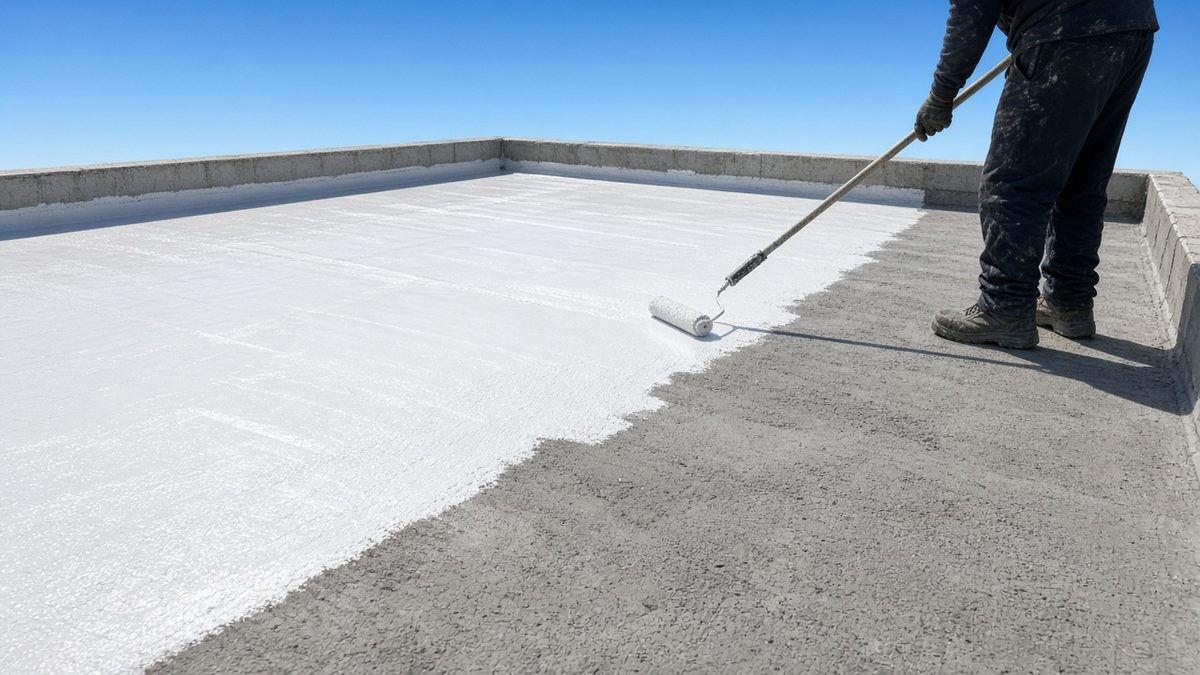
In an Egyptian or Gulf summer an exposed concrete roof becomes a constant heat source, and over time hairline cracks appear and leaks begin. An acrylic roof coating tackles both problems at once: a seamless white rubbery film that keeps water out and reflects much of the sun. This article is based on the datasheets of Sikalastic-560 by Sika and Acrimper by KRYPTON.
Key points
- A water-based acrylic applied cold by roller or spray, forming a seamless rubbery film.
- Sikalastic-560 has a Solar Reflectance Index (SRI) of 102 and an initial solar reflectance of 0.82.
- Coverage is 0.9–1.4 kg/m² as a coating and 2.1–2.8 kg/m² as a fleece-reinforced membrane.
- Not suitable for long-term ponding water or pedestrian traffic.
What is an acrylic roof coating?
It is a water-based acrylic dispersion that dries as the water evaporates, leaving a flexible rubbery layer. Sikalastic-560 is a one-component, polyurethane-modified acrylic that cures with Sika’s “CET” technology. Acrimper is an acrylic rubber dispersion that forms a rubber-like elastomer and also protects concrete against carbonation.
Because it is water-based, no solvents or heating are needed and tools are cleaned with water right after use. That makes it practical for occupied buildings and maintenance work.
Why the white colour matters
Solar reflectance is the share of sunlight a surface sends back instead of absorbing, and emittance is its ability to shed the heat it has absorbed. The SRI combines both: a standard black surface scores 0 and a standard white surface 100. The 102 stated for Sikalastic-560 is therefore a very high figure, and Sika states the product meets the Energy Star initial reflectance requirement. Bear in mind these are initial values; dust build-up lowers reflectance over time, so periodic washing helps.
Where it is used
- Waterproofing new and existing concrete roofs with one continuous layer.
- Extending the life of failing roofs with old bitumen felt, as listed by Sika.
- Reflective coating to reduce heat gain and improve energy efficiency.
- Protecting concrete against carbonation; Acrimper is CE-marked to EN 1504-2.
- Roofs with many details, since the liquid wraps pipes and openings without cutting or welding.
If heat reduction is your main goal, also read about heat-insulating roof coating and our acrylic thermal insulation coating service.
Acrylic roof coating technical data
| Property | Sikalastic-560 | Acrimper |
|---|---|---|
| Type | 1-component PU-modified acrylic | Acrylic rubber dispersion |
| Density | ~1.35 kg/l | 1.4 g/cm³ |
| Solids | 65% by weight / 48% by volume | 63% |
| Elongation, unreinforced | ~350% | 180% |
| Tensile strength, unreinforced | ~1.5 N/mm² | 2.3 MPa |
| Initial solar reflectance | 0.82 | — |
| Thermal emittance | 0.93 | — |
| Solar Reflectance Index | 102 | — |
| Service temperature | −5 to +80°C (intermittent) | — |
| Pack | — | 22.5 kg |
A dash (—) means the value is not stated in the datasheet. With Sikalastic Fleece-120 reinforcement, tensile strength rises to about 12 N/mm² and elongation falls to 40–60%.
How to apply an acrylic roof coating
- Cleaning: power-wash dust, moss and algae, squeegee off standing water and let the roof dry; concrete moisture must be below 4%.
- Repairs: treat cracks and joints and form mortar fillets at upstands and around drains.
- Mixing: mix Sikalastic-560 for one minute with a drill and paddle, avoiding over-mixing that entrains air.
- Primer: on concrete, use the product diluted with 10% water at about 0.3 kg/m²; with Acrimper, a first coat diluted up to 20% can prime porous surfaces.
- Details first: coat corners and penetrations with a thick hair brush before the field.
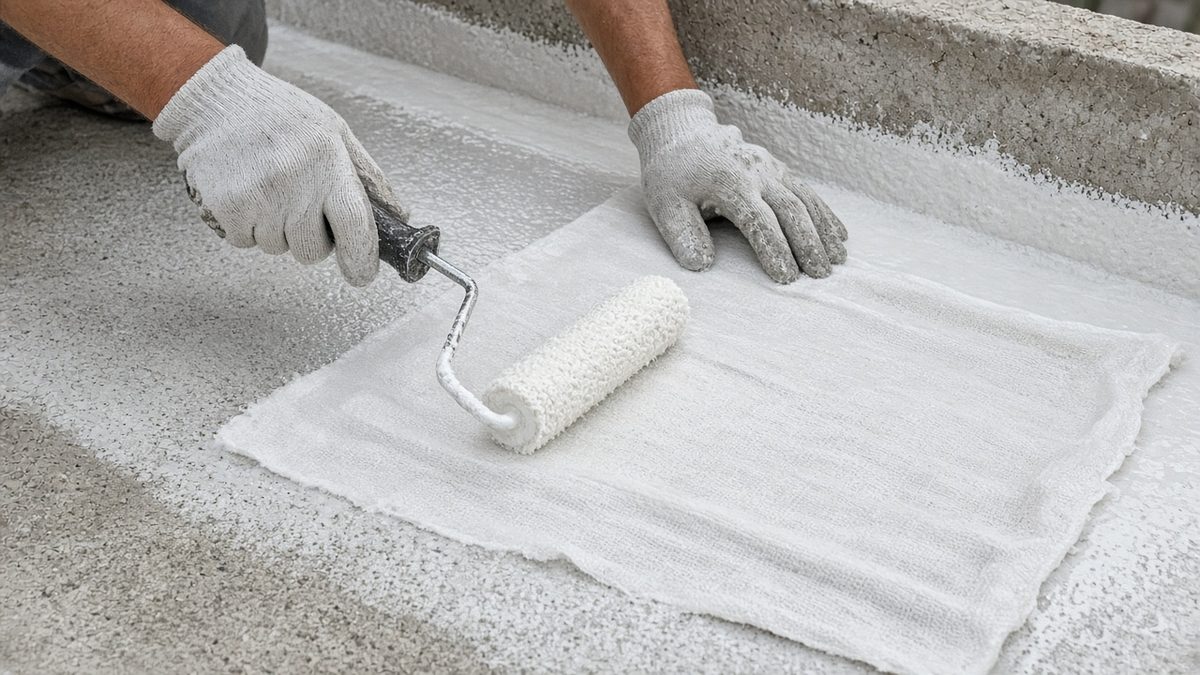
- Reinforcement: for waterproofing, roll a first coat of 0.75–1.00 kg/m² over about one metre, lay the fleece without creases with at least 5 cm overlap, and roll the second coat into it wet-in-wet.
- Top coats: once dry, add one or more coats of at least 0.5 kg/m² by short-pile roller, or by airless spray in at least two layers.
Conditions for the Sika product: air and substrate +8 to +35°C, relative humidity up to 80%, and substrate at least 3°C above dew point. For Acrimper the substrate should be between 5 and 40°C.
Coverage and drying times
- Sikalastic-560 coating: 0.9–1.4 kg/m² in total (about 0.3–0.5 mm).
- Sikalastic-560 reinforced waterproofing: 2.1–2.8 kg/m² in total (about 1.0–1.3 mm), with no more than 0.75 kg/m² per unreinforced coat.
- Acrimper: at least two coats of 1–1.2 kg/m² each for roughly 1 mm.
Approximate example: a 100 m² roof with the Sikalastic-560 coating system needs 90–140 kg, plus around 30 kg of diluted primer. Actual quantities depend on substrate porosity and waste.
Sikalastic-560 can be overcoated after about 6 hours at 20°C or 4 hours at 30°C and is rain-resistant after 1 hour. Acrimper cures in 6 hours at 20°C and returns to service after 24 hours.
Common mistakes
- Poor falls: Sika rules out roofs subject to long-term ponding water.
- One thick coat: more than 0.75 kg/m² per coat can crack while drying.
- Coating before rain or dew: a water-based film needs time to form.
- No fleece at moving cracks: dynamic cracks and joints must be reinforced.
- Using the roof as a walkway: the sheet does not recommend pedestrian traffic.
- Coating insulation boards directly: Sika requires a separation layer.
Acrylic roof coating with Target Engineering
Target Engineering installs reflective acrylic systems on residential and commercial roofs, from surface preparation to the flood test. See our liquid-applied membranes service, and compare acrylic with liquid polyurethane roof waterproofing before deciding.
Further reading: ASTM E1980 defines how the Solar Reflectance Index is calculated, and the Al Sa’fat Dubai Green Building System requires high-reflectance roof materials to limit the heat-island effect.
FAQ about acrylic roof coating
Is an acrylic coating enough on its own to stop leaks?
Yes, when applied as a fleece-reinforced system at the datasheet rate. A thin unreinforced coat acts mainly as a reflective, protective layer.
Can it go over old bitumen felt?
Yes. Sika lists life extension of failing roofs, with a dedicated primer where high reflectivity is needed.
Can I walk on the roof afterwards?
For maintenance only. Trafficked roofs need a dedicated system such as polyurethane with a topcoat.
How do I test it after application?
Sikalastic-560 may be flood-tested with 50 mm of water for a maximum of 48 hours.
Need a site inspection or a quotation? The Target Engineering team is ready to help.

No comment