
Table of Contents
- How does a heat insulating coating work?
- Two different types of heat insulating roof coating
- Technical properties
- Surface preparation for a heat insulating roof coating
- Heat insulating roof coating application steps
- Application conditions
- Where is a heat insulating roof coating used?
- How to choose a heat insulating roof coating
- Common heat insulating roof coating mistakes
- Target Engineering: applying heat insulating coatings
- FAQ
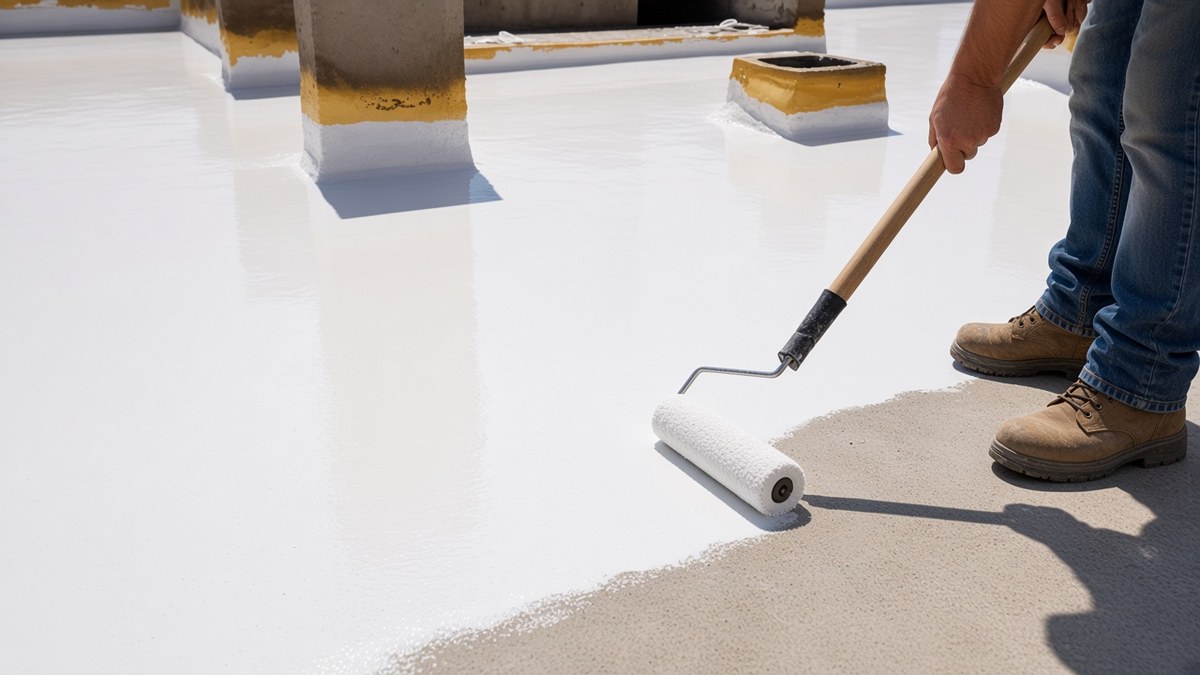
With temperatures in Egypt and the Gulf staying high for more than half the year, many owners look for a quick way to cool the top floor without demolition or extra load on the slab. A heat insulating roof coating is a practical option: a thin layer applied by roller or spray that reflects part of the solar radiation and reduces heat transfer. But not every white paint truly insulates, so this article presents two products with documented values in their datasheets, INSULATE + by KRYPTON and Kemroof PA Thermodry by Prokem, and explains when each fits and how to apply it.
Key points
- Works by reflecting sunlight and through the thermal resistance of the layer itself.
- INSULATE +: water-based acrylic with VOC of only 2 g/L, applied to at least 500 µm.
- Kemroof PA Thermodry: a polyaspartic that also waterproofs, compliant with ASTM C836.
- Thermodry pot life is only 20 minutes, so mix small batches.
How does a heat insulating coating work?
These coatings rely on two mechanisms. The first is reflection: a white, treated surface reflects much of the sunlight instead of absorbing it. The second is the thermal resistance of the layer itself. The INSULATE + datasheet states that it contains dry fibres and porous ceramic mineral particles forming non-conductive cells and low-pressure air voids, giving a low heat-transfer coefficient. Kemroof PA Thermodry contains nano- and micro-sized thermal insulating technology that blocks heat transfer, reflects thermal radiation and forms a moisture barrier.
Two different types of heat insulating roof coating
INSULATE +: water-based insulating acrylic
A one-component, water-based acrylic coating, non-flammable, with VOC of only 2 g/L. Besides thermal insulation, its datasheet cites acoustic insulation when applied with a rough texture, an anti-condensation effect and mould resistance. It is applied to plaster, concrete, iron and metals.
Kemroof PA Thermodry: insulating, waterproof polyaspartic
A 100%-solids, two-component polyaspartic coating, fast-curing and resistant to UV and weathering, acting as a flexible waterproofing membrane compliant with ASTM C836 as well as providing thermal benefits. It is used on concrete, metal and wood roofs, over tiles and old roofing membranes, and on balconies, patios and plaza decks.
Technical properties
| Property | INSULATE + | Kemroof PA Thermodry |
|---|---|---|
| Type | 1K water-based acrylic | 2K polyaspartic, 100% solids |
| Thermal conductivity | 0.194 W/m·K (600 µm, UNE-EN 12664) | 0.036 W/m·°C |
| Thickness / consumption | 500 µm minimum; 3 m²/kg theoretical | 0.25 kg/m² per 250 µm DFT |
| Number of coats | 3 by brush/roller; 1–2 by spray | 2–3 coats |
| Tensile strength | — | 14–15 N/mm² |
| Elongation | — | >90% |
| Adhesion | — | 2.5 N/mm² |
| Hardness | — | 70–75 Shore A |
| Water absorption | — | max. 1% after 21 days |
| Temperature flexibility | — | −40 to +140 °C |
| VOC | 2 g/L | — |
| Pack | 22.5 kg | 1 / 3 / 5 kg |
Surface preparation for a heat insulating roof coating
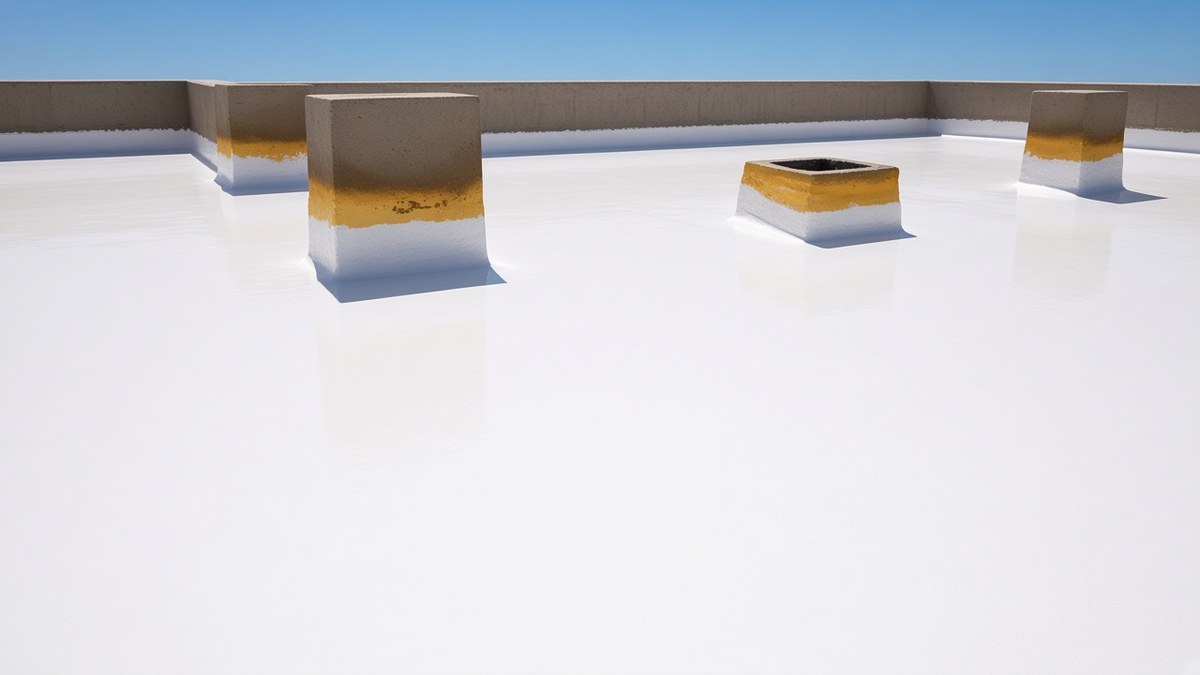
- INSULATE +: clean, dry substrate free of loose or powdery remains. Painted surfaces are washed to remove dirt and grease; glossy paints are lightly sanded.
- Kemroof PA Thermodry: clean, sound, dry substrate (max. 5% moisture); old loose roofing removed by grinding and irregularities smoothed. Prime with Sealer E43 on dry surfaces or Wetseal PA on wet surfaces, and Kemprim M or Kemprim AL on metal; allow to dry overnight.
Heat insulating roof coating application steps
INSULATE +
- Stir mechanically at low speed (400–600 rpm) from bottom to top.
- Thin with 5% water for brush, roller or spray.
- Apply three coats by brush or roller, or 1–2 by airless spray (120–140 kg/cm², nozzle 0.015–0.018), to reach at least 500 µm.
- Touch-dry in 2 hours, fully dry in 8 hours; minimum recoat interval 16 hours.
Kemroof PA Thermodry
- Premix each component, add B to A and mix with a low-speed mixer for 2 minutes. Pot life is only 20 minutes at 25 °C.
- Repair cracks with the material mixed with dry filler to a butter consistency; use Proflex LM for expansion joints.
- Apply by roller or airless spray, leaving 2–4 hours between coats (recoat window 1–24 hours at 25 °C).
- Apply one or two further coats; foot traffic after 2–3 hours, full cure after 7 days at 20 °C.
Application conditions
INSULATE + can be applied from +5 to +45 °C and up to 85% RH, covering most of the year in Egypt. Kemroof PA Thermodry’s short pot life calls for small mixes and fast work, especially in summer.
Where is a heat insulating roof coating used?
- Top-floor roofs of residential and office buildings.
- Metal and wood roofs and warehouse roofs (Thermodry).
- Over tiles and old membranes after preparation (Thermodry).
- Interior and exterior walls exposed to condensation or heat (INSULATE +).
- Balconies, patios and roof seating areas (Thermodry).
How to choose a heat insulating roof coating
If the roof is already watertight and you want to cut heat and refresh the look economically, or the issue is walls and interior condensation, INSULATE + is a good fit: water-based, easy to apply and very low in emissions. If the roof needs waterproofing and thermal benefits in one fast system, or the substrate is metal, tiles or old membranes, Kemroof PA Thermodry combines elongation above 90%, 2.5 N/mm² adhesion and UV resistance, with foot traffic within hours. In both cases, an engineering inspection comes first.
Common heat insulating roof coating mistakes
- Insufficient thickness: INSULATE + below 500 µm will not deliver the stated thermal performance.
- Relying on an acrylic alone as waterproofing: the INSULATE + datasheet notes exterior performance can be prolonged with finishes such as IMPERMAX AQUA, IMPERTRANS ECO or IMPERMAX A, depending on the case.
- Coating friable surfaces or detached old membranes: the coating fails with the weak layer.
- Mixing too much Thermodry: pot life is only 20 minutes.
- Ignoring cracks and joints: they must be treated before coating.
Target Engineering: applying heat insulating coatings
Target Engineering applies heat insulating coatings on roofs and walls, assessing the substrate, selecting the right system and measuring the required thickness during application. See our acrylic thermal insulation coating, thermal insulation and waterproofing and roofing pages, or contact us for a roof inspection.
References: Dubai Municipality’s Al Sa’fat green building system covering envelope energy efficiency, and ASTM C836, with which Kemroof PA Thermodry complies.
FAQ
Does a heat insulating roof coating replace foam or boards?
A coating is a light, fast way to reduce heat, but its thickness is measured in microns, not centimetres, and INSULATE +’s conductivity (0.194) is far higher than foam’s (0.024 for Rayston Foam 40E). It is used where thickness or load cannot be added, or as a complementary layer.
Can it be applied over old paint?
Yes for INSULATE +, over any strongly adhered paint after washing, with light sanding of glossy finishes.
How much does a kilo cover?
INSULATE + covers 3 m²/kg theoretically per coat; Thermodry needs 0.25 kg/m² per 250 µm.
When can I walk on the roof?
After 2–3 hours with Kemroof PA Thermodry at 25 °C, with full cure after 7 days.
Need a site inspection or a quotation? The Target Engineering team is ready to help.


[…] heat reduction is your main goal, also read about heat-insulating roof coating and our acrylic thermal insulation coating […]
[…] Target Engineering installs exposed mineral-slated systems on residential and industrial roofs, reviewing falls and details beforehand. See our bituminous sheets service and waterproofing and roofing page. If heat is the main concern, read about heat-insulating roof coating. […]
[…] Target Engineering waterproofs metal roofs and hangars with polyurea and polyurethane systems, detailing fasteners and laps and keeping crews safe on metal decks. See our polyurea and polyurethanes, polyurea waterproofing works and waterproofing and roofing pages, and read about heat-insulating roof coating. […]