
Table of Contents
- What is an SBS membrane?
- Where an SBS modified bitumen membrane is used
- SBS modified bitumen membrane technical comparison
- How to torch-apply an SBS modified bitumen membrane
- How many rolls do you need?
- Common mistakes when installing an SBS modified bitumen membrane
- SBS systems with Target Engineering
- FAQ about the SBS modified bitumen membrane
When a roof moves or vibrates, or foundations sit in soil that may settle, a waterproofing layer must be more than watertight: it must also stretch. That is where an SBS modified bitumen membrane comes in, a bitumen sheet modified with synthetic rubber that behaves like an elastic layer able to elongate and recover. This article sets out the values published for Hyperflex P10 and P20 by Modern, INSUMERIC NC and INSUSTRETCH P-C by INSUTECH and NiloGum 20 by BituNil, then explains correct installation.
Key points
- Bitumen modified with SBS rubber gives elastic membranes that follow building movement better than conventional rolls.
- Cold flexibility reaches −20°C in Hyperflex P20 and NiloGum 20.
- Torch-welded over a bituminous primer, with 10 cm side laps and 15 cm end laps (Hyperflex).
- PE-faced rolls need a protection layer; mineral-slated rolls are made for exposed roofs.
What is an SBS membrane?
SBS stands for styrene-butadiene-styrene, a rubbery polymer added to bitumen to improve its thermal behaviour and resistance to ageing. A non-woven polyester carrier is saturated and coated with this compound; in Hyperflex the carrier is a composite polyester reinforced with glass-fibre filaments for dimensional stability. The underside has a polyethylene burn-off film, while the top can be polyethylene film, fine sand or coloured mineral granules.
SBS versus APP
APP membranes use a plastomeric polymer and have a high softening point; INSUEXTRA P-E, for example, states 150°C or more. SBS membranes soften at lower temperatures (110–130°C in the sheets we reviewed) but are far more elastic, so they are preferred where there is movement: metal decks, foundations subject to movement and roofs with many joints. APP rolls are covered in detail in our bitumen membranes article.
Where an SBS modified bitumen membrane is used
- Single-layer or base-layer roofing on flat and sloped roofs.
- Re-roofing of existing roofs, as listed in the INSUMERIC and INSUSTRETCH sheets.
- Metal decks subject to significant movement, named specifically for INSUSTRETCH P-C.
- Foundations and underground structures subject to movement.
- Toilets, wet areas, tunnels and swimming pools.
- Green roofs and planters, using root-resistant Hyperflex P20 Anti-Root.
SBS modified bitumen membrane technical comparison
| Property | Hyperflex P10 | Hyperflex P20 | INSUMERIC NC | INSUSTRETCH P-C | NiloGum 20 |
|---|---|---|---|---|---|
| Thickness | 2, 3, 4 mm | 3, 4 mm | 4 mm | 3 / 4 mm | 4 mm |
| Cold flexibility | −10°C | −20°C | −5 to −10°C | −10 to −15°C | −20°C |
| Heat resistance / flow | 100°C | 100°C | 110°C | 110°C | 100°C |
| Tensile L/T (N/5cm) | 850 / 650 | 1000 / 750 | 800 / 500 | 950 / 700 | 1050 / 800 |
| Elongation L/T | 45 / 50% | 50 / 55% | 40 / 40% | 45 / 55% | 55 / 60% |
| Impact resistance | 1750 mm | 1750 mm | ≥ 900 mm | 1800 mm | 1200 mm |
| Watertightness | 100 kPa | 100 kPa | 60 kPa | 60 kPa | 60 kPa |
| Roll size | 10 × 1 m | 10 × 1 m | 10 × 1 m | 10 × 1 m | 10 × 1 m |
Values are taken from the datasheets and are based on 4 mm specimens. The Hyperflex P20 sheet states that the product carries the Egyptian EOS quality mark and an adhesion to concrete of 40 N/cm².
How to torch-apply an SBS modified bitumen membrane
- Substrate: clean, dry, smooth and free of dust and oil; lay a sand-cement screed if the surface is irregular.
- Cant strips: form 5 × 5 cm sand-cement fillets at floor-to-wall junctions so the membrane is never bent at 90°.
- Primer: coat the surface with a cold bituminous primer (the NIROL range in the Hyperflex system) and let it dry.
- Positioning: unroll the membrane in its final position, then re-roll it halfway without changing its alignment.
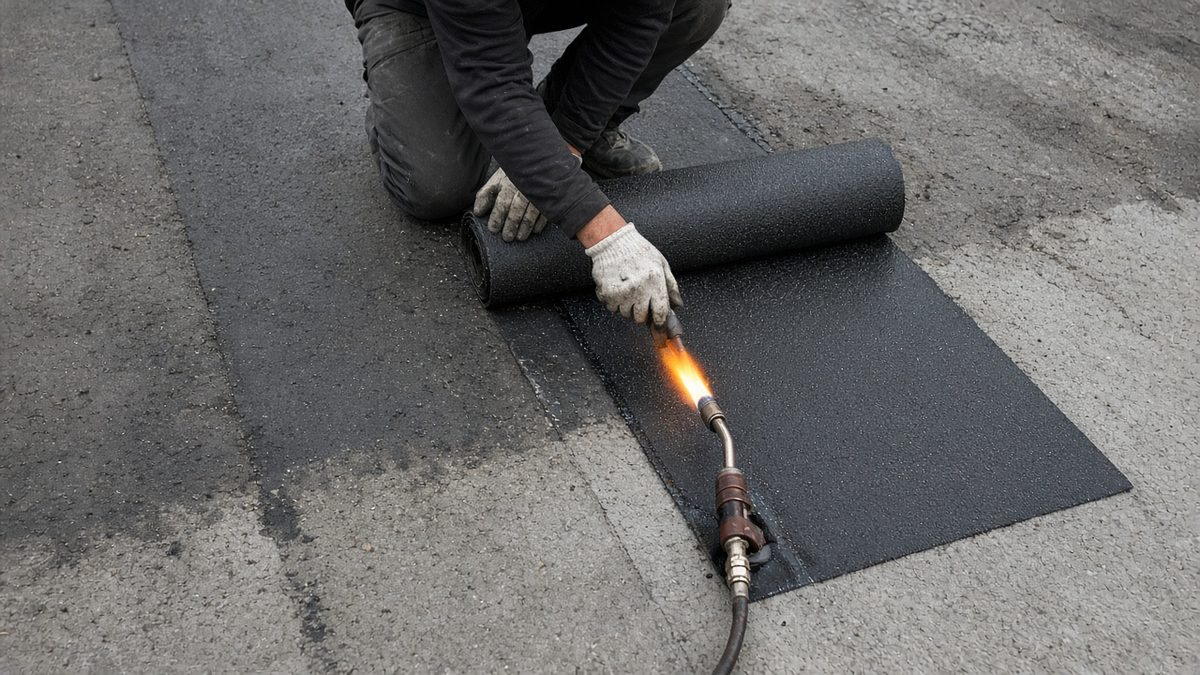
- Welding: unroll slowly while heating the underside with a propane torch until the PE film burns off and the bitumen starts to melt, bonding the sheet to the substrate.
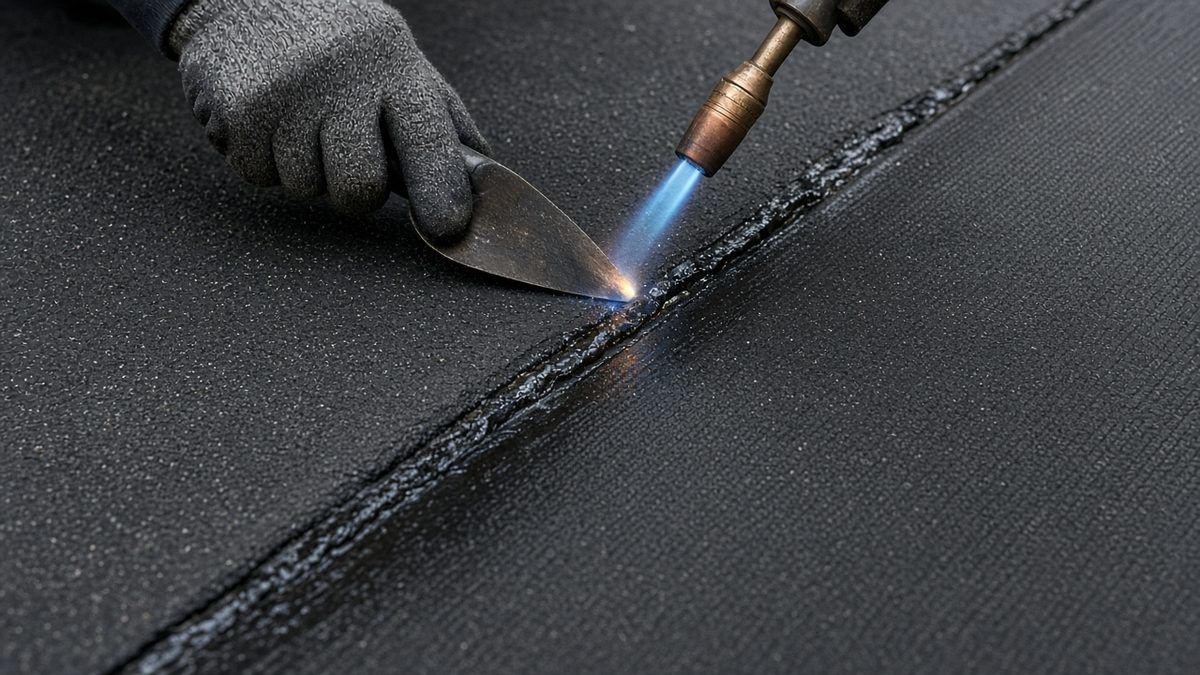
- Laps: 10 cm side laps and 15 cm staggered end laps for Hyperflex; 8–10 cm and 12–15 cm for NiloGum 20. Torch the lap line from above and press it down with a trowel.
- Slopes: start at the lowest edge with rolls running across the slope, each roll overlapping the one below.
The sheets also warn against holding the flame on one spot, throwing rolls off the truck, or storing them anywhere but upright, covered and out of direct sun.
How many rolls do you need?
Each roll covers 10 m² (10 × 1 m), but laps reduce the usable area. With 10 cm side laps and 15 cm end laps, effective coverage is roughly 0.9 × 9.85 ≈ 8.9 m² per roll, so a 100 m² roof needs about 11–12 rolls for a single layer, plus upstands and parapets. This is an approximate calculation; final quantities come from a site survey.
Common mistakes when installing an SBS modified bitumen membrane
- Overheating: burns the bitumen and weakens the carrier instead of melting only the underside.
- Leaving PE-faced rolls exposed: they need a protection layer; exposed roofs need a mineral-slated finish.
- No cant strips: a sharp 90° bend at the parapet tends to crack or peel over time.
- Short laps: seams are the weakest point of any sheet system.
- Damp or dusty substrate: prevents full bonding and causes blisters.
- Choosing on price alone: tensile and puncture values differ widely, so match the product to the loads and movement.
SBS systems with Target Engineering
Target Engineering installs SBS modified bitumen membrane systems on roofs, foundations and green roofs, selecting the right grade for each project and supervising details and laps. See our bituminous sheets and waterproofing and roofing pages, and our guide to foundation waterproofing.
For reference: ASTM D6164 specifies polyester-reinforced SBS-modified bituminous sheets, and the Egyptian Organization for Standardization and Quality grants the quality mark to compliant products in Egypt.
FAQ about the SBS modified bitumen membrane
Do we need SBS in Egypt when winters are mild?
The real benefit in Egypt is elasticity rather than cold resistance: rubbery membranes cope better with movement in metal decks, joints and foundations.
Can it be left exposed to the sun?
Only with a mineral-granule top surface, which the Hyperflex sheet recommends for exposed, non-accessible or low-traffic roofs.
Which roll suits a roof garden?
Hyperflex P20 Anti-Root, which contains additives that resist root penetration and bacterial growth on the membrane.
One layer or two?
The sheets allow single-layer use or multi-layer systems; the choice depends on the system design and the importance of the building.
Need a site inspection or a quotation? The Target Engineering team is ready to help.

[…] is −5 to −10 °C, and rolls are 10 m × 1 m. For more on this membrane type, see our SBS modified bitumen membrane […]