
Table of Contents
- What is sprayed polyurethane foam?
- Why engineers specify spray foam roof insulation
- Technical properties
- Surface preparation for spray foam roof insulation
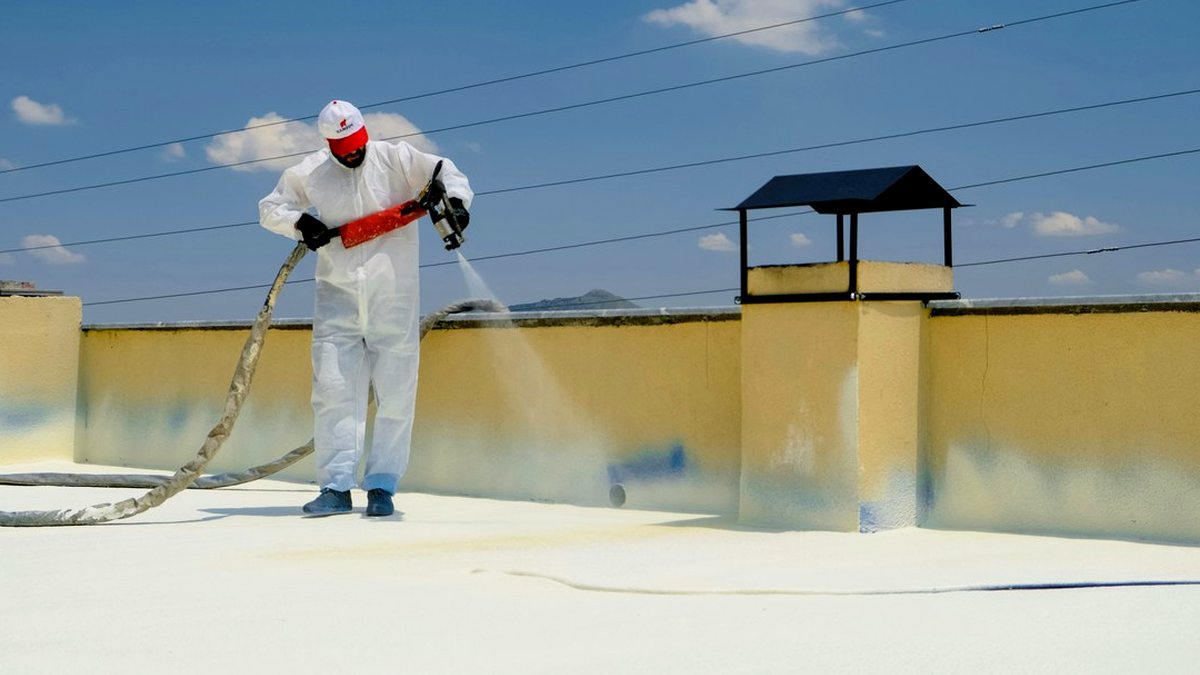
- How spray foam roof insulation is applied
- Consumption and thickness
- Where is spray foam roof insulation used?
- Common spray foam roof insulation mistakes
- Target Engineering: professional spray foam installation
- FAQ
Spray foam roof insulation is one of the most requested solutions in Egypt and the Gulf, because long, hot summers turn the top slab of any building into the main path for heat entering the living space and pushing up air-conditioning bills. This guide explains what sprayed polyurethane foam is, how it works, which technical values you should ask for before signing a contract, and how the system is installed step by step, based on the technical datasheets of Rayston Foam 40E and Rayston Spray Foam 50W by KRYPTON.
Key points
- A two-component polyurethane system that forms one seamless layer, fully bonded to the slab.
- Rayston Foam 40E: thermal conductivity 0.024 W/m·K and at least 90% closed cells.
- Substrate moisture must not exceed 20%; spray in passes of 10–20 mm.
- The foam always needs a UV-resistant protective top layer.
What is sprayed polyurethane foam?
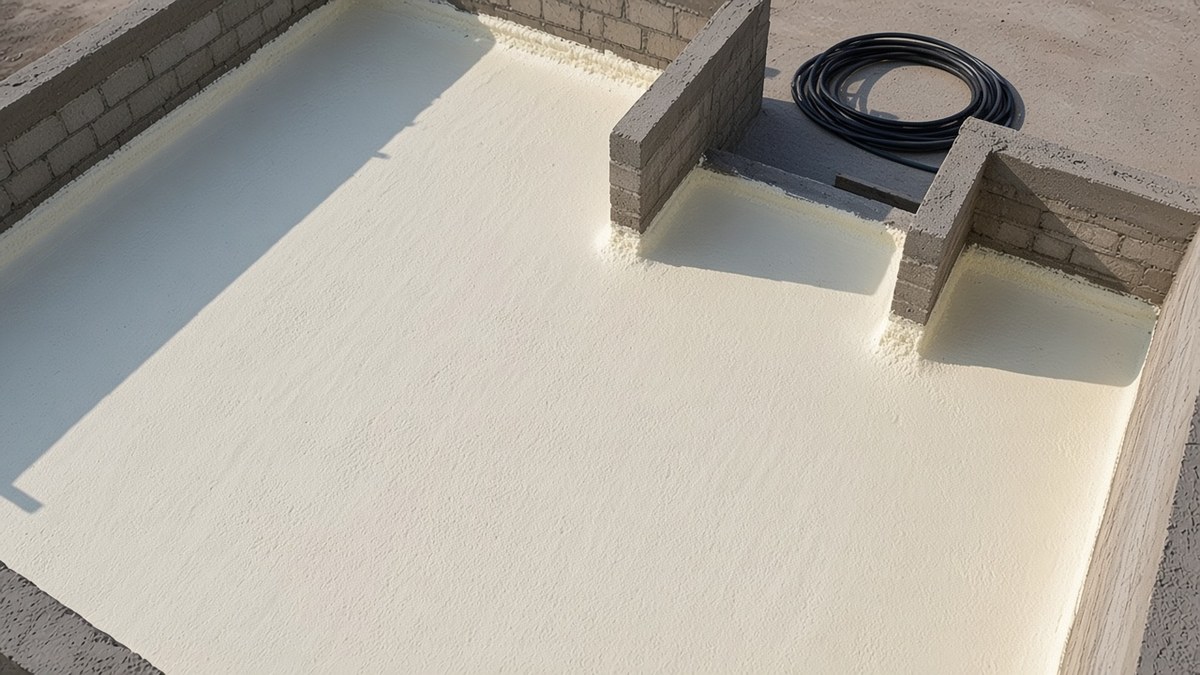
Spray foam is a two-component system: a polyol blend (component A) and an isocyanate (component B). A plural-component spray rig heats and pressurises both components, which meet in the gun and react instantly on the surface. Within seconds the mix expands into a rigid, closed-cell foam that bonds fully to the concrete, forming one continuous layer with no joints or seams. That is the key difference compared with pre-formed boards.
According to its datasheet, Rayston Foam 40E is CFC-free with Zero ODP and is mixed 100:100 by volume. Cream time is 4–5 seconds and gel time 8–10 seconds, so the layer practically forms in front of the applicator.
Why engineers specify spray foam roof insulation
High thermal performance in a thin layer
Rayston Foam 40E has a thermal conductivity of 0.024 W/m·K (ASTM C518). Such a low value means a few centimetres of foam noticeably cut heat transfer. Rayston Spray Foam 50W is declared at 0.033 W/mK (EN 12667).
Closed cells that resist water
Closed-cell content is at least 90% for 40E (ASTM D6226) and above 95% for 50W (DIN ISO 4590). Water absorption therefore stays low (0.90 vol% for 40E), and the foam helps against water ingress, although it must always be protected by a UV-resistant top layer.
Seamless and lightweight
Because spraying wraps corners, pipes and penetrations in one layer, the thermal bridges typical of board joints disappear, and the system adds almost no load to the slab.
Technical properties
| Property | Rayston Foam 40E | Rayston Spray Foam 50W |
|---|---|---|
| Density | 40±2 kg/m³ core (BS EN 1602) | 50 kg/m³ free expansion |
| Compressive strength | 170 kPa (EN 826) | >300 kPa (EN 826) |
| Thermal conductivity | 0.024 W/m·K (ASTM C518) | 0.033 W/mK (EN 12667) |
| Closed cells | ≥90% (ASTM D6226) | >95% (DIN ISO 4590) |
| Water absorption | 0.90 vol% (ASTM C209) | — |
| Tensile strength | 180 kPa (BS EN 1608) | — |
| Dimensional stability | L 7.0% / W 7.0% / T 2.0% (BS EN 1604) | — |
| Fire classification | Euroclass F / B3 (BS EN 13501-1) | Euroclass E; B-Roof T3 with Rayston Fire 3:1 |
| Pull-off adhesion | — | ≥1.5 N/mm² |
| Packaging | 220 kg (polyol) and 250 kg (iso) drums | 215 kg / 250 kg |
Surface preparation for spray foam roof insulation
- Cleanliness: remove dust, oil and weak material; full adhesion is the basis of performance.
- Moisture: porous substrates must not exceed 20% moisture, as stated by the manufacturer.
- Primer: where needed, spray a thin flash coat of 1–2 mm to improve bond.
- Weather: for 40E, ambient temperature +10 to +48 °C, relative humidity below 85% and wind no more than 20 km/h. For 50W the substrate should be above roughly 20 °C.
How spray foam roof insulation is applied
- Set the rig: heat 40E components to 30–50 °C at 50–80 bar, and 50W components to 30–35 °C at 50–100 bar.
- Spray in passes: each pass is 10–20 mm; 50W layers must not exceed 20 mm. Hold the gun about 80 cm from the surface.
- Respect waiting times: for total thicknesses above 6 cm leave 10 minutes between passes, and longer above 10 cm.
- Falls and drainage: spraying can help improve falls towards drains while keeping the minimum design thickness.
- Protect the foam: cover it with a waterproofing membrane or protective coating such as polyurea or polyurethane systems, because bare foam does not withstand long UV exposure.
Consumption and thickness
Consumption depends directly on density and thickness. At 40 kg/m³, every centimetre of thickness theoretically needs about 0.4 kg of material per square metre, plus a waste allowance for wind and surface texture. The engineer sets the thickness based on the required thermal performance and the applicable building code, usually built up in two or more passes.
Where is spray foam roof insulation used?
- Roofs of villas, residential blocks, offices and commercial buildings.
- Wall and floor insulation, as listed in the Rayston Foam 40E datasheet.
- Metal, concrete and plywood substrates, e.g. hangar and warehouse roofs after sheet preparation.
- Roof refurbishment after assessing the existing surface and confirming adhesion.
Explore our polyurethane foam and thermal insulation services.
Common spray foam roof insulation mistakes
- Spraying on wet or dirty substrates: causes delamination and blisters.
- Over-thick passes: the datasheet notes that thicker-than-recommended layers lower density and dimensional stability, while very thin layers raise density and reduce yield.
- Working in strong wind: increases overspray waste and leaves an irregular surface.
- Leaving foam exposed: UV degrades the surface and discolours it over time.
- Poorly calibrated equipment: any deviation from the 100:100 ratio directly affects density and properties.
Target Engineering: professional spray foam installation
Target Engineering installs spray foam roof insulation with trained crews and calibrated hot-spray rigs, checks the substrate before starting, measures thickness during application and then installs the right protective layer. Learn about our hot-applied polyurethane foam and waterproofing and roofing solutions, or contact us for a site inspection and quotation.
For further reading, ASTM C518 describes the thermal conductivity test cited in the datasheet, and Dubai Municipality’s Al Sa’fat green building system provides a regional reference for building envelope efficiency.
FAQ
Does spray foam roof insulation replace waterproofing?
Closed-cell foam reduces water penetration, but it is primarily thermal insulation and must be protected by a waterproofing membrane or UV-resistant coating for long service life.
What is the difference between Rayston Foam 40E and 50W?
40E has a 40 kg/m³ core density and 0.024 conductivity, while 50W is denser (50 kg/m³) with compressive strength above 300 kPa, suiting roofs with more traffic and maintenance.
Can foam be sprayed in summer?
Yes. The 40E datasheet allows application up to +48 °C, subject to humidity and wind limits; cooler hours are preferable.
How long does a roof take?
The reaction takes seconds, so an average roof is often completed within one working day, depending on preparation, area and thickness.
Need a site inspection or a quotation? The Target Engineering team is ready to help.


[…] insulation: polyurethane foam can be sprayed and then covered with polyurea, as explained in our spray foam roof insulation […]