
Table of Contents
- What are extruded polystyrene (XPS) boards?
- Advantages of XPS insulation boards
- INSUTECH ISO Foam (XPS) properties
- INSUboard grades
- Installing XPS insulation boards on a roof
- Calculating thickness and quantity
- XPS insulation boards or white EPS?
- Site handling and storage
- Where are XPS insulation boards used?
- Common mistakes
- Target Engineering: complete roof systems
- FAQ about XPS insulation boards
When a roof needs thermal insulation as part of a complete build-up with waterproofing, protection and tiles, XPS insulation boards (the familiar “blue foam”) are the most widely used choice on Egyptian projects. They are light and easy to cut and fit, and combine low thermal conductivity with compressive strength that carries foot traffic and tiles, plus very low water absorption. This article explains what extruded polystyrene is, compares the values of INSUTECH ISO Foam (XPS) and INSUboard from their datasheets, and shows the correct installation in an inverted roof.
Key points
- Closed-cell extruded polystyrene with 0.025 W/m·K conductivity (ISO Foam at 30 and 40 mm).
- Compressive strength of 250–350 kPa for ISO Foam and up to 700 kPa for INSUboard SX50.
- Water absorption of no more than 0.7 vol% for ISO Foam.
- Best installed in an inverted roof, over flood-tested waterproofing.
What are extruded polystyrene (XPS) boards?
They are rigid boards made by continuous extrusion of polystyrene, creating a uniform closed-cell structure. That structure is the secret of their performance: closed cells trap air to cut heat transfer, keep water out of the board and give high compressive strength for the weight. INSUTECH ISO Foam boards come in standard blue with a flat or lipped overlap edge, while INSUboard comes with ship-lap or square edges and uses CFC- and HCFC-free blowing agents.
Advantages of XPS insulation boards
- Low thermal conductivity: 0.025 W/m·K for ISO Foam at 30 and 40 mm.
- High compressive strength: 250 to 350 kPa for ISO Foam, and up to 700 kPa in the INSUboard SX50 grade.
- Low water absorption: no more than 0.7 vol% for ISO Foam and below 1% for INSUboard.
- Light weight: 32–36 kg/m³ adds practically no load to the slab.
- Stable performance: the INSUboard datasheet states that the K value does not change after prolonged use.
INSUTECH ISO Foam (XPS) properties
| Property | Standard | Value |
|---|---|---|
| Density | BDS EN 1602 | 32–36 kg/m³ |
| Thermal conductivity λD | BDS EN 12667 | 0.025 W/m·K (30/40 mm); 0.026 (50/60 mm) |
| Thermal resistance RD | BDS EN 12667 | 1.2 / 1.6 / 2 / 2.4 m²K/W at 30 / 40 / 50 / 60 mm |
| Compressive strength CS(10) | BDS EN 826 | 250 kPa (30 mm); 350 kPa (40–60 mm) |
| Dimensional stability | EN 1604 (48 h, 70 °C, 90% RH) | <5% |
| Water vapour resistance µ | BDS EN 12086 | ≥200 |
| Water absorption | BDS EN | ≤0.7 vol% |
| Specific heat | EN 12524 | 1200 J/(kg·K) |
| Max. service temperature | — | 75 °C |
| Tensile strength | BDS EN | ≥400 kPa (30 mm); ≥600 kPa |
| Size | — | 123.5 × 60 cm, 3–5 cm thick |
INSUboard grades
INSUboard (by Supreme Petrochem) comes in four grades by compressive strength at 10% deflection: SX40 at 180 kPa, SX60 at 300 kPa, SX70 at 500 kPa and SX50 at 700 kPa. Equivalent thermal conductivity is 0.0289 W/m·K maximum (ASTM C518), fire classification B2 to DIN 4102, standard size 600 × 1250 mm, and the boards meet ASTM C578 Types IV to VII on request. Higher grades suit cold-store floors and loaded roofs.
Installing XPS insulation boards on a roof
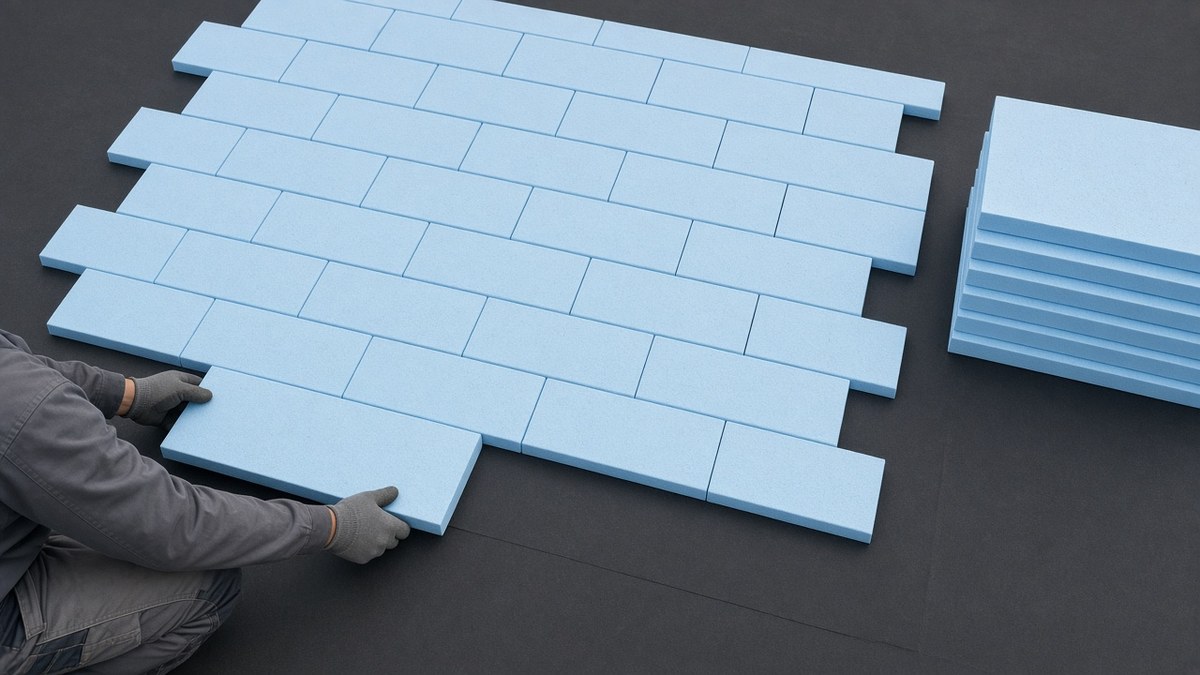
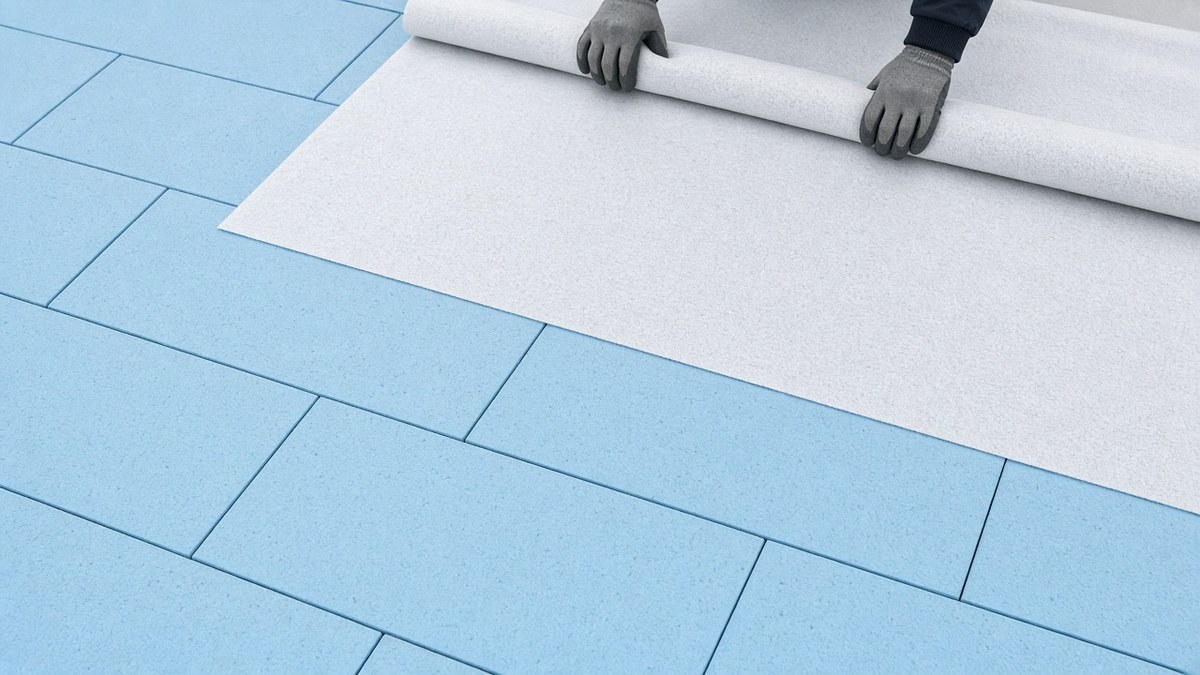
The most common approach is the inverted roof, where thermal insulation sits above the waterproofing, protecting it from heat, UV and impact:
- Prepare the slab and screed to falls towards drains.
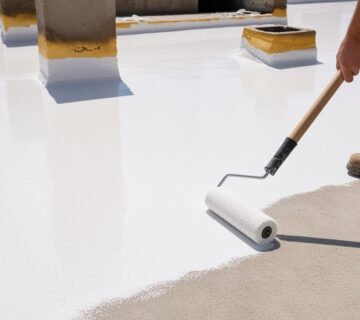
- Install the waterproofing (bitumen rolls or liquid membranes) and flood-test it.
- Lay XPS boards tightly butted with staggered joints, using lipped edges to reduce thermal bridging.
- Separation layer of geotextile or polyethylene over the boards.
- Protection layer of sand, screed and tiles, or gravel on non-accessible roofs.
Calculating thickness and quantity
Thickness follows the required thermal resistance. Per the ISO Foam datasheet, 50 mm gives 2 m²K/W and 60 mm gives 2.4. Board count is roof area divided by board area (123.5 × 60 cm ≈ 0.74 m² for ISO Foam, or 0.75 m² for INSUboard), plus a cutting allowance around upstands and pipes.
XPS insulation boards or white EPS?
Both are polystyrene and both are covered by ASTM C578, but they are made differently. EPS is produced by expanding and moulding beads, leaving small voids between beads where water can penetrate. XPS is extruded continuously into a connected closed-cell structure, so it is preferred in inverted roofs where the board is permanently exposed to moisture above the waterproofing, and where higher compressive strength is needed. EPS may be cheaper, but its natural place is in dry, protected applications.
Site handling and storage
Boards are light and easy to carry but sensitive to UV and direct heat. Store them flat under cover, secure them against wind on exposed roofs and open packs just before installation. Keep them away from strong solvents and hot bitumen.
Where are XPS insulation boards used?
- Roof insulation and under-deck insulation.
- External, internal and cavity wall insulation.
- Perimeter floor insulation and underground structures.
- Cold-store floors and refrigeration cabinets.
- Pipe insulation and soundproofing.
Common mistakes
- Leaving boards in the sun: the INSUboard datasheet advises storing them flat, covered, away from direct sunlight and UV.
- Placing boards under the waterproofing without design: in a conventional roof they must be protected from torch heat.
- Open joints between boards: become thermal bridges.
- Choosing a low compressive grade for a loaded roof: leads to settling tiles.
- Exceeding the maximum temperature: 75 °C for ISO Foam, so avoid direct contact with hot materials.
Target Engineering: complete roof systems
Target Engineering installs complete roof build-ups with XPS insulation boards over waterproofing, selecting the right thickness and compressive grade and flood-testing before covering. See our XPS extruded polystyrene boards, thermal insulation and bituminous sheets pages, or request a roof inspection.
References: ASTM C578 for polystyrene thermal insulation, and Dubai Municipality’s Al Sa’fat green building system as a regional reference for envelope efficiency.
FAQ about XPS insulation boards
XPS or spray foam?
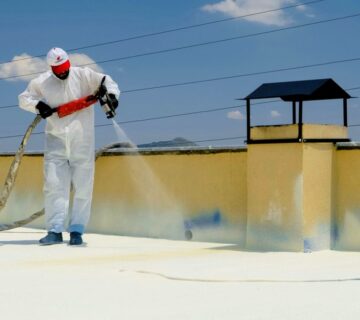
XPS boards have factory-fixed thickness and density, while spray foam forms on site without joints. Boards suit inverted roofs under tiles; spray suits complex and metal roofs.
Do XPS boards absorb water?
Very little: ≤0.7 vol% for ISO Foam and below 1% for INSUboard, which is why they work above the waterproofing.
What thickness suits a residential roof?
The engineer sets it according to the insulation code and required resistance; ISO Foam is listed in 3 to 5 cm thicknesses.
Can they carry tiles and foot traffic?
Yes. ISO Foam’s 250–350 kPa handles tiles and foot traffic; heavier loads call for higher INSUboard grades.
Are XPS boards fire-safe?
Standard INSUboard is classified B2 to DIN 4102, with B1 available on request. In inverted roofs the boards are covered by screed and tiles, and the applicable fire code must always be followed.
Need a site inspection or a quotation? The Target Engineering team is ready to help.


[…] lists XPS grades with higher compressive strength, up to 700 kPa. You can compare options on our XPS insulation boards […]